
Garima
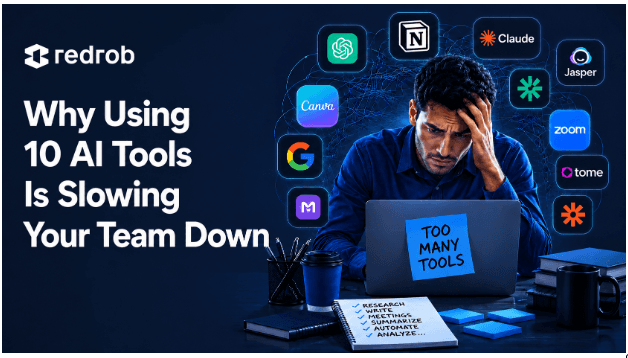
There is a quiet productivity crisis happening inside Indian organisations right now. Not because teams are not working hard. Not because the technology does not exist. But because the tools are working against each other.
The average Indian professional in a startup, an enterprise, a hiring team, a college placement cell is toggling between five, six, sometimes ten different AI tools in a single workday. One for writing. One for research. One for job matching. One for summarising. One for scheduling. And somehow, none of them talk to each other.
According to a McKinsey Global Institute report, knowledge workers spend nearly 28% of their workday managing email and communication alone and that figure climbs when you add app-switching and context re-loading across fragmented tool stacks. For Indian teams operating at scale, across languages, across cities, across hiring cycles, this fragmentation is not a minor inconvenience. It is a compounding cost.
In this blog, we will cover why fragmented AI workflow management fails at scale, what to look for in a consolidated AI productivity tool, and how Redrob AI is built differently for Indian teams.
The Real Cost of Running 10 AI Tools Simultaneously
Most teams measure tool cost in rupees per seat. The actual cost is measured in time, context, and decisions that never get made.
When a recruiter switches from an AI workflow tool to a separate job aggregator to a resume parser to a communication platform, they are not just changing tabs. They are rebuilding mental context every single time. Each switch carries a cognitive reload. Each reload is dead time. Over eight hours, this adds up to hours of productive capacity lost not to bad work, but to navigation.
The broken reality looks like this:
AI tools for writing that do not know your hiring pipeline
Research tools that cannot speak to your JD requirements
Resume screeners that export to CSV and die there
Job platforms that list roles but cannot match them to your existing candidate database
Communication tools that have no context about where the candidate is in the funnel
Each tool does its job in isolation. None of them know what the others are doing.
For Indian teams specifically, this fragmentation compounds further. Many AI tools are built for English-only workflows. They do not understand the context of a 12 LPA PM role in Pune versus a 28 LPA equivalent in Singapore. They do not parse Hindi CVs well. They do not know that certain tier-2 cities produce specific engineering profiles at high volume. You are using world-class tools to solve India-specific problems. The fit was never there.
Why AI Workflow Management Breaks at Indian Scale
AI workflow management sounds like a solved problem until you try to implement it inside an Indian organisation with 200 hiring managers, 30 languages in the workforce, and placement cycles that run on different academic calendars than the rest of the world.
Here is where fragmented stacks specifically fail Indian teams:
Language gaps
Most enterprise AI tools handle English natively and treat regional languages as an afterthought translated, not originated. When your candidate base speaks Tamil, Telugu, Bengali, and Marathi, and your tool only thinks in English, you are losing signal at every layer of the funnel.
Data gaps
Global AI-powered workflows are trained on global data. They do not know which Indian companies are growing, which sectors are contracting, or what a realistic compensation band looks like in Nagpur versus Noida. Every output they produce requires manual recalibration for Indian context.
Integration gaps
The promise of AI productivity tools is that they save time. The reality when you have ten of them is that someone on your team spends forty minutes every day moving data between systems that were never designed to talk to each other.
Trust gaps
When an AI tool produces an output that is technically correct but contextually wrong for India a resume that reads like a Silicon Valley application, a job description calibrated to US salary bands teams stop trusting the tool. And a tool your team does not trust is just expensive shelf-ware.
Running Too Many AI Tools Across Your Hiring Stack?
One platform. 50+ platforms searched. 30+ languages native. Zero context-switching.
Try Redrob AI
What Good AI Workflow Consolidation Actually Looks Like
Not every consolidated platform solves the right problem. For Indian teams, three criteria separate genuine consolidation from repackaged fragmentation.
Built on Indian data, not adapted to it
There is a difference between an AI workflow tool trained on Indian professional data and one that has been adapted to understand Indian context. The former knows what a realistic fresher CTC looks like in tier-2 cities, which platforms carry relevant job postings in your sector, and how Indian career trajectories actually work. The latter is guessing and the outputs show it.
Reduces steps. Does not digitise them
The best AI productivity tools do not ask your team to repeat itself across platforms. They carry context from job brief to candidate to communication to workflow without human intervention at each handoff. If your team is still manually copying data between systems, the tool has not solved the problem. It has given it a new interface.
Speaks the language of your entire team
An AI tool that works for your English-speaking leadership but fails your hiring managers in regional offices is not an enterprise solution. It is a proof-of-concept that never scaled. Native multilingual capability not translation, not an add-on built into the core product is the standard Indian teams should hold every AI workflow management platform to.
Step-by-Step: How to Audit and Consolidate Your AI Stack
If your team is running five or more AI tools across a single workflow, here is a practical consolidation audit
Step 1 – Map every tool to a job
Write down every AI tool your team uses. Next to each one, write the one job it does. If two tools are doing the same job, that is immediate redundancy. If one tool requires the output of another tool to be useful, that is a fragmentation cost.
Step 2 - Measure the handoff tax
For each place where data moves from one tool to another manually, estimate how many minutes per day that takes across your team. Multiply by your team size. That number — in hours per month — is what fragmented AI workflow management is actually costing you.
Step 3 – Identify context loss points
Where does a tool produce an output that requires human correction because it lacks Indian context? Every manual correction is a signal that the tool was not built for your use case. Log these. They are your strongest argument for consolidation.
Step 4 - Evaluate consolidated platforms
Use your audit findings. The right consolidated AI productivity tool for an Indian team should eliminate at least 60% of the handoff tax, produce India-relevant output without manual recalibration, and work natively in the languages your team actually operates in.
Step 5 – Run a time-boxed pilot, not a feature demo
Do not evaluate tools in a demo environment. Give a real team a real problem a live hiring cycle, an actual research task, a real placement batch and measure output quality, time saved, and adoption friction. A tool that wins in demos but loses in production is just a well-designed demo.
See What a Consolidated AI Stack Looks Like for Indian Teams?
Redrob AI runs Jobs, Resumes, Research, Productivity, and Workflows in one platform.
Redrob AI: One Platform Built for the Way Indian Professionals Actually Work
Most AI tools were built somewhere else and adapted for India. The data is global. The language defaults are English. The career context is Western. Redrob AI was originated here built on 6 years of Indian professional data, for Indian hiring realities, across 30+ languages.
Here is what that means in practice.
790M+ Profiles. The Deepest Indian Professional Dataset Available.
Every match Redrob AI surfaces draws on 790M+ Indian professional profiles not global data with an India filter. Indian career trajectories, salary realities, and hiring signals built in from the ground up. Other AI tools approximate. Redrob AI knows.
50+ Platforms Searched in One Query
The Indian job market is fragmented across dozens of platforms most professionals never open. Redrob AI searches 50+ simultaneously LinkedIn, Naukri, and well beyond so no opportunity slips through. For teams running AI-powered workflows, this means a genuinely complete candidate pool, not just the visible surface everyone else is looking at.
30+ Languages. Native, Not Translated
Most AI productivity tools treat regional languages as a translation layer applied after the fact. Redrob AI supports Tamil, Telugu, Bengali, Marathi, Hindi, and 25+ more at the core not as add-ons. Your full team can use it. Not just the head office.
Six Products. One Login. No Handoffs
Jobs. AI. Resumes. Research. Productivity. Workflows — all under one login. The output of each product feeds the next without manual exports or context rebuilt at every seam. The switching stops here.
Built for Recruiters, Enterprise Teams, and Campus Cells Alike
According to LinkedIn's 2024 Future of Recruiting report, 73% of recruiting professionals say AI tools significantly impact hiring effectiveness but only when integrated, not fragmented. Redrob AI delivers one connected AI workflow management platform for every team type recruiters, enterprise leaders, and campus placement cells included.
A recruiter at Company saw your profile. You did not apply. That is exactly how this works because Redrob AI runs in the background while your team does everything else.
Looking for an AI Platform Built for India's Scale?
Replace fragmented tools with one connected AI platform.
Explore Redrob AI
Final Thoughts
The problem with ten AI tools is not that they are individually bad. Most of them are technically capable. The problem is the architecture: ten separate contexts, ten separate data silos, ten separate outputs that require a human to synthesise into one coherent decision.
Indian teams operating at the scale, linguistic diversity, and market complexity that Indian organisations operate at cannot afford that architecture. The handoff tax is too high. The context loss is too significant. And the tools were largely not built for this context in the first place.
Redrob AI is the answer to a question Indian professionals have been asking for years: where is the one platform that actually understands our world?
It is here. Built around you.
Frequently Asked Questions
What is the difference between AI tools and an AI platform?
Individual AI tools handle one task writing, searching, summarising. An AI platform like Redrob AI connects those tasks into a single workflow so the output of one feeds directly into the next, without manual handoffs or context loss.
How does Redrob AI handle Indian languages?
Redrob AI supports 30+ languages natively not translated. This means regional language inputs and outputs work at the same quality level as English, built into the core product.
Is Redrob AI suitable for enterprise teams or just individual users?
Both. Individual professionals use Redrob AI for job search, resume building, and research. Enterprise teams and recruiters use it for candidate sourcing across 50+ platforms, AI workflow management, and productivity across the full hiring cycle.
How is Redrob AI different from ChatGPT or other general AI tools?
General AI tools know the world. Redrob AI knows the Indian professional market - 790M+ profiles, 6 years of Indian data, 50+ Indian job platforms, Indian salary benchmarks, and 30+ native languages. That specificity is the difference between a tool that produces plausible outputs and one that produces accurate ones.

Work Smarter with
One AI platform powering job search, work, discovery, and productivity.
Latest AI Blogs.

Jun 23, 2026
How Recruiters Actually Shortlist Candidates Today
Garima

Jun 23, 2026
Best AI Job Search Agents in 2026: Find Jobs Smarter with Redrob
Bhushan

Jun 23, 2026
How Recruiters Shortlist Candidates in 2026: A Complete Guide
Garima

Jun 23, 2026
How to Get More Interviews Without Applying to Hundreds of Jobs
Bhushan
Jun 23, 2026
AI Resume Checker vs ATS Resume Checker: What's the Difference
Garima

Jun 23, 2026
One AI Assistant vs Multiple AI Tools: Which Is Better
Garima