
Garima
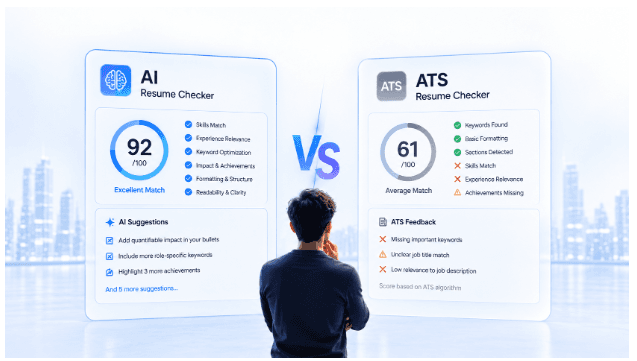
A resume can be professionally written, packed with impressive achievements, and still fail to reach a recruiter. That is because the first “reader” of a resume is not always a person.
Many companies use an applicant tracking system to organize, filter, and rank applications before recruiters review them. At the same time, AI-powered resume tools have become popular for helping candidates improve wording, identify gaps, match job descriptions, and make resumes more relevant.
This creates a common question: should a candidate use an ATS Resume Checker, an AI resume checker, or both?
The difference matters because these tools may look similar on the surface, but they solve different problems.
In this blog, we’ll break down how ATS and AI resume checkers work, where they differ, when each one is useful, how to check a resume before applying, and how an AI-powered platform can bring these capabilities together.
The Resume Has Two Audiences Before the Interview
Think of a modern job application as having two checkpoints.
The first checkpoint is technology. An applicant tracking system may parse the resume, identify information such as skills and experience, and help recruiters manage applications.
The second checkpoint is the recruiter. Once a resume reaches human review, clarity, relevance, achievements, and overall fit become much more important.
That is why a resume needs to work in two ways: it should be easy for software to understand and compelling enough for a recruiter to continue reading.
An ATS Resume Checker primarily focuses on the first challenge. An AI resume checker can go further by examining the quality and relevance of the content itself.
The distinction becomes clearer when the two are compared side by side.
ATS Checks the Gate. AI Looks at the Bigger Picture.
An ATS-focused tool is mainly concerned with compatibility.
An ATS Resume Checker can examine whether a resume is structured in a way that an applicant tracking system can process effectively. Depending on the tool, this may include checking formatting, headings, keywords, sections, and how closely the resume aligns with a job description.
An ats cv checker is therefore useful when the concern is simple: Can the hiring system properly read and interpret this resume?
An AI resume checker, on the other hand, can evaluate the content more broadly.
It may identify vague language, weak bullet points, missing skills, repetitive wording, poor alignment with the target role, or opportunities to make achievements more specific. Instead of only asking whether a resume can pass through a system, AI can help assess whether the resume actually presents the candidate strongly.
In short:
ATS Resume Checker: focuses on technical compatibility and screening factors.
AI resume checker: focuses on content quality, relevance, optimization, and improvement.
AI resume checker vs ATS: the biggest difference is the depth of analysis rather than the basic purpose.
Neither approach makes the other irrelevant. In fact, the strongest resume-review process often combines both.
Why ATS Compatibility Still Matters
There is a reason ATS optimization has become such a common part of the modern job search.
According to the U.S. Bureau of Labor Statistics, 55.4% of unemployed jobseekers in 2024 reported sending resumes or completing applications as an active job-search method.
With large volumes of applications moving through digital hiring systems, a resume needs to be both searchable and understandable.
That does not mean filling a resume with keywords.
Keyword stuffing can make a resume awkward and less convincing. The goal is to naturally reflect relevant skills and terminology from the job description while keeping the document readable.
This is where an ats resume checker can be useful before an application is submitted. It can provide an initial indication of whether obvious ATS-related problems need attention.
But compatibility is only one part of the equation.
A Good Score Doesn’t Automatically Mean a Great Resume
This is where many candidates get stuck.
A resume might receive a strong ATS score but still feel generic.
For example, consider these two statements: “Managed social media campaigns and increased engagement.” Compared with: “Managed Instagram and LinkedIn campaigns that increased organic engagement by 42% over six months.”
The second version communicates much more. It explains what was managed and provides evidence of impact.
An ATS may recognize keywords in both versions. An AI resume checker can help identify why the second version is stronger from a content perspective.
That is the real advantage of looking beyond a score.
A resume should not be written to impress a checker. It should be optimized to communicate career value clearly.
The Smarter Resume-Checking Process
Instead of treating resume checking as a single score-generating exercise, it helps to think of it as a short optimization cycle.
Start with the actual job description
The job description becomes the reference point.
Before checking the resume, identify the important skills, responsibilities, tools, qualifications, and terminology associated with the target role. A resume written for a digital marketing position, for example, should not be optimized using the same priorities as one targeting a software engineering role.
Let the ATS perspective find technical gaps
Run the resume through an ATS Resume Checker.
Look for issues involving formatting, section structure, readability, keywords, and parsing. If important information is being overlooked or the format creates compatibility problems, those issues should be fixed before moving forward.
Bring in the AI perspective
This is where an AI resume checker adds another layer.
Instead of stopping at compatibility, the review can look at whether the resume actually communicates experience effectively. Weak action verbs, vague achievements, missing role-specific skills, repetitive content, or underdeveloped sections can become easier to spot.
Turn feedback into improvements
The goal is not to make every suggested change.
A useful resume review should lead to practical edits: strengthening an achievement, adding a missing skill that is genuinely possessed, removing unnecessary information, or making an experience section more relevant to the target role.
Check again before applying
Resume optimization works best as a cycle rather than a one-time task.
After making meaningful changes, another check can confirm that the improvements have not created new formatting or keyword issues.
The result is a resume that is not simply “optimized.” It is application-ready.
When an ATS Checker Is the Better Choice
An ATS resume checker free tool can be particularly useful when a candidate:
Is applying through a company career portal.
Wants to verify basic ATS compatibility.
Is unsure whether the resume format can be parsed correctly.
Wants to compare resume keywords against a specific job description.
Has already written strong content but wants a technical compatibility check.
For candidates searching for a resume checker free option, an ATS-focused tool can be a useful first filter.
But if the bigger concern is “Why does my resume still feel weak even though it passes ATS checks?”, an AI-powered review becomes more valuable.
When AI Resume Checking Makes More Sense
An AI resume checker is especially useful when the resume needs more than a technical review.
It can help when:
The resume feels generic.
Achievements are difficult to quantify.
The experience section is too descriptive.
The resume needs to be tailored to a new role.
A career switch requires skills to be reframed.
A fresher needs to make projects, internships, or academic experience more relevant.
The resume has keywords but lacks a strong professional story.
This is especially important for career switchers. A keyword can show that a skill exists, but strong positioning explains how that skill can transfer into a new role.
The Best Approach Isn’t “AI or ATS” - It’s Both
The AI resume checker vs ATS debate can make these tools sound like competitors.
They are not. An ATS-focused review answers: “Can the system read and recognize this resume?”
An AI-focused review asks: “Does this resume communicate the right skills and value for the role?”
Those questions complement each other.
The best ats resume checker free option, therefore, is not necessarily the one with the highest score or the longest report. It is the one that helps identify meaningful problems and gives a candidate a clear path to improve the application.
One Resume Tool Can Make the Process Simpler
Switching between multiple platforms can make job searching unnecessarily complicated: one tool for ATS checking, another for resume feedback, another for job discovery, and another for tracking applications.
Redrob AI brings several parts of this process into one career-focused experience.
With Redrob Jobs, candidates can upload a resume once and access ATS insights, resume analysis, job matching, and AI-powered recommendations. The platform also evaluates resume compatibility, keyword matching, and application readiness while connecting candidates with relevant opportunities.
That makes the resume checker part of a larger workflow rather than an isolated score.
Final Thoughts
The difference between an ATS Resume Checker and an AI resume checker comes down to what each tool is trying to evaluate.
An ATS-focused tool is valuable for checking compatibility, parsing, keywords, and other screening-related factors. An AI-powered checker can go deeper into content, relevance, positioning, and potential improvements.
Neither replaces good resume writing.
A strong resume still needs real achievements, accurate information, relevant skills, clear structure, and a story that makes sense for the role.
The smartest approach is to use technology as a second pair of eyes—not as a substitute for professional judgment.
And when resume optimization, job matching, and application preparation can happen in one place, the process becomes much easier to manage.
Frequently Asked Questions
1. Is one AI assistant better than using multiple AI tools?
One AI assistant can be better for everyday tasks that require research, writing, analysis, and planning. It reduces switching and keeps more of the workflow connected.
2. What are the main benefits of an all-in-one AI assistant?
An all-in-one AI assistant can save time, reduce context switching, and simplify workflows. It also reduces the need to learn and manage several different platforms.
3. When are specialized AI tools a better choice?
Specialized AI tools are useful when a task requires advanced or highly specific capabilities. This can include professional design, video editing, coding, or other specialist work.
4. Can one AI assistant completely replace multiple AI tools?
Not always. One assistant may handle most everyday tasks, while specialized tools can still be valuable when deeper functionality or greater control is required.
5. How does Redrob AI reduce the need to switch between tools?
Redrob AI connects capabilities such as research, people and company search, jobs, documents, email, and workflows through one AI experience. This helps users complete connected tasks with less tool switching.

Work Smarter with
One AI platform powering job search, work, discovery, and productivity.
Latest AI Blogs.

Jun 23, 2026
How Recruiters Actually Shortlist Candidates Today
Garima

Jun 23, 2026
Best AI Job Search Agents in 2026: Find Jobs Smarter with Redrob
Bhushan

Jun 23, 2026
How Recruiters Shortlist Candidates in 2026: A Complete Guide
Garima

Jun 23, 2026
How to Get More Interviews Without Applying to Hundreds of Jobs
Bhushan
Jun 23, 2026
AI Resume Checker vs ATS Resume Checker: What's the Difference
Garima

Jun 23, 2026
One AI Assistant vs Multiple AI Tools: Which Is Better
Garima