
Bhushan

Imagine your team's average workday.
It starts with checking emails. Then comes updating spreadsheets, scheduling meetings, searching for documents, preparing reports, following up with clients, entering CRM data, reviewing resumes, and answering the same questions over and over again.
By lunchtime, hours have gone by but very little strategic work has actually been completed.
This isn't because people aren't productive.
It's because too much of their day is consumed by repetitive, low-value tasks that technology can already handle.
Today, AI Automation is changing the way modern teams work. Instead of spending hours on manual processes, businesses are using AI to eliminate repetitive work, accelerate decision-making, and give employees more time for creative thinking, collaboration, and growth.
Whether you're leading a startup, managing operations, running HR, or overseeing sales and marketing, AI has evolved from a "nice-to-have" tool into a practical business advantage.
Businesses that embrace automation aren't replacing people they're helping people focus on the work that truly matters.
In This Blog, We'll Explore Discover why repetitive work is holding teams back, which everyday tasks AI should already be handling, and how AI Workflow Automation,and AI Productivity Tools can streamline work. We'll also explore practical ways to introduce AI into your workflows and how Redrob AI helps teams automate smarter.
The Hidden Cost of "Busy Work"
Most professionals don't notice how much time disappears into repetitive work because each task seems small on its own.
Updating one spreadsheet takes five minutes.Finding one document takes another five.
Scheduling a meeting, sending reminders, preparing notes, copying information between tools. it all feels harmless.
But when these activities repeat dozens of times every day across an entire organization, they create a significant productivity drain.
According to McKinsey & Company, nearly 60% of occupations have at least 30% of activities that could be automated using existing technologies, giving employees more time to focus on higher-value work.
The biggest productivity problem isn't a lack of effort.It's the amount of manual work happening behind the scenes.
Repetitive Tasks AI Should Already Be Handling
The greatest value of AI Task Automation lies in removing low-value, repetitive activities that consume employee time without contributing directly to business outcomes.
Below are some of the most impactful areas where AI can immediately improve operational efficiency.
Email Management and Routine Communication
Email remains one of the largest consumers of workplace productivity.
Sorting messages, drafting responses, managing follow-ups, organizing conversations, and prioritizing communications require considerable manual effort.
Modern AI Productivity Tools can automate many of these activities by:
Prioritizing important emails
Drafting contextual responses
Summarizing lengthy email threads
Scheduling follow-ups
Organizing inboxes intelligently
Highlighting action items
Rather than managing inboxes throughout the day, employees can focus on conversations and decisions that require human expertise.
Meeting Summaries and Action Tracking
Meetings generate valuable discussions, but documenting outcomes often becomes another manual process.
Capturing notes, summarizing conversations, assigning responsibilities, and tracking action items require additional administrative effort after every meeting.
AI can automate these tasks by generating meeting summaries, identifying key
decisions, assigning action items, and creating structured follow-ups immediately after discussions conclude.
This enables teams to remain engaged during meetings while ensuring accountability without additional administrative work.
Data Entry Across Business Systems
Many organizations still rely on employees to manually transfer information between multiple applications.
Customer information moves from forms into CRMs.
Recruitment data is copied into hiring platforms.
Sales updates are entered into reporting systems.
Marketing metrics are transferred into dashboards.
These repetitive processes consume significant time while increasing the likelihood of human error.
Through AI Workflow Automation, organizations can connect business systems and automate data synchronization across applications, improving both efficiency and data accuracy.
Report Preparation and Business Updates
Recurring reports are essential for business visibility, but producing them often requires collecting information from multiple systems, organizing data, and formatting presentations.
Whether preparing sales reports, hiring updates, marketing dashboards, or operational reviews, the process is frequently repetitive.
AI can automatically consolidate information, generate summaries, identify trends, and prepare structured reports for review, allowing teams to spend less time creating reports and more time acting on insights.
Enterprise Knowledge Search
Employees frequently lose valuable time searching for internal information.
The latest proposal.
An approved presentation.
Past project documentation.
Customer history.
Policy documents.
Instead of searching across multiple folders and platforms, Enterprise AI enables employees to retrieve relevant information through natural language queries across connected business systems.
The result is faster access to knowledge and significantly reduced time spent searching for information.
Scheduling and Administrative Coordination
Calendar management, meeting coordination, reminders, and follow-ups are essential but repetitive administrative responsibilities.
AI assistants can automatically schedule meetings, recommend available time slots, resolve calendar conflicts, send reminders, and notify participants about updates.
While individually small, these tasks collectively consume a meaningful portion of the workday. Automating them enables employees to dedicate more attention to strategic initiatives and collaborative work.
Why Let Repetitive Work Slow Your Team Down?
Give your team more time for meaningful work by automating the tasks AI can already handle
Explore Redrob AI
What Changes When Repetitive Work Is Automated?
The value of AI Automation extends far beyond saving time. It fundamentally changes how teams operate, collaborate, and make decisions.
When repetitive tasks are automated, employees gain the capacity to focus on initiatives that directly contribute to business growth. Instead of spending hours on administrative work, they can invest more time in problem-solving, innovation, customer engagement, and strategic planning.
Organizations that successfully adopt Business Process Automation often experience benefits across multiple functions, including operations, sales, marketing, HR, and customer support.
The Business Benefits of AI Automation
Greater Productivity Without Increasing Workload
One of the biggest misconceptions about productivity is that it requires employees to work longer hours.
In reality, productivity improves when teams spend less time on repetitive activities and more time on meaningful work.
By combining AI Workflow Automation with intelligent workflows, businesses can eliminate routine bottlenecks and enable employees to accomplish more within the same workday.
Faster Decisions Backed by Real-Time Information
Business decisions are only as effective as the information available.
When employees spend valuable time collecting updates from multiple tools or waiting for reports, decision-making naturally slows down.
AI helps streamline this process by consolidating information, surfacing relevant insights, and making business data readily accessible. This enables leaders to respond faster to opportunities while reducing delays caused by manual reporting.
Improved Accuracy Across Business Processes
Manual processes often introduce inconsistencies whether through duplicate entries, missed updates, or human error.
Automating repetitive workflows helps standardize routine operations, improving data quality and ensuring greater consistency across teams.
This becomes particularly valuable as organizations scale and manage larger volumes of information.
Better Employee Experience
Employees are rarely motivated by repetitive administrative work.
Tasks like updating spreadsheets, organizing files, or manually tracking follow-ups consume time without providing meaningful professional value.
Automating these activities allows employees to focus on work that develops their expertise, encourages collaboration, and creates a greater sense of ownership over business outcomes.
According to Microsoft's 2025 Work Trend Index, nearly 80% of employees say they don't have enough uninterrupted time to complete their work, highlighting the growing need to reduce administrative overhead through AI-powered workflows.
Building an AI-First Workflow: Where Should You Begin?
Adopting AI doesn't require replacing your existing systems or transforming every process overnight.
The most successful organizations begin by identifying repetitive work that consumes significant time while contributing minimal strategic value.
Rather than viewing AI as another standalone tool, think of it as a layer that improves the way your existing workflows operate.
Start with Repetitive, Rule-Based Tasks
The best automation opportunities are usually the easiest to identify.
Look for activities that are performed repeatedly, follow a predictable process, and require little human judgment.
Examples include:
Routine email responses
Meeting summaries
CRM updates
Report generation
Data synchronization
Calendar scheduling
Document organization
These tasks often deliver immediate productivity gains without disrupting existing operations.
Connect Existing Business Systems
Most organizations already use multiple applications across departments.
The challenge isn't the lack of tools it's that those tools often operate independently.
Effective Workflow Automation Software connects these systems, allowing information to move automatically between platforms instead of requiring employees to update each application manually.
The result is a more connected workflow with fewer repetitive tasks and less administrative effort.
Keep People in the Decision-Making Loop
Not every task should be fully automated.
Activities involving customer relationships, strategic planning, hiring decisions, or business negotiations still require human expertise.
AI performs best when it manages repetitive execution while employees retain ownership of decisions, collaboration, and critical thinking.
The objective is augmentation not replacement.
Measure Business Impact, Not Just Time Saved
The success of AI for Teams shouldn't be measured only by the number of hours automated.
Organizations should also evaluate improvements in:
Team productivity
Project completion speed
Operational efficiency
Response times
Employee satisfaction
Process accuracy
These indicators provide a clearer understanding of how automation contributes to long-term business performance.
Ready to Build Smarter Workflows?
Connect AI with your everyday business processes.
See Redrob AI in Action
Common Mistakes That Limit the Value of AI Automation
Many organizations adopt AI with high expectations but fail to achieve meaningful results because they automate the wrong processes or implement disconnected solutions.
Some of the most common challenges include:
Automating Inefficient Processes
Automation cannot fix a broken workflow.
If an existing process contains unnecessary approvals, duplicate work, or outdated practices, AI will simply automate the inefficiency rather than eliminate it.
Using Too Many Independent AI Tools
Adding separate AI tools for writing, meetings, search, scheduling, reporting, and project management often creates another layer of complexity.
Instead of improving productivity, employees spend more time switching between platforms.
An integrated AI ecosystem typically delivers greater value than multiple disconnected solutions.
Expecting Immediate Transformation
AI adoption is a continuous process rather than a one-time implementation.
Organizations that achieve the best outcomes begin with targeted use cases, evaluate measurable improvements, and gradually expand automation across departments.
This phased approach minimizes disruption while encouraging long-term adoption.
By approaching AI Automation strategically, businesses can move beyond simply automating tasks they can create workflows that are faster, more connected, and better equipped to support sustainable growth.
Why Modern Teams Need More Than Standalone AI Tools
Many organizations have already adopted AI in some form.
One tool writes content.
Another summarizes meetings.
A third helps search documents.
Others manage emails, scheduling, or reporting.
While each tool solves a specific problem, switching between multiple platforms often creates a fragmented workflow. Employees end up spending just as much time moving between applications as they do completing the work itself.
The next phase of Enterprise AI isn't about adding more AI tools—it's about creating connected experiences where AI works seamlessly across everyday business activities.
This is where integrated AI Automation platforms provide greater long-term value by bringing information, workflows, and intelligent assistance into one unified workspace.
How Redrob AI Helps Teams Work Smarter
As businesses continue to automate repetitive work, they need a solution that goes beyond individual AI features.
Redrob AI is built to help professionals and organizations simplify work through intelligent automation. Instead of juggling multiple disconnected applications, teams can access AI-powered capabilities from a single platform—helping them search faster, organize information, streamline workflows, and improve productivity.
Whether you're managing projects, hiring talent, researching information, or handling day-to-day operations, Redrob AI helps reduce manual effort so your team can focus on higher-value work.
With capabilities designed for modern businesses, Redrob AI supports:
AI-powered search across business information
Smarter research and knowledge discovery
Workflow assistance for everyday business tasks
Faster access to information and insights
Productivity tools that reduce repetitive work
A unified AI experience for growing teams
Rather than replacing the way your team works, Redrob AI enhances existing workflows—making everyday work faster, simpler, and more efficient.
Final Thoughts
Every growing business reaches a point where repetitive work begins to limit productivity.
The challenge isn't that employees lack skills or motivation. It's that too much of their time is consumed by routine activities that technology can already handle.
AI Automation gives organizations an opportunity to rethink how work gets done. By automating repetitive processes through AI Workflow Automation, Business Process Automation, and intelligent AI Productivity Tools, teams gain more time for strategic thinking, innovation, customer engagement, and business growth.
The future of work won't be defined by how many tasks people complete manually.
It will be defined by how effectively businesses combine human expertise with intelligent automation.
Organizations that embrace this shift today will be better positioned to scale, adapt, and compete tomorrow.
What Could Your Team Achieve With More Time?
Let AI handle the routine while your team drives growth.
Frequently Asked Questions
1. What is AI Automation?
AI Automation uses artificial intelligence to perform repetitive business tasks with minimal manual effort. It helps organizations improve productivity, reduce errors, and allow employees to focus on higher-value work.
2. Which business tasks can AI automate?
AI can automate email management, meeting summaries, report generation, scheduling, document search, CRM updates, data entry, customer support, and many other routine administrative tasks.
3. Is AI Automation only for large enterprises?
No. Businesses of all sizes can benefit from AI for Business. Small and medium-
sized companies often see significant productivity improvements by automating repetitive workflows without increasing team size.
4. How do I introduce AI into my team's workflow?
Start by identifying repetitive, time-consuming tasks, automate one or two high-impact workflows, measure the results, and gradually expand automation across other business functions.
5. How does Redrob AI help businesses improve productivity?
Redrob AI brings AI-powered search, research, workflow assistance, and productivity features into one platform, helping teams reduce repetitive work and collaborate more efficiently without relying on multiple disconnected tools.

Work Smarter with
One AI platform powering job search, work, discovery, and productivity.
Latest AI Blogs.

Jun 23, 2026
How Recruiters Actually Shortlist Candidates Today
Garima

Jun 23, 2026
Best AI Job Search Agents in 2026: Find Jobs Smarter with Redrob
Bhushan

Jun 23, 2026
How Recruiters Shortlist Candidates in 2026: A Complete Guide
Garima

Jun 23, 2026
How to Get More Interviews Without Applying to Hundreds of Jobs
Bhushan
Jun 23, 2026
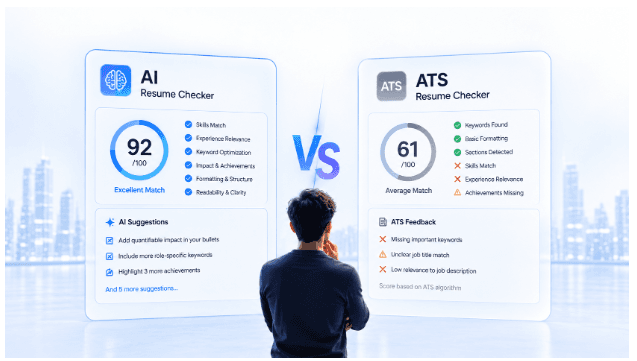
AI Resume Checker vs ATS Resume Checker: What's the Difference
Garima

Jun 23, 2026
One AI Assistant vs Multiple AI Tools: Which Is Better
Garima