Bhushan
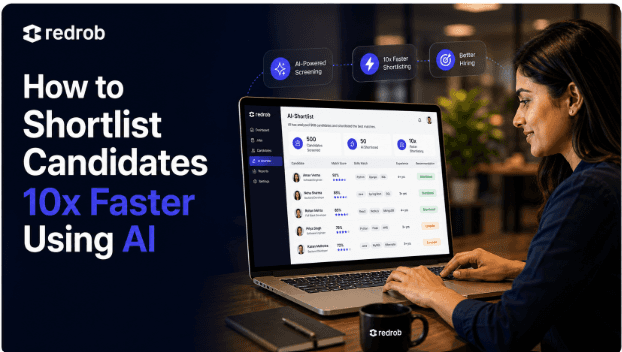
Hiring has always been a numbers game. Post a job, get flooded with applications, spend days screening, and still somehow miss the best candidate who accepted an offer somewhere else while you were reading resume numbers.
The problem is not the volume. The problem is the process. Manual screening was designed for a world where 50 people applied for a role. Today, a single job post on a major platform can pull 500+ applications within 48 hours. The tools never caught up.
AI hiring changes this. Not the hype version not "AI that understands your culture" or "AI that predicts performance." The real version: AI recruiting tools that search faster, screen smarter, and surface the right profiles before the best candidates are gone.
In this blog, we will cover why manual shortlisting breaks at scale, what good AI candidate screening actually looks like, a step-by-step process for cutting shortlisting time by 10x, how platforms like Redrob AI are built specifically for this problem, and the most common questions hiring teams ask before making the switch.
Why Manual Shortlisting Breaks at Scale
Before fixing the problem, name it precisely.
A recruiter screening 300 applications manually spends approximately 6–8 seconds per resume during the first pass. That is not a judgment it is a survival mechanism. At 300 applications, a thorough 3-minute read of each resume would require 15 hours of uninterrupted focus. Nobody has that.
The result: qualified candidates get filtered out by keyword mismatch. Exceptional profiles from non-target colleges or unconventional career paths disappear. The shortlist ends up looking like a clone of the last hire, not the best available talent.
According to LinkedIn's Global Talent Trends report, 75% of HR managers say they have hired the wrong person at least once, and screening errors are a leading contributor. The cost of a bad hire - in lost productivity, re-hiring, and team disruption averages 15–30% of the employee's annual salary (SHRM, 2022).
The manual process is not just slow. It is systematically biased toward the familiar and against the exceptional.
What AI Candidate Screening Actually Does
Strip away the jargon. AI resume screening does four things that humans cannot do at speed:
1. Reads every resume completely
No 6-second skim. No fatigue at application 200. Every profile, every word, scored consistently against the same criteria.
2. Matches on signal, not keywords
A candidate who managed "customer retention programmes" has the same skills as one who ran "client success operations." Human scanners miss this. Good AI candidate sourcing tools do not.
3. Ranks, not just filters
Instead of a binary pass/fail, quality AI tools for recruitment return a ranked list the top 20 candidates by fit, with the reasoning visible.
4. Works while you are doing something else
Recruitment automation means the shortlist is ready before your morning coffee. Not after three days of back-and-forth between two recruiters.
This is not the future of hiring. This is what the best talent teams are running right now.
Step-by-Step: How to Shortlist 10x Faster Using AI
This is the process. It works whether you are hiring one role or fifty.
Step 1 - Define the Fit Criteria Before Sourcing
The biggest shortlisting mistake: starting with a vague JD and hoping the AI figures it out. It will not.
Before you touch any AI hiring software, write down three things:
The three skills this person cannot be weak on (non-negotiable)
The two outcomes they need to deliver in their first 90 days
The one background signal that consistently predicts success in this role at your company
These become the scoring rubric. Every AI shortlisting tool from AI sourcing to full AI recruitment software performs better when it has explicit criteria, not a job description that reads like a wishlist.
Redrob AI takes this further. Because it is built on 790M+ professional profiles and six years of Indian job market data, it understands context that a generic AI tool misses what a "Senior Manager" title means at a Series B startup versus a PSU, what a 7 LPA to 18 LPA jump in three years actually signals in different sectors.
Step 2 - Source Across All Active Channels at Once
The candidate you want is probably not where you are looking.
Most hiring teams post on LinkedIn and Naukri, then wait. But in India's job market, relevant candidates are spread across 50+ platforms domain-specific job boards, GitHub, portfolio sites, campus portals, communities on Discord and Telegram.
AI candidate sourcing solves this by aggregating across all of them in a single search. Redrob AI searches across 50+ platforms simultaneously, pulling profiles that would never surface through a single-platform search. The hiring team does not need to manage 50 logins or 50 browser tabs. One search. Every source.
This step alone removes 3–4 hours from a typical sourcing cycle.
Step 3 - Run the First-Pass Screen Automatically
With the criteria defined and the source pool pulled, let AI resume screening do what it is built for.
Configure the screening criteria: required skills, experience band, location, and any hard filters (certification, language, specific domain). The AI first-pass runs against every profile in the pool and returns a ranked shortlist not a dump of every candidate who used the right keywords, but a prioritised list sorted by fit score.
What good AI recruiting tools show you at this stage:
Why each candidate ranked where they did
Which criteria they scored highest on
Flags for anything that needs human review (career gaps, unusual trajectory, inconsistent data)
The recruiter's job shifts from reading 300 resumes to reviewing 30 ranked profiles with context already prepared. Time saved: 70–80%.
Step 4 – Layer in Human Judgment at the Right Stage
AI hiring is not a replacement for recruiter judgment. It is a compression of where that judgment gets applied.
The human layer matters most at three points:
Reviewing the top 20 ranked candidates for culture signals the AI cannot score
Deciding which borderline candidates are worth a conversation
Structuring the interview to probe the AI-flagged strengths and gaps
Everything before this sourcing, first-pass screening, ranking can run on recruitment automation. The recruiter's cognitive bandwidth is preserved for the decisions that require it.
Step 5 - Move Fast on the Top Tier
This is where most teams lose the candidates they want. The AI shortlist is ready. The recruiter is satisfied. Then the role goes into internal review for a week. The top three candidates who were actively interviewing accept offers elsewhere.
AI tools for recruitment compress time-to-shortlist from days to hours. But the ROI is only realised if the team acts on the shortlist with the same urgency. Build the internal process to match the speed the tool creates.
Scale Hiring Without Scaling Complexity
Search, screen, and shortlist candidates faster with AI.
Why Redrob AI Is the Hiring Platform Built for Bharat
Most AI recruitment software is built for Western markets and adapted for India as an afterthought. The data is wrong. The salary benchmarks are wrong. The talent signals are wrong.
Redrob AI is built from the ground up on 790M+ Indian professional profiles, six years of job market data, and 50+ platform aggregation for how hiring in Bharat actually works.
For HR Managers and In-House Hiring Teams
One search across 50+ platforms. Ranked shortlist. No tab-switching, no reconciliation.
Searches every relevant source simultaneously - LinkedIn, Naukri, niche boards, regional portals
Returns candidates ranked by fit score, not keyword match
Updates in real time as new profiles go live no manual re-runs
For Recruitment Agencies and Staffing Firms
Multiple mandates. One platform. Redrob AI candidate screening runs parallel searches per client and auto-refreshes matches so your team closes faster without adding headcount.
Separate ranked shortlists per client mandate
Client-specific scoring criteria, not a generic model
70–80% reduction in sourcing time per role
For Campus Hiring Teams
Campus hiring at scale needs more than CV reading. Redrob AI scores freshers on projects, certifications, and internships - across 20+ campuses simultaneously, without institution bias.
Criteria-based screening built for candidates with limited work history
Understands the Indian college ecosystem beyond just top-tier institutions
Ranked shortlist per campus, per role, before your panel arrives
For Talent Sourcers Handling Large Pipelines
30+ languages natively supported. Candidates who built profiles in Hindi, Tamil, Telugu, or Marathi are fully visible - not filtered out by a tool designed for English-only input.
Full pipeline coverage across tier-2 and tier-3 cities
Regional context that global AI for hiring tools miss entirely
No language-specific manual searches needed
The Switching Stops Here
One platform for sourcing, screening, and shortlisting
The Real Benefit: What Changes When Shortlisting Gets Faster
Speed is the headline. But the downstream effects matter more.
Better candidate experience
When shortlisting takes 3 days instead of 3 weeks, candidates hear back faster. Response rate to interview invites is significantly higher when outreach happens within 48 hours of application. According to a Talent Board study, candidates who receive timely communication are 4x more likely to reapply or refer others (Talent Board, 2023).
Fewer regretted losses
The candidates most likely to get multiple offers are the ones your AI shortlist puts at the top. Moving on the top tier within 24 hours of shortlisting, rather than 7–10 days, is the difference between hiring them and reading their LinkedIn announcement about joining a competitor.
More defensible decisions
When a hiring manager asks "why did we not shortlist this candidate?" - the AI scoring rubric gives you an honest answer. Not "we had a lot of applicants" but "they scored in the bottom 30% on the three defined criteria." That is accountability, not deflection.
Scalable campus hiring
For campus hiring teams running placement drives across 20+ colleges simultaneously, manual shortlisting is impossible at the volume. AI hiring software makes it possible to run consistent, fair, fast screening across hundreds of campuses without proportional headcount growth.
Final Thoughts
The hiring teams winning in 2025 and beyond are not the ones with the biggest teams. They are the ones whose process runs faster than their competition.
AI candidate screening is not a future capability. It is available today. The question is not whether to adopt it - it is how fast you can close the gap between where your process is and where it needs to be.
The 10x speed improvement is real. But more importantly: the quality improvement is real. Fewer missed profiles. Fewer screening errors. More decisions made with complete information rather than 6-second gut reads.
Redrob AI gives hiring teams the infrastructure to do this - built specifically for India's job market, India's talent pools, and India's recruiting realities.
The switching stops here.
Frequently Asked Questions
What is AI candidate shortlisting?
It is the use of AI recruiting tools to automatically screen, score, and rank applicants so recruiters review a curated shortlist instead of hundreds of raw resumes.
How does AI resume screening work?
The tool reads every resume against a defined criteria set, scores each candidate on fit, and returns a ranked list. No keyword guessing, no manual sorting.
Is AI hiring software accurate?
Accuracy depends on the data behind the tool. Redrob AI is built on 790M+ Indian professional profiles and 6 years of job market data making it significantly more accurate for Indian roles than generic global platforms.
Can AI replace recruiters?
No. AI candidate screening handles the volume work sourcing and first-pass filtering. Recruiters focus on what actually needs human judgment: culture fit, borderline calls, and interviews.
How much time does AI shortlisting actually save?
Most hiring teams cut sourcing and screening time by 70–80% per role. A process that took 3 days typically comes down to a few hours.
Is Redrob AI free to use?
Visit Redrob AI Pricing for current plans and pricing.

Work Smarter with
One AI platform powering job search, work, discovery, and productivity.
Latest AI Blogs.

Jun 23, 2026
How Recruiters Actually Shortlist Candidates Today

Garima

Jun 23, 2026
Best AI Job Search Agents in 2026: Find Jobs Smarter with Redrob
Bhushan

Jun 23, 2026
How Recruiters Shortlist Candidates in 2026: A Complete Guide
Garima

Jun 23, 2026
How to Get More Interviews Without Applying to Hundreds of Jobs
Bhushan
Jun 23, 2026
AI Resume Checker vs ATS Resume Checker: What's the Difference
Garima

Jun 23, 2026
One AI Assistant vs Multiple AI Tools: Which Is Better
Garima