
Garima
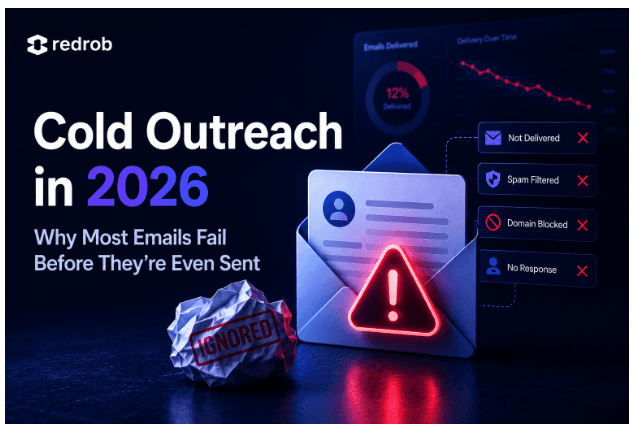
Cold outreach isn’t dead in 2026 - but most of it is ineffective.
The issue isn’t email as a channel. It’s how teams are using it.
Today’s buyers are more aware, more distracted, and far less likely to engage with messages that feel generic or poorly timed. As a result, over 95% of cold emails never receive a reply, meaning most campaigns fail to create even a single meaningful conversation.
That’s not a copy problem. It’s a system problem.
This guide breaks down why cold emails fail, what’s broken in the typical cold outreach strategy, and how the landscape has fundamentally changed.
More importantly, it gives you clear, practical fixes your SDR team can apply immediately including how platforms like Redrob help solve these issues at the root.
The Reality of Cold Outreach Today
Cold outreach still works - but the rules have changed.
The problem is most teams are still using outdated playbooks. Strategies like high-volume sending, basic email personalization, and aggressive follow-ups used to deliver results. Now, they often lead to lower engagement, lower Email open rate, and poor Email deliverability.
Inbox environments are far more competitive and intelligent today. Email spam filters are more aggressive, and recipients decide within seconds whether a message is worth their time. The margin for error is smaller than ever.
At the same time, email automation and AI have made sending emails easier but also more repetitive. This has created a new challenge:
More emails in every inbox
More messages that look the same
Less attention from buyers
Volume is no longer the advantage it once was.
The takeaway is simple: success in outbound email strategy today depends less on how much you send, and more on how relevant and timely your message is.
Ready To Improve Your Cold Outreach Results?
Build smarter campaigns with verified data, better targeting, and AI-driven outreach workflows.
Book a Demo Now
Why Most Emails Fail Before They’re Even Sent
Most cold emails don’t fail because of bad copy. They fail because the foundation behind them is broken.
Before your email even reaches the inbox, multiple factors determine whether it has any chance of being seen, opened, or trusted. And in most cases, things start going wrong much earlier than teams realize.
Here’s what actually breaks first.
1. Weak Data Foundations
Everything in cold outreach starts with your data and this is where many campaigns quietly fall apart. If your email list for marketing is outdated, poorly segmented, or misaligned with your offering, the rest of your efforts won’t matter.
Bad data leads to multiple downstream issues. Emails bounce, engagement drops, and sender reputation suffers. Over time, this affects not just one campaign, but your overall ability to reach inboxes.
A strong data foundation isn’t just about having email addresses it’s about having relevant, usable context. That includes knowing who the decision-makers are, what their company is going through, and whether your solution fits their current needs.
Without this, outreach becomes a volume exercise rather than a targeted email marketing strategy.
2. No Clear Reason to Reach Out
Many cold emails fail because they lack a clear trigger. They are sent simply because a contact exists not because there is a meaningful reason to start a conversation.
From the recipient’s perspective, this feels random. And when an email feels random, it’s easy to ignore.
Strong outreach is usually tied to context. That context gives your message urgency and relevance. For example:
A company just raised funding and is expanding its team
A prospect recently changed roles or responsibilities
A business is entering a new market or launching a product
These moments create natural entry points for outreach marketing. Without them, your message has to work much harder to justify its presence in the inbox and most fail to do so.
3. Deliverability Is Treated as an Afterthought
One of the biggest misconceptions in cold outreach is assuming that “sent” means “seen.” In reality, a significant portion of emails never reach the primary inbox.
Email deliverability depends on a mix of technical setup and sender behavior. If either is weak, your emails may be filtered out before they’re ever read.
Common issues include:
Improper domain authentication
Sending too many emails too quickly
Low engagement history
Poor list quality
These factors don’t just affect a single campaign they compound over time. A few poorly executed campaigns can damage your domain reputation, making future outreach even less effective.
This is why deliverability should be treated as a core part of Email marketing best practices, not a technical detail.
4. Overuse of Generic Personalization
Email personalization is often seen as the solution to poor outreach but in many cases, it’s part of the problem.
Most emails today include surface-level personalization that doesn’t add real value. Mentioning someone’s job title or company name doesn’t make a message relevant it just makes it slightly less generic.
What actually works is contextual relevance, not just personalization. This means understanding what the recipient cares about and aligning your message with that.
When personalization lacks depth, it creates the illusion of effort without delivering real impact. And experienced buyers can recognize this immediately.
5. Messaging That Prioritizes Selling Over Value
A large number of cold emails focus too heavily on the sender’s product or service. They highlight features, achievements, or capabilities without clearly connecting them to the recipient’s needs.
This creates a disconnect. The recipient is forced to figure out why the message matters and most won’t take the time to do that.
Effective messaging takes a different approach. It starts with the problem, builds relevance, and then introduces a solution in a way that feels natural. The goal is not to pitch immediately, but to earn attention first.
Strong Email subject lines and concise messaging also play a major role here. If the opening feels self-promotional, most recipients won’t continue reading.
6. Too Much Focus on Volume
Scaling outreach by increasing volume used to be a common strategy. Today, it often backfires.
Sending more emails without improving quality leads to:
Lower engagement rates
Higher spam complaints
Reduced deliverability
Instead, high-performing teams are moving toward a more focused approach:
Smaller, better-defined prospect lists
Better email list building practices
More research per contact
Higher-quality messaging
Intentional follow-ups
This doesn’t just improve results it also makes outreach more sustainable over time.
The Shift: From Volume to Precision
Cold outreach is evolving from a numbers game into a precision-driven process. The emphasis is no longer on how many emails you send, but on how relevant and timely those emails are.
This shift requires a change in mindset. Instead of thinking in terms of campaigns, it’s more effective to think in terms of conversations. Each email should feel like a deliberate attempt to start something meaningful, not just another step in an automated sequence.
Teams that adapt to this approach often see better outcomes with fewer emails. They invest more time upfront—researching, segmenting, and crafting messages but that investment pays off in higher engagement and stronger relationships.
Precision doesn’t limit scale it improves it.
Want Better Replies Without Sending More Emails?
Use signal-based prospecting and precision targeting to create outreach that actually converts.
See Redrob in Action
How Redrob Is Changing Cold Outreach
Redrob approaches cold outreach differently by focusing on the areas where most campaigns fail. Rather than optimizing for speed or volume, it helps teams build a stronger foundation.
One of its key strengths is improving how prospects are identified and selected. By focusing on higher-intent leads, it reduces wasted effort and increases the likelihood of meaningful engagement.
It also supports more context-driven outreach. Instead of relying on generic templates, users can create messages that align with real-world signals and timing. This makes communication feel more relevant and less intrusive.
On the technical side, Redrob helps ensure that emails are properly configured and more likely to reach the inbox. This includes guidance around domain health and sending practices—areas that are often overlooked but critical for success.
Overall, the platform shifts the focus from sending more emails to building better outreach systems and smarter email marketing workflows.
What Actually Works in 2026
While tools and tactics continue to evolve, the core principles of effective outreach remain consistent. What’s changed is how strictly those principles need to be followed.
Successful outreach today is built on a few key elements:
Clear relevance to the recipient’s current situation
Simple, direct communication that respects their time
Thoughtful timing based on real-world context
Strong Email subject lines with clear intent
A focus on creating value before asking for anything
When these elements come together, outreach feels less like an interruption and more like a useful interaction. That’s what drives replies.
Final Thoughts
Most cold emails don’t fail because of poor writing they fail because the groundwork isn’t done properly. By the time the email is sent, the outcome is often already determined.
Improving results isn’t about finding a better template or tweaking subject lines. It’s about fixing the fundamentals:
Better data
Stronger targeting
Reliable Email deliverability
More relevant messaging
Smarter cold outreach strategy
Cold outreach still has the potential to be a powerful growth channel. But in 2026, it rewards those who are intentional, precise, and willing to move beyond outdated strategies.
Platforms like Redrob help businesses build stronger outreach systems with verified data, intent-driven prospecting, smarter targeting, and deliverability-focused workflows all in one platform.
Ready To Build Smarter Cold Outreach?
Power your outbound strategy with AI-driven prospecting, verified contact data, and precision targeting.
Book a Demo
Frequently Asked Questions
1. Is cold outreach still effective today?
Yes, but only when it’s highly targeted and relevant. Broad, generic campaigns are becoming less effective.
2. What is the biggest reason emails fail?
A lack of relevance, weak email list building, and poor Email deliverability are the most common reasons.
3. How important is timing in outreach?
Very important. Emails tied to real events or triggers perform significantly better.
4. Should I send more emails to get better results?
Not necessarily. Increasing volume without improving quality often leads to worse outcomes and lower Email open rate.
5. How can tools like Redrob help?
Platforms like Redrob help teams improve targeting, optimize outbound email strategy, strengthen deliverability, and create more context-driven outreach campaigns.

Work Smarter with
One AI platform powering job search, work, discovery, and productivity.
Latest AI Blogs.

Jun 23, 2026
How Recruiters Actually Shortlist Candidates Today
Garima

Jun 23, 2026
Best AI Job Search Agents in 2026: Find Jobs Smarter with Redrob
Bhushan

Jun 23, 2026
How Recruiters Shortlist Candidates in 2026: A Complete Guide
Garima

Jun 23, 2026
How to Get More Interviews Without Applying to Hundreds of Jobs
Bhushan

Jun 23, 2026
AI Resume Checker vs ATS Resume Checker: What's the Difference
Garima

Jun 23, 2026
One AI Assistant vs Multiple AI Tools: Which Is Better
Garima