Bhushan

Artificial intelligence is moving faster than ever. Every week, a new model launches, a new benchmark gets broken, and another AI company claims to have built the future. But while the global conversation focuses heavily on models, India’s AI journey is unfolding very differently.
For India, the biggest AI challenge is not simply building smarter models. It is building AI that people can actually use at scale.
A highly advanced AI model means very little if it is too expensive, inaccessible in regional languages, or impossible to deploy across millions of users. That is why the future of AI for India will not be decided only by technical performance. It will be decided by affordability, scalability, and accessibility.
According to recent industry reports, India is among the fastest-growing markets for AI usage globally, with millions actively using platforms like ChatGPT in India for learning, work, and productivity. However, enterprise-level AI adoption in India still remains significantly lower than many global markets because businesses continue to face challenges around infrastructure, cost, language accessibility, and practical implementation.
This creates an important shift in the conversation around AI in India.
The companies that succeed will not necessarily be the ones building the biggest models. They will be the companies building AI systems that work for Bharat - across languages, industries, devices, and user segments.
In this blog, we will talk about why cost, scale, and language are becoming more important than models, how Indian businesses are approaching AI differently and how platforms like Redrob AI are helping make AI more scalable and practical for Indian users.
Why India Needs a Different AI Approach
Most global AI products are designed for mature enterprise ecosystems. They assume users have high purchasing power, advanced software infrastructure, and English-first workflows.
India is different.
India’s digital economy operates at enormous scale, but with massive diversity in language, digital literacy, internet quality, and spending power. A product that works smoothly for a US enterprise may completely fail in tier-2 or tier-3 India if it ignores affordability or localization.
That is why many ai companies in india are now focusing less on “who has the biggest model” and more on “who can make AI accessible.”
This shift is important because India’s opportunity is not limited to enterprise AI adoption. The real opportunity lies in bringing AI to:
Students
SMBs
First-time digital users
Regional businesses
Non-English audiences
Mobile-first users
The future of ai of india depends on usability just as much as intelligence.
Scalable AI for Bharat
Accessible AI for businesses, students, and everyday users.
Try Redrob AI Free
Cost Will Decide the Next AI Wave
One of the biggest barriers slowing ai adoption in india is cost.
Many advanced AI tools are still priced for Western enterprise markets. While global companies can justify expensive subscriptions and infrastructure costs, Indian businesses often prioritize operational efficiency and affordability.
This is where the real challenge begins.
India’s AI ecosystem cannot grow if AI remains accessible only to large corporations. The next phase of AI for India depends on lowering the cost of AI deployment and usage.
That is why several top ai companies in india are now investing heavily in:
Lightweight AI systems
Efficient infrastructure
Lower inference costs
Scalable automation workflows
Faster deployment systems
Mobile-first AI experiences
India has historically scaled technology through affordability. UPI transformed payments because it removed friction and cost barriers. Cheap mobile internet accelerated digital adoption across the country.
AI will likely follow the same pattern.
The companies that make AI affordable will drive the next wave of adoption.
Language Is the Biggest Untapped AI Opportunity
One of the most overlooked aspects of AI in India is language accessibility.
Most AI systems today still heavily prioritize English-based interactions. But India is one of the most linguistically diverse countries in the world.
Millions of users are far more comfortable interacting in Hindi, Tamil, Telugu, Marathi, Bengali, Gujarati, and other regional languages. If AI products fail to support these users naturally, adoption will always remain limited.
That is why ai indian companies are increasingly focusing on multilingual experiences instead of purely technical benchmarks.
The next generation of AI systems will need to:
Understand multilingual prompts naturally
Handle mixed-language conversations
Generate localized responses accurately
Support regional communication patterns
Simplify usage for first-time AI users
This is especially important for ai for bharat, where accessibility matters more than complexity.
The companies that solve language accessibility will likely define the future of leading india ai innovation.
AI That Speaks India’s Languages
Built for multilingual conversations and regional accessibility.
Why Scale Matters More Than Hype
Building a viral AI demo is easy.
Building AI infrastructure that works consistently for millions of users is much harder.
India’s internet ecosystem operates at enormous scale. Platforms can onboard millions of users within weeks. This changes how AI products need to be designed.
The future leaders among companies in ai in india will likely focus heavily on:
Scalable AI infrastructure
Faster response systems
Lower operational costs
Efficient compute usage
Stable user experiences at scale
This is where many AI products struggle.
A system may perform well in small test environments but fail when exposed to real-world traffic volumes and operational demands. India’s AI market requires products that can scale efficiently without becoming financially unsustainable.
That is why scalability matters just as much as model quality.
The Gap Between AI Awareness and AI Adoption
AI awareness is growing rapidly across industries. Businesses are experimenting with automation, AI assistants, workflow optimization, and productivity tools.
But awareness does not automatically translate into adoption.
Many businesses still struggle with:
Fragmented AI tools
Poor integration workflows
High implementation costs
Lack of internal AI expertise
Difficulty scaling usage across teams
This creates a major gap in ai adoption.
Companies want AI systems that create measurable operational impact not just impressive demos.
That is why many businesses are now prioritizing:
Workflow automation
Execution-focused AI systems
AI-powered operational efficiency
Simplified user experiences
Faster implementation cycles
Practical execution is becoming more important than hype.
AI That Drives Real Business Execution
Simplify workflows, automate tasks, and scale operations faster.
Join the Redrob AI Waitlist
How Redrob AI Is Building AI for Bharat
Instead of focusing only on bigger models, Redrob AI focuses on practical AI adoption for businesses, teams, and professionals across India.
The platform combines AI-powered workflows, multilingual accessibility, and scalable infrastructure into one connected system designed for real-world execution. From hiring and communication to search and productivity, Redrob AI aims to simplify how users interact with AI daily.
30+ Language Support
Built for multilingual AI interactions across India’s diverse user base, helping users communicate, search, and work more naturally across regional languages.
Low-Cost, High-Speed AI
Powered by a lightweight 2B parameter infrastructure with faster response times, lower latency, and significantly reduced deployment costs for scalable AI adoption.
Unified Search & Intelligence
Access people search, company insights, hiring signals, verified contacts, and growth data through one AI-powered platform without switching between multiple tools.
Smarter Hiring Workflows
Simplify hiring, candidate evaluation, and recruitment operations using AI-powered automation.
Interview Coach
Integrated Productivity Tools
Search Drive files, summarize Gmail threads, schedule meetings, and manage Calendar workflows through connected AI assistance that keeps context intact.
This reflects how the future of ai adoption in india will depend not only on model performance, but also on usability, affordability, scalability, and workflow simplicity.
Stop Switching Between AI Tools
Manage hiring, search, workflows, and productivity through one connected AI platform.
Explore Redrob AI
Why India’s AI Opportunity Is Bigger Than Model Wars
The global AI race often focuses on model comparisons, funding rounds, and benchmark scores.
But India’s opportunity is different.
India’s AI future depends on:
Affordability
Accessibility
Language inclusion
Scalable infrastructure
Workflow integration
Mass adoption
The biggest winners in AI for India may not necessarily be the companies with the most advanced foundational models.
They may be the companies that:
Simplify AI usage
Reduce operational friction
Support regional users effectively
Scale affordably
Create practical business outcomes
India has already proven it can scale digital innovation faster than most markets globally.
AI could become the next major example.
Final Thoughts
The first phase of AI was about proving what models could achieve.
The next phase especially for AI in India will be about making AI truly accessible to millions of users.
That means solving for:
Cost
Scale
Infrastructure
Regional language accessibility
Real-world execution
Workflow usability
The future of AI for Bharat will not belong only to companies building smarter models.
It will belong to companies building systems people can realistically adopt every day.
As more top ai companies in india focus on scalable execution instead of just technical benchmarks, India could emerge as one of the world’s most important AI growth markets.
The companies that understand Bharat’s realities will shape the future of AI adoption.
AI Designed for India’s Next Billion Users
Built for multilingual workflows, faster execution, and scalable adoption
Discover Redrob AI

Work Smarter with
One AI platform powering job search, work, discovery, and productivity.
Latest AI Blogs.

Jun 23, 2026
How Recruiters Actually Shortlist Candidates Today

Garima

Jun 23, 2026
Best AI Job Search Agents in 2026: Find Jobs Smarter with Redrob
Bhushan

Jun 23, 2026
How Recruiters Shortlist Candidates in 2026: A Complete Guide
Garima

Jun 23, 2026
How to Get More Interviews Without Applying to Hundreds of Jobs
Bhushan
Jun 23, 2026
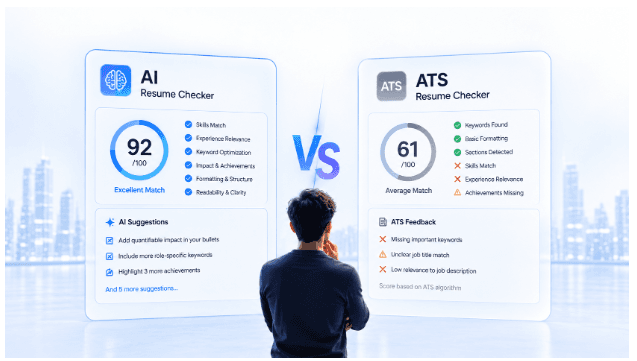
AI Resume Checker vs ATS Resume Checker: What's the Difference
Garima

Jun 23, 2026
One AI Assistant vs Multiple AI Tools: Which Is Better
Garima