
Garima
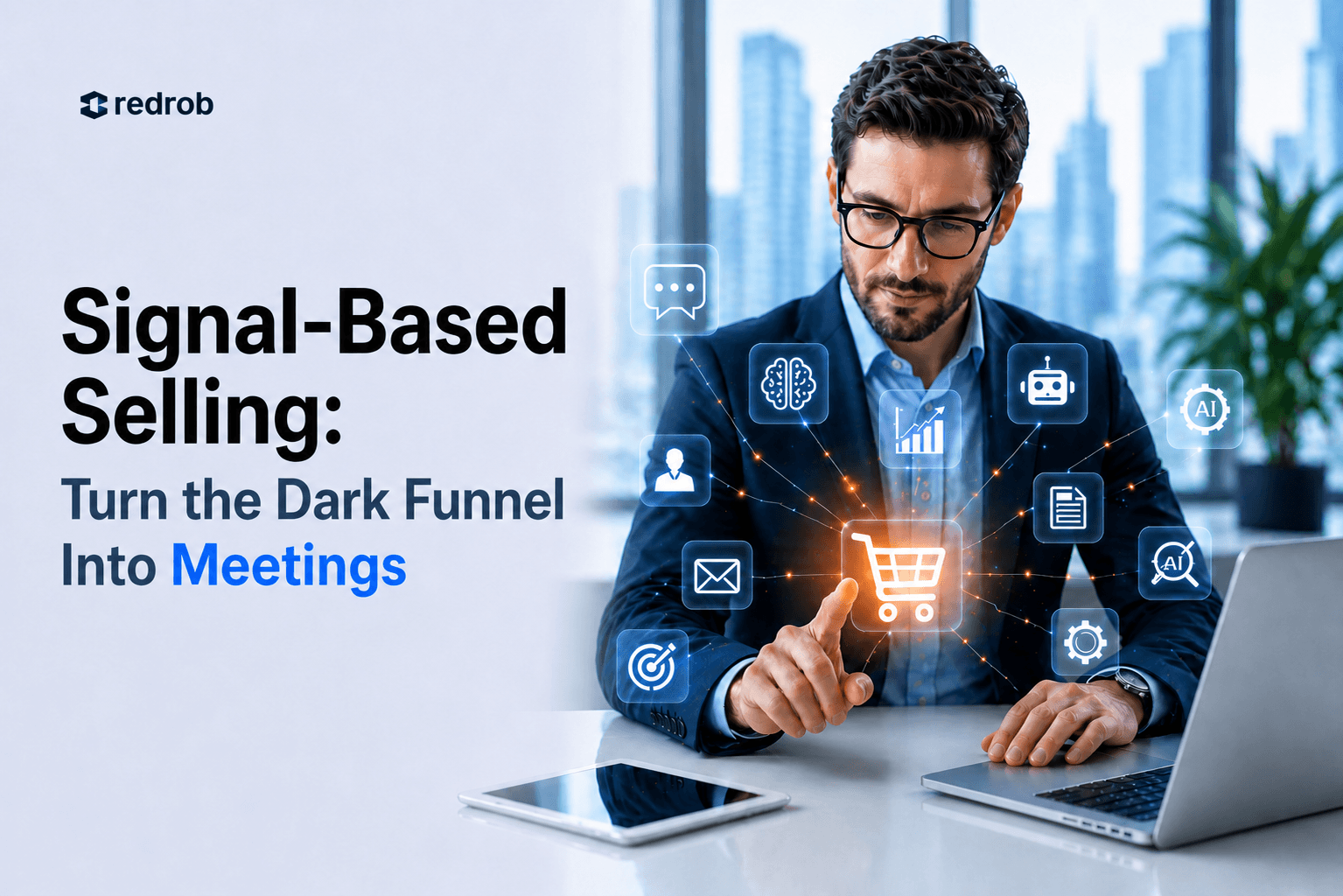
Here’s the uncomfortable truth behind most B2B pipelines: by the time a prospect fills out a form or books a demo, they’ve already done most of the work. They’ve compared vendors, read reviews, explored pricing pages, and narrowed down their options often without ever interacting with your sales team.
In fact, According to the reports 84% of B2B buyers choose a vendor before ever speaking to a sales representative.
This means the real decision-making is happening in what we call the dark funnel a space where buyer intent exists, but visibility doesn’t. Prospects are active, researching, and forming opinions, but you’re not tracking most of it.
Signal-based selling is built on a simple idea: buyers leave behind buyer intent signals everywhere and the teams that act on these signals first win.
In this blog, we’ll break down the different types of buying signals, how to prioritize them, a practical framework to act on them, and how you can turn hidden intent into real meetings faster using smarter sales prospecting strategies.
What Is Signal-Based Selling?
Signal-based selling is a modern approach to b2b prospecting where outreach is driven by real-time buyer behavior, not static lists.
Instead of guessing who might be interested, you identify prospects who are already showing intent through actions like engaging with content, visiting websites, or researching competitors and reach out at the right moment.
It’s the difference between:
Cold outreach: “Let me know if you’re interested.”
Signal-based outreach: “I noticed your team is actively exploring this space - here’s how we can help.”
The second works because it’s timely, relevant, and aligned with what the buyer is already doing.
Looking to Improve Your Prospecting Accuracy?
Use AI-driven insights to identify high-intent leads and eliminate guesswork from your outreach.
Try Smart Prospecting Tools
The 5 Categories of Buying Signals
Not all signals mean the same thing. Some show curiosity, while others indicate serious buying intent. Understanding this difference helps you prioritize your outreach using sales intelligence.
1. Intent Signals (High Urgency)
These signals show that a company is actively researching your category or competitors.
Examples:
Visiting review platforms
Comparing vendors
Reading solution-specific content
These are strong intent signals that indicate a buying decision is already in progress.
2. Engagement Signals (High Urgency)
These come from known contacts interacting with your brand.
Examples:
LinkedIn likes, comments, or profile views
Email clicks or replies
Content downloads
3. Technographic Signals (Medium Urgency)
These signals indicate changes in a company’s tech stack.
Examples:
Installing new tools
Replacing existing solutions
4. Firmographic Signals (Medium Urgency)
These are business-level changes that could trigger buying needs.
Examples:
New hires in leadership roles
Funding announcements
Expansion into new markets
5. Behavioral Signals (Medium to High Urgency)
These reflect how prospects interact with your product or website.
Examples:
Repeated website visits
Product usage patterns
Feature exploration
Where Do These Signals Come From?
To make b2b prospecting more effective, you need visibility into multiple data sources.
Some of the most valuable include:
Review platforms: Activity on comparison pages or listings
LinkedIn: Engagement with content, competitor activity, profile visits
Job postings: Hiring for roles related to your solution category
Website visits: Anonymous or identified traffic showing interest
Product data: Usage trends in product-led growth models
Content downloads: Indicating active research
Combining these sources strengthens your b2b sales intelligence tools stack and gives you a clearer picture of real buyer intent.
Struggling to Find Verified Contacts?
Use AI-powered search to discover decision-makers actively researching your category
Try People Search
Signal Scoring: Turning Data Into Action
Raw signals are noisy. You need a way to prioritize them and that’s where signal scoring comes in for smarter outbound prospecting.
A simple framework can help you categorize accounts based on intent:
Tier | Score Range | Signal Profile | Recommended Action |
Tier 1: Hot | 80–100 | Multiple high-intent signals, known contact engagement, recent trigger events | Immediate outreach within 24 hours |
Tier 2: Warm | 50–79 | Limited intent signals or engagement | Follow up within 48 hours and add to nurture |
Tier 3: Monitor | 20–49 | Single or low-confidence signals | Add to tracking and nurture campaigns |
Below Threshold | <20 | Minimal or no signals | No direct sales outreach |
The Signal-to-Meeting Playbook (First 24 Hours)
Speed is everything in signal-based selling. Acting quickly can be the difference between winning and losing a deal.
Step 1: Capture the Signal
Set up systems to detect and alert you when a high-intent signal appears.
Step 2: Understand the Context
Before reaching out, analyze:
What triggered the signal
What the prospect is exploring
Any recent company updates
Step 3: Personalize Your Message
Don’t just mention the signal translate it into a relevant conversation.
Example:
“Noticed your team has been exploring solutions. We’ve helped similar companies solve [specific problem].”
Step 4: Use Multi-Channel Outreach
Run a focused 4–5 touch sequence:
Day 1: Personalized email
Day 2: LinkedIn connect
Day 3: Follow-up with value
Day 5: Call or voice note
Keep it short and relevant.
Step 5: Track and Optimize
Measure:
Response rates
Meetings booked
Pipeline generated
Refine your scoring model based on what actually works.
Want to Turn Signals Into Meetings Faster?
Automate your outreach workflows and engage prospects at the right time with the right context.
Get Started Now
How Redrob Helps You Execute Signal-Based Selling
Executing signal-based selling manually is complex. That’s where Redrob simplifies your sales prospecting workflow.
1. Real-Time Signal Tracking
Redrob helps you identify key prospect activities so you never miss high-intent opportunities.
2. Chrome Extension for Seamless Prospecting
With the Redrob Chrome extension, you can capture, enrich, and act on signals directly from LinkedIn without switching tools.
3. Data Enrichment
Get complete prospect and company insights in one place, helping you craft
better outreach.
4. Prioritization of High-Intent Leads
Redrob highlights the most relevant leads so your team focuses on what matters.
5. Faster Outreach Execution
With signal-backed insights, your messaging becomes timely and contextual leading to higher response rates.
6. Unified Workflow
Instead of juggling multiple tools, Redrob brings everything into one streamlined system saving time and improving efficiency.
Signal-Based Selling vs Traditional Outreach
Factor | Traditional Outreach | Signal-Based Selling |
Trigger | Predefined lists | Real-time buyer behavior |
Timing | Fixed sequences | Based on intent signals |
Personalization | Generic | Context-driven |
Response Rate | Low | Higher due to relevance |
Sales Cycle | Longer | Shorter |
Approach | Volume-based | Precision-based |
Common Mistakes to Avoid
Even the best outbound prospecting strategy can fail with poor execution:
Acting too late on signals
Relying on a single signal
Over-personalizing and sounding intrusive
Not aligning sales and marketing
Ignoring data optimization
The key is consistency, timing, and continuous improvement.
Final Thoughts
The way buyers make decisions has changed but most sales strategies haven’t.
Signal-based selling helps you tap into the dark funnel, leverage buyer intent signals, and improve your overall sales prospecting strategy.
Instead of chasing cold leads, you focus on timing, relevance, and precision.
And when done right, you don’t just generate leads you generate meetings that convert into real revenue.
Ready to Turn Buyer Signals Into Revenue?
Stop chasing cold leads and start converting high-intent prospects.
Book a Demo Now
Frequently Asked Questions
1. What is signal-based selling?
It’s a modern b2b prospecting approach where outreach is triggered by buyer behavior and intent signals.
2. What are buying signals in B2B?
They are actions or events like content engagement, website visits, or hiring trends that indicate potential buying intent.
3. What is the dark funnel?
The dark funnel refers to the invisible part of the buyer journey where prospects research and evaluate options without interacting directly with your brand.
4. How do you use intent data in sales?
Intent data helps identify which accounts are actively researching your category, allowing you to prioritize outreach and personalize messaging.
5. What tools are needed for signal-based selling?
You typically need tools for intent data, enrichment, CRM integration, and outreach platforms like Redrob help bring these together.

Work Smarter with
One AI platform powering job search, work, discovery, and productivity.
Latest AI Blogs.

Jun 23, 2026
How Recruiters Actually Shortlist Candidates Today
Garima

Jun 23, 2026
Best AI Job Search Agents in 2026: Find Jobs Smarter with Redrob
Bhushan

Jun 23, 2026
How Recruiters Shortlist Candidates in 2026: A Complete Guide
Garima

Jun 23, 2026
How to Get More Interviews Without Applying to Hundreds of Jobs
Bhushan
Jun 23, 2026
AI Resume Checker vs ATS Resume Checker: What's the Difference
Garima

Jun 23, 2026
One AI Assistant vs Multiple AI Tools: Which Is Better
Garima