Why Your Resume Isn't Getting Shortlisted & How to Fix It

Garima

According to Jobscan, over 98% of Fortune 500 companies use an Applicant Tracking System (ATS) to screen resumes before they ever reach a recruiter.
This means a resume is often evaluated by software before a human sees it. If the document isn't optimized with the right keywords, structure, and formatting, it can be filtered out within seconds, regardless of the candidate's experience or potential.
In today's competitive hiring landscape, creating an ATS Resume is no longer optional. It has become one of the most important factors in improving an ATS Score, increasing resume visibility, and getting shortlisted for interviews.
In this blog, we'll explain why resumes don't get shortlisted, how ATS works, the common mistakes to avoid, and simple ways to build an ATS-friendly resume.
The Resume Black Hole: Why So Many Applications Disappear
One of the biggest frustrations in any job search is submitting countless applications and hearing nothing back.
For many professionals, this creates uncertainty. Was the experience insufficient? Were there too many applicants? Was someone else simply a better fit?
While these questions are understandable, the answer is often much simpler.
The resume may never have reached a recruiter.
Modern hiring has changed dramatically over the past decade. A single job posting can attract hundreds or even thousands of applications within a few days. Reviewing every resume manually would require enormous amounts of time, making the hiring process slow and inefficient.
To manage this volume, organizations use Applicant Tracking System (ATS) software to organize, filter, and prioritize resumes before recruiters begin reviewing candidates.
As a result, the first hiring decision often happens automatically.
Only resumes that closely match the employer's requirements move to the next stage.
Everyone else remains invisible.
Is Your Resume Getting Rejected Before a Recruiter Sees It?
Find out how ATS evaluates your resume before you apply
Check Your ATS Score
What Is an Applicant Tracking System (ATS)?
An Applicant Tracking System (ATS) is recruitment software designed to help employers manage large volumes of job applications efficiently.
Rather than selecting resumes randomly, ATS evaluates applications using predefined hiring criteria and ranks candidates based on how closely their resumes match the role.
Depending on the employer, the system may analyze factors such as:
Industry-specific keywords
Previous job titles
Work experience
Educational qualifications
Resume structure and readability
After this evaluation, recruiters usually begin reviewing the resumes that best match the requirements.
This explains why two professionals with similar qualifications may experience very different outcomes during the hiring process.
Why Qualified Candidates Still Miss Interview Opportunities
Not getting shortlisted doesn't always mean a candidate lacks the right skills or experience.
In many cases, the problem isn't what's on the resume - it's how the information is presented.
Recruiters and Applicant Tracking System (ATS) software don't automatically recognize potential. They evaluate resumes based on relevance, clarity, and alignment with the job description. When important information is missing, difficult to find, or presented in a way the system can't interpret, even highly qualified candidates can be overlooked.
The good news is that many of these issues are completely fixable.
Here are some of the most common reasons resumes fail to make the shortlist.
1. The Resume Speaks a Different Language Than the Job Description
A job description is more than a list of responsibilities - it's a blueprint for what the employer wants.
Recruiters intentionally include the skills, tools, certifications, and competencies they're looking for, and ATS software searches for many of those same terms when evaluating applications.
For example, a project manager may describe previous experience as:
Managed multiple client projects and coordinated team activities.
While the job description may emphasize keywords such as:
Agile
Scrum
Stakeholder Management
Risk Management
Sprint Planning
Project Lifecycle
Although both versions describe similar work, the second reflects the employer's language. When relevant keywords are missing, the resume may appear less relevant even if the candidate has the required experience.
Takeaway: Aligning resume language with the job description improves both ATS Score and recruiter visibility.
2. One Resume Is Expected to Fit Every Opportunity
Every role has different priorities.
A resume written for a marketing position won't necessarily highlight the same strengths as one tailored for a product management or operations role. Yet many professionals apply for dozens of jobs using exactly the same resume.
That generic approach often reduces keyword relevance and makes applications appear less targeted.
Customizing a resume doesn't require starting from scratch. Updating the professional summary, skills section, and key achievements to reflect the specific role is often enough to create a much stronger application.
Takeaway: A tailored resume consistently performs better than a one-size-fits-all resume.
3. The Design Looks Great, but ATS Can't Read It
Many modern resume templates prioritize appearance over functionality.
Multiple columns, graphics, icons, tables, and text boxes may create an attractive layout, but they can also confuse ATS software, causing important information to be missed or read incorrectly.
An effective ATS Resume focuses on clarity rather than decoration.
A recruiter should be able to scan it quickly, and ATS software should be able to process it without difficulty.
A strong layout typically includes:
A clean, single-column format
Clear section headings
Standard fonts
Consistent spacing
Well-organized content
Takeaway: Simplicity often performs better than creativity during the initial screening process.
4. Responsibilities Are Listed, but Impact Is Missing
Recruiters aren't just interested in what candidates were responsible for they want to understand the results those candidates delivered.
Compare the following examples.
Less Effective
Managed social media campaigns.
More Effective
Increased social media engagement by 42% and generated a 30% increase in qualified leads through targeted content campaigns.
The second example tells a stronger story because it demonstrates measurable business impact rather than simply describing a task.
Whenever possible, achievements should include numbers, percentages, cost savings, revenue growth, productivity improvements, or other quantifiable outcomes.
Takeaway: Results make a resume memorable. Responsibilities alone rarely do.
5. Valuable Skills Are Difficult to Find
Many candidates possess the exact skills employers are looking for, but those skills are scattered throughout long paragraphs or hidden inside work experience.
Both ATS software and recruiters benefit from a clearly organized skills section.
Highlighting technical skills, software proficiency, certifications, industry knowledge, and core competencies in one place makes the resume easier to evaluate and improves keyword matching.
Takeaway: If recruiters have to search for important skills, there's a greater chance they'll be overlooked.
A Practical Framework for Building an ATS-Friendly Resume
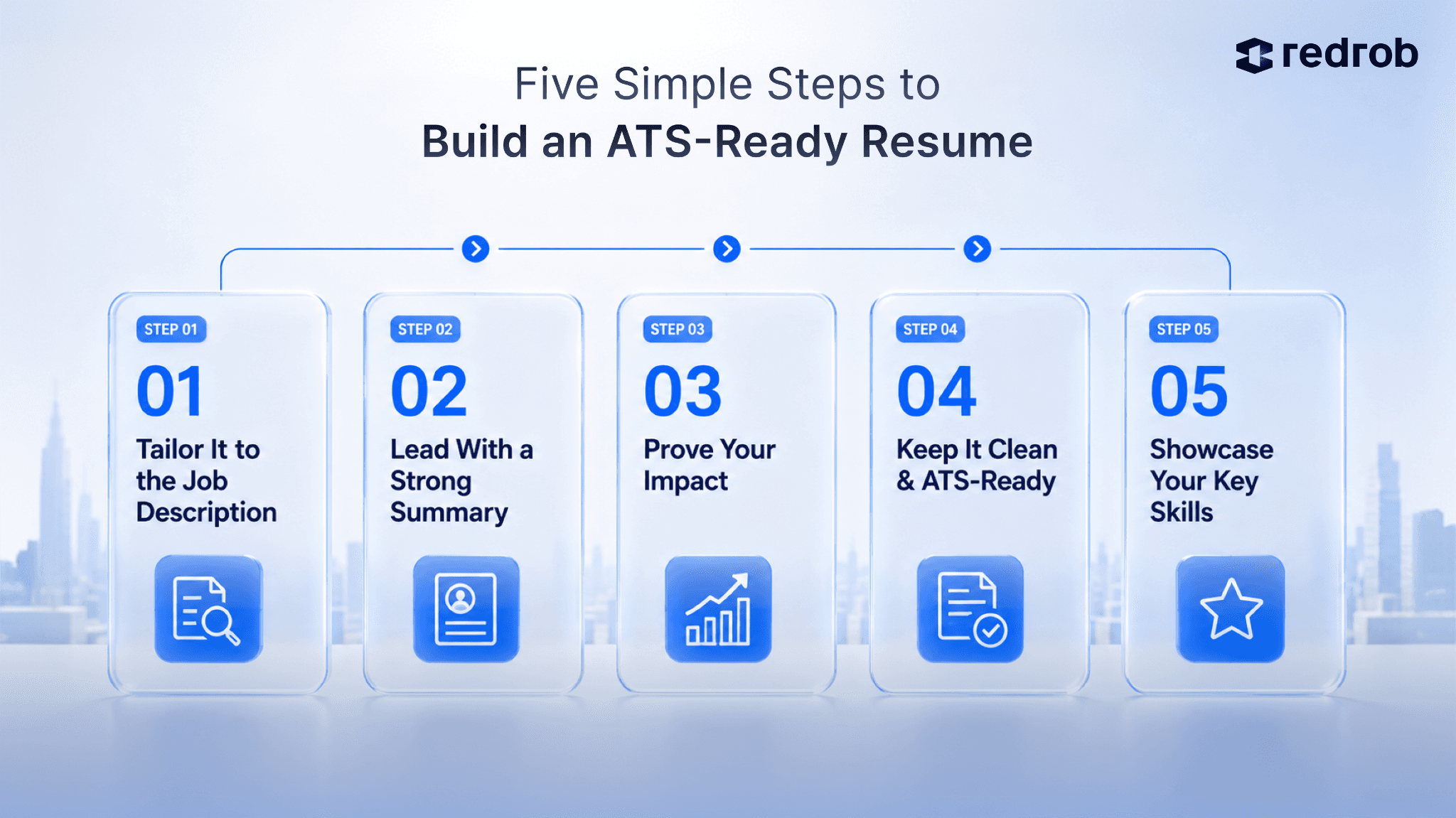
A strong ATS Resume isn't built by adding more content - it's built by making every section more relevant. Small improvements in keywords, achievements, and formatting can significantly increase the chances of getting shortlisted.
Here's a practical framework that helps resumes perform better during Applicant Tracking System (ATS) screening.
1. Let the Job Description Guide the Resume
Every job description reveals what employers are looking for. Pay close attention to recurring keywords, required skills, certifications, and tools, then incorporate them naturally throughout the resume wherever they match the candidate's experience.
The goal isn't to add more keywords - it's to improve relevance.
2. Make the Professional Summary Count
The professional summary is often the first thing a recruiter reads. Instead of using generic statements, it should quickly highlight years of experience, core expertise, industry specialization, key achievements, and career focus.
A strong summary immediately communicates value.
3. Focus on Results, Not Responsibilities
Recruiters are interested in impact, not just daily tasks.
Less Effective
Content Writer responsible for blog creation.
More Effective
Created SEO-focused content that increased organic website traffic by 45% within one year while improving search rankings for competitive keywords.
Achievements supported by measurable results make resumes more compelling and credible.
4. Highlight the Skills That Matter Most
Important skills should be easy to find not buried within long paragraphs.
A dedicated skills section featuring relevant technologies, tools, certifications, and professional competencies improves both recruiter readability and ATS Score.
5. Keep the Layout Simple and Professional
A visually appealing resume isn't always ATS-friendly. Complex layouts, graphics, icons, and multiple columns can make resumes difficult for ATS software to read.
A clean layout with clear headings, standard fonts, consistent spacing, and simple formatting makes the resume easier for both recruiters and Applicant Tracking System (ATS) software to evaluate.
Ready to Build an ATS-Friendly Resume?
Optimize every section of your resume for better visibility and stronger interview opportunities.
Small Resume Mistakes That Can Cost Big Opportunities
Not every resume gets rejected because of missing experience. Sometimes, seemingly small mistakes can quietly reduce its visibility during Applicant Tracking System (ATS) screening.
The good news? Most of these issues are easy to fix once they're identified.
Using Job Titles That Recruiters Don't Recognize
Job titles help recruiters and ATS software quickly understand a candidate's background. If previous titles are overly creative, internal to a company, or different from industry standards, the resume may appear less relevant.
Whenever appropriate, use widely recognized job titles that accurately reflect the role.
Missing the Right Keywords
Even a well-written resume can struggle if it doesn't include the terminology employers are searching for.
Naturally incorporating role-specific skills, tools, and industry keywords throughout the resume improves both readability and ATS Score without making the content feel forced.
Making Recruiters Read Too Much
Recruiters often spend only a few seconds reviewing a resume. Large blocks of text make it difficult to identify important information quickly.
Short, achievement-focused bullet points make the resume easier to scan while drawing attention to the candidate's most valuable accomplishments.
Keeping Information That No Longer Adds Value
An outdated certification, irrelevant work experience, or obsolete technical skill can distract from stronger qualifications.
Every section of a resume should support the role being applied for. Removing outdated information creates space for achievements and skills that matter most today.
How AI Is Transforming Resume Optimization
Resume optimization has become smarter, faster, and far more efficient.
Instead of manually reviewing every job description and updating resumes for each application, professionals are increasingly relying on AI Productivity to simplify the process.
Modern AI Productivity Tools can help:
Compare resumes with job descriptions
Identify missing keywords
Suggest stronger achievement statements
Improve resume readability
Highlight skills gaps
Recommend content improvements
By automating repetitive tasks, AI Workflow Automation allow professionals to spend less time editing resumes and more time preparing for interviews.
This shift reflects the growing role of ai and the future of work, where technology enhances productivity rather than replacing human expertise. As digital hiring continues to evolve, AI Tools for Work and AI Automation Tools are becoming valuable companions for building stronger, more competitive applications.
Why an ATS-Friendly Resume Makes a Difference
A strong ATS Resume does more than pass automated screening - it creates a better experience for recruiters from the very first glance.
When a resume is relevant, well-structured, and easy to read, it becomes easier for both ATS software and hiring managers to recognize a candidate's strengths.
Some of the biggest advantages include:
Improves ATS Score through better keyword alignment.
Increases visibility during resume screening.
Highlights relevant skills and measurable achievements.
Makes resumes easier for recruiters to scan quickly.
Improves alignment with employer expectations.
Increases the likelihood of securing interview calls.
Ultimately, resume optimization isn't about adding more information - it's about presenting existing experience in the most effective way.
Is the Resume Ready for Today's Hiring Process?
Small improvements today can lead to more interview opportunities tomorrow.
Build an ATS-friendly resume
How Redrob AI Supports Every Stage of the Job Search
Redrob AI brings career intelligence and productivity tools together in one connected platform, helping professionals manage their job search more efficiently.
With Redrob AI, professionals can:
Improve resumes before applying.
Identify missing skills and keywords that affect ATS Resume performance.
Discover AI-powered job recommendations.
Research companies before interviews.
Get AI-powered career assistance and insights.
Manage job search activities without switching between multiple platforms.
By combining AI Productivity, AI Productivity Tools, and AI Tools for Work, Redrob AI helps simplify the job search while reducing repetitive work. As hiring becomes increasingly technology-driven, connected AI Automation Tools make it easier to prepare stronger applications and make more informed career decisions.
Looking for More Than Just a Resume Checker?
Manage your resume, discover better job matches, and prepare for interviews all in one place.
Explore Redrob AI
Final Thoughts
A lack of interview calls doesn't always reflect a lack of ability.
More often, it reflects a resume that isn't communicating the candidate's strengths in a way that modern hiring systems can understand.
A well-optimized ATS Resume combines relevant keywords, measurable achievements, clear formatting, and role-specific content to improve visibility during Applicant Tracking System (ATS) screening.
As hiring continues to evolve, combining strong resume practices with AI Productivity can help professionals prepare better applications, save valuable time, and approach every opportunity with greater confidence.
In today's competitive job market, success isn't about sending more resumes - it's about sending the right resume.
Frequently Asked Questions
1. What is an ATS Resume?
An ATS Resume is designed to be easily read by an Applicant Tracking System (ATS). It uses clear formatting, relevant keywords, and structured sections to improve the chances of getting shortlisted.
2. How can an ATS Score be improved?
An ATS Score can be improved by tailoring the resume to each job description, using relevant keywords, highlighting measurable achievements, and following ATS-friendly formatting.
3. Do all companies use Applicant Tracking Systems?
While not every employer uses ATS software, most medium and large organizations rely on Applicant Tracking System (ATS) platforms to manage high application volumes. According to Jobscan, over 98% of Fortune 500 companies use ATS during recruitment.
4. Can AI help optimize a resume?
Yes. Modern AI Productivity Tools can analyze resumes, identify missing keywords, improve content quality, and recommend changes that strengthen ATS compatibility.
5. How does Redrob AI help job seekers?
Redrob AI combines resume optimization, AI-powered job search, company research, and career assistance in one platform, helping professionals save time and build stronger applications.