
Garima

The Economics of AI Access: Why Distribution Matters More Than Models
Artificial intelligence has reached a point where building powerful models is no longer the biggest competitive advantage. Every few months, a new large language model enters the market with better reasoning, faster responses, or lower costs. Yet, many businesses still struggle to generate measurable value from AI.
Why?
Because success isn't determined by who has the smartest model it's determined by who makes AI easier to access, deploy, and use.
Today, businesses are realizing that AI access is becoming the real differentiator. Companies that remove friction from adoption, simplify integrations, and deliver AI exactly where users need it are creating far greater impact than those focused only on improving model performance.
Think about it this way. The internet wasn't transformed because the best websites existed it changed because browsers made the internet accessible to everyone. AI is following the same path.
Whether you're a startup founder, enterprise leader, developer, or investor, understanding how AI distribution is reshaping the market is becoming essential for long-term success.
In this blog, we'll explore why AI access and distribution are becoming more valuable than building larger models, how businesses can accelerate AI adoption with scalable AI platforms, and why AI accessibility and Enterprise AI will shape the future of business.
The AI Race Has Changed
Not long ago, success in AI was measured by one thing - who built the smartest model.
Every company wanted better benchmark scores, more parameters, and increasingly sophisticated capabilities. While those improvements remain important, businesses have started asking a different question:
"How quickly can our teams actually use this AI?"
An incredibly powerful model delivers little value if employees struggle to access it, developers spend months integrating it, or workflows become more complicated instead of more efficient.
Imagine buying the world's fastest sports car without having roads to drive it on. That's exactly what happens when organizations invest heavily in AI models but overlook accessibility and implementation.
Today, successful businesses focus on questions like:
Can employees start using AI with minimal training?
Does it integrate with the tools they already rely on?
Can it scale securely across departments?
Will it improve productivity from day one?
These questions have little to do with model intelligence and everything to do with AI access.
The Market Is Already Moving Toward AI Access
The data confirms that businesses are prioritizing adoption over experimentation.
According to McKinsey's 2025 State of AI report, 78% of organizations now use AI in at least one business function, a sharp increase from previous years. As AI becomes mainstream, the challenge is no longer whether companies should adopt AI. it's how quickly they can make it useful across the organization.
At the same time, PwC estimates that AI could contribute $15.7 trillion to the global economy by 2030, but most of that value will come from successful implementation and widespread business adoption not simply from building larger AI models.
These numbers reveal an important shift. Building powerful AI is no longer enough.
The organizations creating the greatest business value are the ones removing barriers to adoption and making AI available where work actually happens.
Why AI Distribution Is Becoming the New Competitive Advantage
Imagine two companies launching nearly identical AI products.
Company A builds an exceptionally powerful AI model. However, implementation takes several weeks, requires technical expertise, and involves multiple integrations before teams can begin using it.
Company B offers a slightly less advanced model but enables employees to get started in minutes through a simple interface that integrates seamlessly into existing workflows.
Which solution is more likely to succeed?
For most businesses, the answer is obvious.
Technology only creates value when people can use it effortlessly.
That's why AI distribution is becoming one of the biggest competitive advantages in the industry. Instead of asking users to change the way they work, leading AI companies are bringing intelligence directly into the tools professionals already use every day.
This includes integrations with:
CRM platforms
HR and recruitment systems
Customer support software
Internal knowledge bases
Collaboration tools
Business productivity platforms
The easier AI fits into existing workflows, the faster organizations see adoption, higher employee engagement, and stronger returns on investment.
Is Your Business Ready for the Next AI Advantage?
The future belongs to companies that make AI easy to use.
Why Businesses Are Putting AI Access First
For many organizations, the biggest challenge isn't finding powerful AI it's making sure employees can actually use it. A sophisticated AI solution has little business value if it's difficult to access, requires extensive technical expertise, or doesn't fit into existing workflows.
That's why AI access has become a strategic priority. The easier AI is to implement and use, the faster organizations can unlock productivity, innovation, and measurable business outcomes.
Here's how accessible AI creates a competitive advantage:
Faster Time to Value
Businesses spend less time on complex implementations and more time solving real business problems. When AI is easy to deploy, teams can start seeing results sooner rather than months later.
Higher Employee Adoption
Employees are far more likely to embrace AI when it integrates seamlessly into the tools they already use. A simple, intuitive experience encourages consistent usage across teams not just among technical users.
Lower Operational Costs
Accessible AI automates repetitive tasks, reduces manual effort, and streamlines workflows. This allows employees to focus on strategic work while improving overall efficiency.
Smarter Decision-Making
When AI insights are available across departments - from HR and sales to marketing and operations organizations can make faster, data-driven decisions instead of relying on isolated information.
Better Return on Investment
AI delivers its greatest value when it's widely adopted. The quicker employees begin using AI effectively, the sooner businesses realize productivity gains, cost savings, and measurable ROI.
The Infrastructure Behind Every Successful AI Strategy
Great AI experiences don't happen by accident.
Behind every fast, reliable, and scalable AI application is a strong foundation that users rarely see AI infrastructure.
Think of it as the engine powering an AI platform. Without it, even the most advanced model can suffer from slow performance, security risks, unreliable outputs, and integration challenges.
As businesses expand AI across multiple teams, investing in robust infrastructure becomes essential. Modern AI infrastructure enables organizations to deploy AI confidently while maintaining speed, security, and long-term reliability.
A strong AI foundation typically includes:
Cloud infrastructure for scalable computing power
APIs that connect AI with existing business applications
Vector databases for fast and context-aware knowledge retrieval
Enterprise-grade security and governance controls
Model management for monitoring performance and updates
Analytics and monitoring to optimize AI usage continuously
Without these building blocks, AI often remains an isolated experiment instead of becoming a business-wide capability.
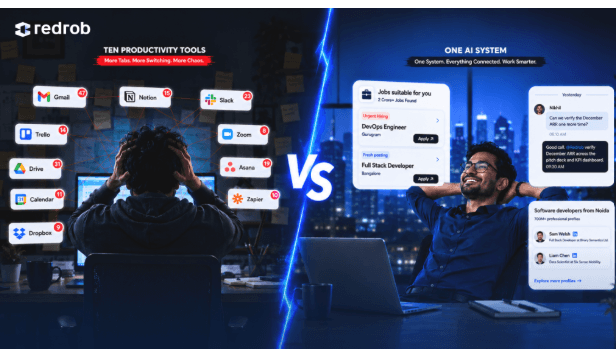
Why Businesses Are Replacing AI Tools with AI Platforms
When AI first entered the workplace, companies adopted individual tools for specific tasks.
One application helped write content.Another summarized meetings.A third generated reports.
Soon, teams found themselves managing multiple subscriptions, switching between applications, and duplicating work across disconnected systems.
This growing collection of AI tools solved individual problems—but created a new one: complexity.
Today, organizations are moving toward unified Enterprise AI platforms that bring everything together in one ecosystem.
Instead of juggling several vendors, businesses now prefer platforms that combine multiple capabilities under a single interface.
A modern AI platform often includes:
Multiple AI models for different use cases
Workflow automation
Team collaboration features
Enterprise security and governance
Analytics dashboards
API integrations
Centralized user and permission management
This shift reduces operational overhead, improves collaboration, and creates a consistent AI experience across departments.
As AI adoption grows, companies aren't looking for more tools.
They're looking for fewer tools that do more.
Still Switching Between Multiple AI Tools?
Bring your AI workflows together in one platform.
How Successful Enterprises Scale AI
One of the biggest misconceptions about AI adoption is that businesses need to transform everything overnight.
In reality, the most successful Enterprise AI strategies begin small and scale gradually.
Instead of deploying AI across every department at once, organizations typically follow a structured approach.
1. Identify High-Impact Opportunities
Businesses first identify repetitive, time-consuming processes where AI can deliver immediate value.
Examples include:
Customer support
Recruitment
Internal knowledge management
Sales operations
Report generation
These quick wins build confidence and demonstrate measurable business impact.
2. Integrate AI into Existing Workflows
Rather than replacing existing software, successful organizations embed AI into the tools employees already use.
This minimizes disruption while encouraging faster adoption.
3. Start with Small Pilot Programs
Launching AI with a focused team allows organizations to gather feedback, measure results, and refine workflows before expanding across departments.
4. Scale with Governance
Once AI proves its value, businesses expand adoption while maintaining security, compliance, and standardized governance policies.
This phased approach reduces implementation risk and improves long-term success.
The goal isn't simply to deploy AI.
It's to make AI a trusted part of everyday work.
Why India Is Becoming One of the World's Fastest-Growing AI Markets
Nowhere is the shift toward accessible AI more evident than in India.
Businesses across industries are embracing AI to improve productivity, automate workflows, and accelerate digital transformation. From startups to large enterprises, organizations are investing in scalable AI solutions that are affordable, secure, and easy to implement.
India's growing AI ecosystem is being driven by several factors:
Rapid digital transformation across industries
Expanding cloud infrastructure
Strong startup innovation
Government initiatives supporting AI adoption
Increasing demand for multilingual AI experiences
As AI adoption accelerates, businesses are becoming less concerned about owning the most advanced model and more focused on deploying AI that employees can use effectively from day one.
The next wave of innovation in India won't be defined by who builds the smartest AI.
It will be defined by who makes AI accessible to millions of professionals and businesses.
What Happens When AI Becomes Accessible to Everyone?
Turn AI adoption into a real business advantage.
How Redrob AI Simplifies AI Adoption
For many organizations, the biggest challenge isn't recognizing AI's potential it's putting that potential into practice.
Redrob AI addresses this challenge by making AI simple, practical, and accessible for everyday business operations.
Rather than asking companies to manage multiple disconnected tools or build complex AI systems from scratch, Redrob AI brings intelligent workflows together in one platform.
Businesses can streamline hiring, discover talent faster, generate workforce insights, and improve decision-making through AI-powered recruitment and productivity solutions all without the complexity of managing a fragmented AI ecosystem.
This reflects one of the biggest lessons from the modern AI economy:
The companies creating the greatest impact aren't necessarily building the biggest models.
They're building the easiest path to AI adoption.
As AI continues to evolve, organizations that prioritize accessibility, seamless integration, and user experience will be better positioned to unlock long-term business value.
Final Thoughts: The Future Belongs to the Most Accessible AI
The AI industry has spent years competing to build smarter models.
The next decade will be defined by something different.
Who can make AI available to the most people?
As foundational models become increasingly powerful and widely available, technical superiority alone will no longer guarantee market leadership. Businesses will compete on how easily AI fits into existing workflows, how quickly employees adopt it, and how effectively it solves real-world problems.
This shift marks the beginning of a new AI economy - one where AI access, AI distribution, and seamless AI deployment become the true drivers of competitive advantage.
Organizations that invest in accessible Enterprise AI platforms, modern AI infrastructure, and user-first experiences won't just deploy AI faster—they'll unlock higher adoption, stronger productivity, and greater long-term returns.
Ultimately, success won't belong to the companies building the biggest AI models.
It will belong to those making AI simple enough for everyone to use.
Frequently Asked Questions (FAQs)
1. Why is AI access becoming more important than building better AI models?
As AI models become increasingly similar in capability, the real differentiator is how easily people can use them. Businesses that simplify AI adoption achieve faster implementation, higher usage, and better ROI.
2. What does AI distribution mean?
AI distribution is the process of delivering AI through the tools and workflows people already use. This makes AI easier to adopt without disrupting existing business operations.
3. Why are businesses choosing AI platforms over standalone AI tools?
AI platforms bring multiple capabilities into one place, reducing tool sprawl, improving collaboration, and simplifying management. This creates a more efficient and scalable AI experience.
4. How can organizations successfully deploy AI?
Start with high-impact use cases, integrate AI into existing workflows, train employees, and continuously measure results. A phased approach leads to better adoption and long-term success.
5. What makes Redrob AI different from other AI platforms?
Redrob AI combines AI-powered hiring, workforce intelligence, productivity, and business workflows into one platform. Instead of managing multiple AI tools, organizations can simplify adoption with a single, scalable solution.

One AI platform powering job search, work, discovery, and productivity.
Latest AI Blogs.
Jun 23, 2026
The Economics of AI Access: Why Distribution Matters More Than Models
Garima

Jun 23, 2026
Will AI Replace Humans? The Future of Work in the AI Era
Garima

Jun 23, 2026
Why AI Search Will Replace Traditional Search Workflows
Garima

Jun 23, 2026
Top Indian AI Tools in 2026: Global Impact & Real-World Use Cases
Bhushan

Jun 23, 2026
Why Global AI Models Struggle With Indian Context
Garima
Jun 23, 2026
One AI System vs Ten Productivity Tools
Bhushan