Go back
Why Korea's Biggest VCs Are All-In on India's AI Future - Through Redrob
Authors:
Bhushan
Date:

Four of Korea's most powerful institutional investors are backing a thesis that challenges the prevailing AI playbook: the best model doesn't win. The best distribution into the world's largest underserved market does.
NEW YORK - April 14, 2026
—————————————————————————————————————
Redrob (redrob.io), the AI research company building proprietary large language models for emerging markets, has secured backing from four of South Korea's most prestigious institutional investors - Korea Investment Partners (KIP), KB Investment (KBIC), Kiwoom Investment, and KDB Capital - as part of its Series A funding round. Together, these firms manage over $7 billion in assets and have backed category-defining companies from Kakao to Didi Chuxing. Their convergence on a single India-focused AI company is unprecedented.
The bet is deliberately contrarian. Most AI capital today chases the frontier model arms race - bigger parameters, higher benchmarks, faster reasoning. These Korean institutions are backing a different thesis entirely: the most valuable AI company of the next decade will not be the one with the smartest model. It will be the one with the most users. And the most users are in India.
The logic is ruthless. Every lab on earth is driving inference costs toward zero. Cheap LLMs are a commodity, not a moat. What separates winners from the rest is the distribution wedge - a product with enough gravitational pull to acquire hundreds of millions of users before the cost advantage disappears. Redrob's wedge is India's most urgent structural crisis: 367 million young people who need quality jobs, 40% of graduates who are unemployed, and an economy producing 5 million new degree-holders per year but only 2.8 million jobs for them. Few global AI companies are building for this market because the unit economics don't work with external APIs. Redrob's ensemble LLM makes it the only player for whom they do.
The Capital Behind the Conviction
These are not speculative angels writing small checks. The Redrob syndicate represents the deep institutional infrastructure of Korean finance - four entities that collectively manage over $7 billion in assets, have backed companies from Kakao and Naver to Didi Chuxing and Swiggy, and maintain offices from Seoul to Silicon Valley. Their simultaneous convergence on a single India-focused AI company is without precedent.
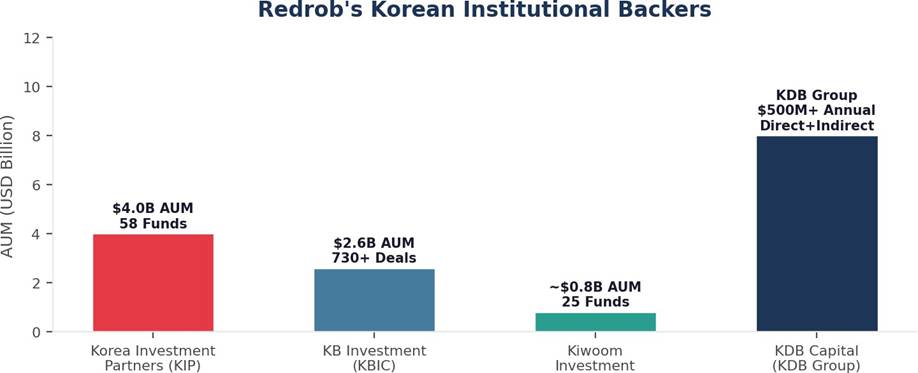
Korea Investment Partners (KIP) - $4 Billion AUM, 37 Years of Venture Investing
KIP is a subsidiary of Korea Investment Holdings, one of Korea's largest private financial groups. With58 active funds and a track record spanning over 1,100 investments since 1986, KIP has backed defining companies including Kakao, Naver, YG Entertainment, and Didi Chuxing. It has liquidated 18 funds with an average multiple of 2.0x and IRR of 16.7%. Operating from Seoul, Shanghai, Beijing, Singapore, and Sunnyvale, KIP invested approximately $500 million into startups in 2021 alone - roughly 10% of all venture capital deployed in Korea that year. Its backing of Redrob signals KIP's expanding cross-border thesis into India's AI economy.
KB Investment (KBIC) - $2.6 Billion AUM, Korea's Premier Financial Group
KBIC is the venture capital arm of KB Financial Group, Korea's largest financial group by domestic customer base. Founded in 1990 (formerly Kookmin Venture Capital), KBIC has executed over 730 investments across consumer products, healthcare, IT, life sciences, and clean tech - spanning the US, Southeast Asia, and Israel. KBIC provides post-investment management services including HR, strategy, legal, and governance - the kind of operational support typically associated with top-tier Silicon Valley firms. Its inclusion in the Redrob syndicate reflects KB Financial Group's strategic conviction that proprietary AI infrastructure, rather than API dependency, will define the next decade of enterprise technology.
Kiwoom Investment - 25+ Years, $700M+ Deployed, Global Expansion
Founded in 1999 as a subsidiary of Kiwoom Securities Group, Kiwoom Investment has invested over
$700 million across 500+ companies. Originally specializing in IT and semiconductors, it has expanded into energy, biotech, healthcare, advanced materials, and AI. With 25 active funds and recent offshore fund formations in Japan and Singapore, Kiwoom is rapidly globalizing. Its AUM is approaching $750 million, with over $480 million in blind funds raised in just the last five years. Kiwoom's participation in Redrob's round represents its growing thesis on cross-border AI ventures that bridge Korean capital with Indian scale.
KDB Capital - Korea Development Bank's Innovation Arm
KDB Capital is the venture and private equity subsidiary of the Korea Development Bank, a state-owned institution founded in 1954 that has financed Korea's industrial transformation from post-war reconstruction to semiconductor global leadership. KDB made over $500 million in direct and indirect investments in 2020 alone, and established KDB Silicon Valley in 2021 with $100 million in dedicated cross-border venture capital. As the 61st largest bank globally, KDB's involvement signals sovereign-level institutional confidence in Redrob's model - the kind of backing typically reserved for national strategic industries.
Six Things the AI Industry Gets Wrong About India
The conventional wisdom in AI venture capital goes like this: build the best model, win the richest customers, expand from there. Every assumption in that sentence is wrong when applied to India. Here are six insights that most professional tech investors miss - and that explain why Korean institutional capital is moving first.
1. Jevons Paradox: Cheaper AI Is Making AI More Expensive, Not Less
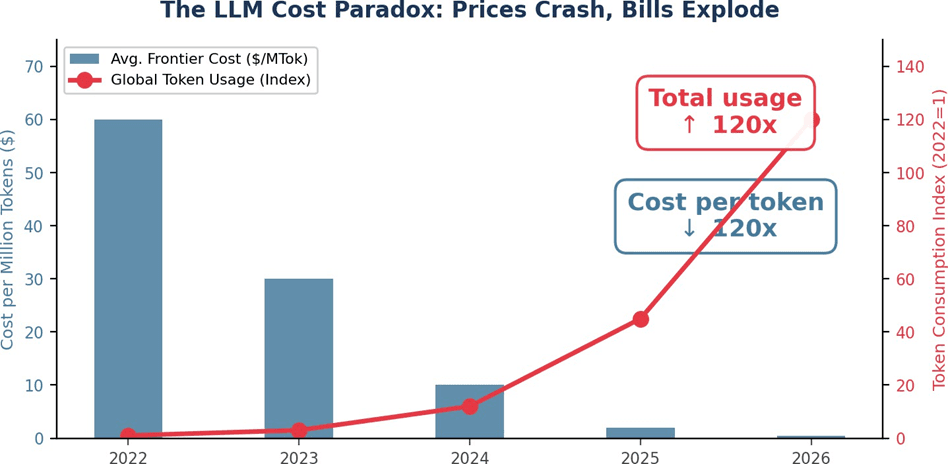
Here is a fact that should trouble every AI investor: per-token LLM pricing has collapsed 120x since 2022, yet total enterprise AI spending has risen 320% in the same period. OpenAI generated $3.7 billion in revenue in 2025 and lost $5 billion. It spends $1.35 for every dollar it earns. The more people use AI, the faster the company that provides it goes broke.
This is Jevons Paradox - the 160-year-old economic law the AI industry keeps rediscovering. In 1865, William Stanley Jevons observed that more efficient steam engines did not reduce coal consumption; they increased it, because cheaper energy unlocked entirely new categories of demand. After DeepSeek's breakthrough, Microsoft CEO Satya Nadella posted: "Jevons paradox strikes again!" He was right. Agentic workflows now trigger 10-20 LLM calls per user task. RAG inflates context windows 3-5x. Always-on agents consume compute 24/7. Efficiency does not reduce AI costs. It detonates them.
For India, this is the kill shot against API-dependent competitors. The average Indian GenAI ARPU is $0.27/month. External API costs run $3.50-$4.50/user/month - a 13x deficit. As Jevons Paradox drives per-user token consumption relentlessly higher, that deficit widens every quarter. Redrob's ensemble LLM (Redrob 2B, Llama 8B/70B/405B, Llama 4 Maverick) on AWS Bedrock eliminates the API tax entirely. Jevons works in Redrob's favor: the more users consume, the more its fixed-cost infrastructure advantage compounds.
2. LLM Cost Reduction Rates Are Wildly Unequal - And This Matters
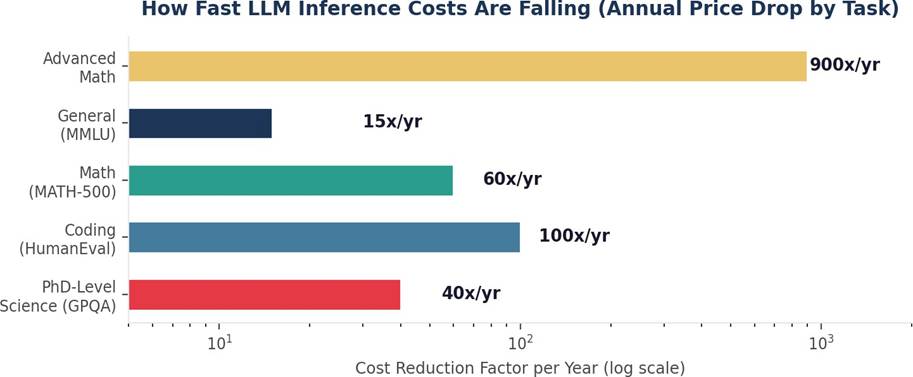
According to Epoch AI's landmark 2025 analysis, the rate at which LLM inference costs fall varies dramatically by task - from 9x to 900x per year. For PhD-level science questions, costs fall at ~40x/year. For advanced math, the drop has been as steep as 900x in recent years. This unevenness means that companies building products for emerging markets can't simply "wait for costs to come down" - they must architect their model stack to optimize for the specific tasks their users need (recruiting, sales prospecting, skill assessment) rather than relying on general-purpose frontier models that optimize for benchmarks irrelevant to their user base.
3. India Has More Offline People Than Most Countries Have People
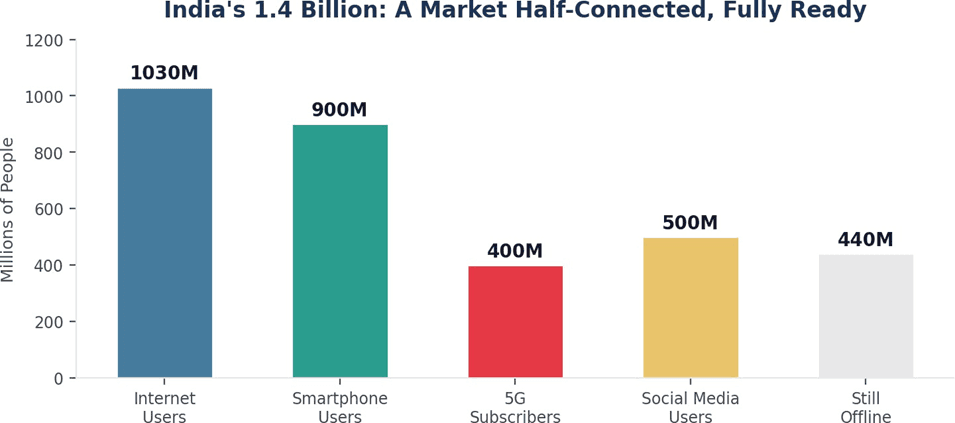
India's 1.03 billion internet users make it the world's second-largest digital market. But the 440 million Indians still offline represent a larger population than the entire United States. With 400 million 5G subscribers already active and internet penetration at 70% (up from 55% just one year prior), India is not a "future" AI market - it is an AI market in the middle of the fastest digital expansion in human history. The average Indian now consumes over 36GB of mobile data per month. India is the world's second-largest adopter of generative AI globally, leading in content editing and holding 12% of the global market for AI-powered content tools.
4. The Distribution Wedge: 367 Million Young Indians Need Jobs, Not Chatbots
Most AI investment today targets knowledge workers earning six figures. The largest AI market on earth is 367 million Indians aged 15-29 who cannot find work. This is not a niche. It is a third of India's working-age population. Every year, 12 million young people enter the labor force and 5 million new graduates join the job market. Only 2.8 million find employment. The State of Working India 2026 report found that 40% of graduates under age 25 are unemployed - and that the graduate unemployment rate of 29.1% is five times higher than for those with only school-level education. India does not have an education problem. It has a matching problem.
Here is the paradox that makes this an AI opportunity, not just a policy crisis: companies are desperate for talent. But only 54.8% of Indian graduates are considered employable by industry standards. Over 80% of Indian jobs are informal - low wages, no security, no career path. The gap between what graduates can do and what employers need is the single largest source of AI demand in the world. Redrob's platform sits directly on top of this gap: AI skill assessment that measures actual capability (not credentials), AI candidate matching that connects employers to verified talent, and AI sales intelligence that helps Indian companies grow the revenue to create those jobs in the first place.
This is what a distribution wedge looks like. Cheap LLMs are a commodity - every lab is racing costs to zero. But a platform magnetically attached to the most painful structural problem in the world's largest young workforce creates a user acquisition flywheel that no pure-play LLM company can replicate. Redrob does not need to convince Indians to adopt AI. Indians need jobs. Redrob is the fastest path from diploma to paycheck.
5. Platform Beats Product: The "Android of LLMs" Architecture
Most AI companies today are building products. Redrob is building a platform. Its 5-Model Ensemble - Redrob 2B (lightweight, on-device), Llama 8B, 70B, 405B, and Llama 4 Maverick - creates a tiered intelligence stack that routes each query to the cheapest model capable of handling it. A contact lookup hits the 2B. A multilingual reasoning task escalates to 405B. OpenAI is now attempting this with GPT-5's automatic model switcher. Redrob has been doing it in production, at India price points, for paying customers.
The strategic parallel is Android. Google did not build the best phone. It built an open, scalable ecosystem that let manufacturers compete on price while the platform captured value. Smartphones went from luxury items to ubiquitous tools for 5 billion people. Redrob's LLM platform does the same for intelligence: 1M-token context windows, native Indic language support, deep research synthesis, real-time web retrieval - all without frontier API costs. The model race ends in a commodity. The platform race has barely started.
6. The 13x Gap Is Not a Pricing Problem. It Is a Physics Problem.
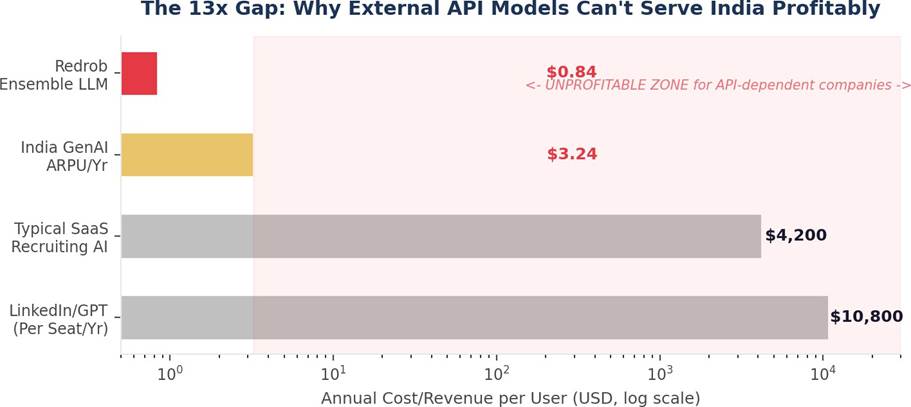
LinkedIn's AI recruiting features cost $10,800 per seat per year. Most SaaS recruiting AI competitors face structurally similar economics. India's average GenAI ARPU is $0.27/month -
$3.24/year. The API costs alone ($3.50-$4.50/user/month) to serve a single Indian user exceed what that user will ever pay by 13x. This gap does not close with scale. It widens with Jevons Paradox. The more useful the AI, the more tokens it burns, the faster the API-dependent company bleeds.
No amount of fundraising, pricing optimization, or market timing fixes this. If your inference stack is rented, India is structurally unprofitable at any scale. Redrob's ensemble LLM reduces per-user inference costs to a fraction of a dollar annually - making it the only architecture that can profitably serve AI-powered recruiting, sales intelligence, and skill assessment to 1.4 billion people. The question is not whether India needs AI. It is whether anyone other than Redrob can afford to give it to them.
The Numbers Behind the Conviction
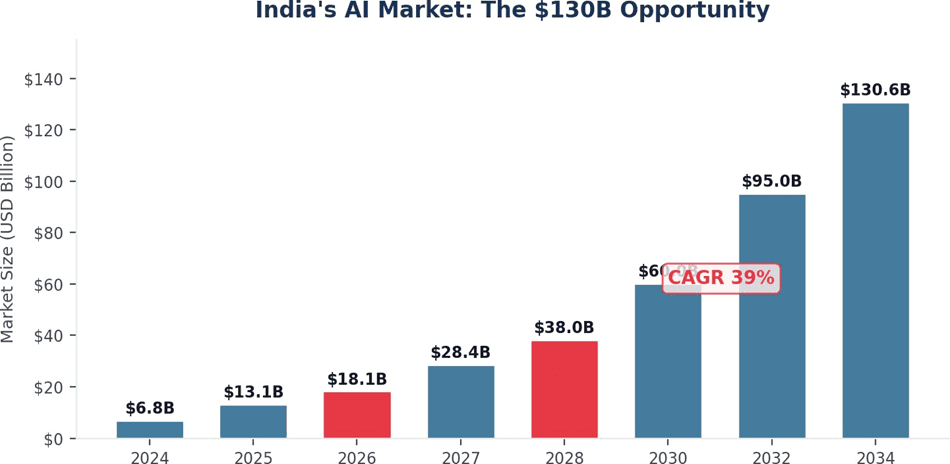
India's AI market is projected to grow from $13 billion in 2025 to $131 billion by 2032 at a CAGR of 39%. The country has 600,000 AI professionals (16% of the global talent pool, second only to the US), 1.03 billion internet users, 400 million 5G subscribers, and scalable public digital infrastructure (Aadhaar, UPI, DigiLocker) that no other emerging market can replicate. BCG projects the market will triple to $17 billion by 2027 alone.
But here is the number that matters most: Gartner predicts that by 2030, inference on a trillion-parameter LLM will cost 90%+ less than today. That cost reduction benefits companies that own their inference stack. For companies renting it, margins compress to zero. The window to build proprietary infrastructure at scale - before commodity pricing makes it irrelevant - is measured in quarters, not decades. Redrob is already through it.
Why Korea, Why Now
This investment does not exist in a vacuum. Korea is systematically repositioning itself as the bridge between Asian capital and Indian scale. In February 2025, India and Korea jointly announced AI infrastructure commitments - India deploying 18,000 high-end GPUs, Korea outlining a national LLM development project. Krafton, Naver, and Mirae Asset launched a $669 million India-focused fund. Korean and Japanese companies increasingly view India as the China+1 innovation hub.
Korea's 2026 venture reform - the most extensive in its history - explicitly targets cross-border AI and deep-tech investments. New venture investment hit $10.2 billion in 2025, up 14%, with private LPs providing over 80% of commitments. Korea is not making a speculative bet on India. It is executing a national strategy to become Asia's premier venture capital exporter. Redrob is the tip of that spear.
About Redrob
Redrob
(redrob.io) is an AI research company building proprietary large language models and AI-powered applications for emerging markets. Headquartered in New York, Redrob operates globally with teams across the United States, South Korea, and India.
Redrob LLM
A proprietary 5-Model Ensemble (Redrob 2B, Llama 8B/70B/405B, Llama 4 Maverick) on AWS Bedrock. On-device AI for any smartphone, 1M-token context, multilingual Indic language support, deep research, and real-time web retrieval. The Android of LLMs.
Redrob HR -
AI hiring intelligence that reduces recruitment time by 92% and cost by 88%. Adaptive skill assessments, AI-proctored interviews, resume parsing, candidate matching, and an integrated ATS across India's talent pool.
Redrob Sales -
AI outbound intelligence across 700M+ global contacts from 19+ verified sources. Lead generation, enrichment, and campaign execution in one platform. Used by 5,000+ companies.
The company has raised $14 million cumulatively from institutional investors including Korea Investment Partners, KB Investment, Kiwoom Investment, KDB Capital, DS&Partners, Murex Partners, Daekyo Investment, and Wanted Lab. Redrob was founded in 2018 and was bootstrapped for six years before accepting venture capital.
Redrob Inc.
1 Penn Plaza, Suite 1423, New York, NY 10019
+1-646-956-5196
redrob.io
© 2026 Redrob Inc. All rights reserved. Redrob is a registered trademark of Redrob Inc.