Go back
Redrob Launches Passport: AI That Translates the World's Credentials for Global Hiring
Authors:
Felix and Redrob Research Center
Date:
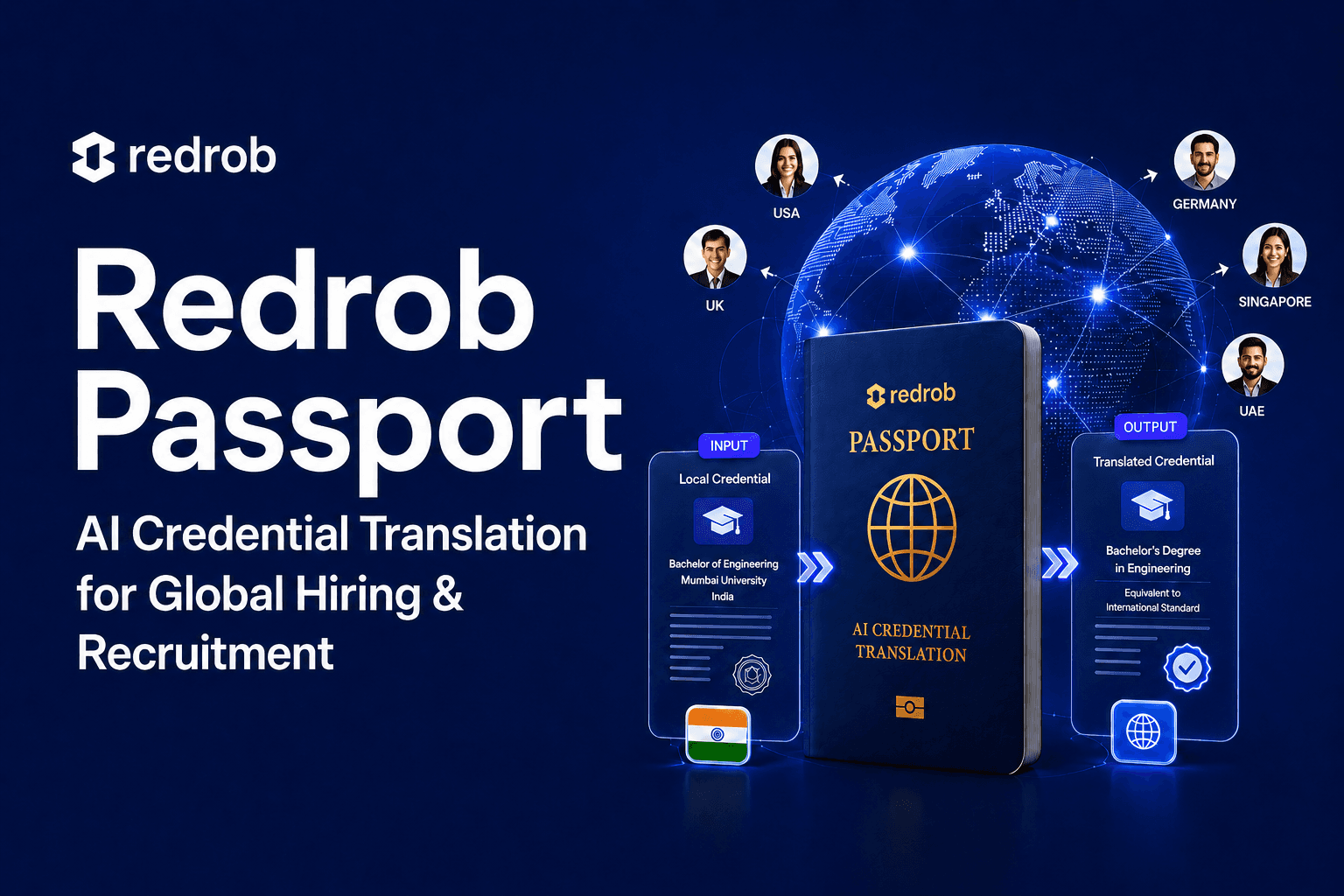
An IIT Bombay graduate is harder to admit than a Harvard student. A Naver engineer has built products for 40 million users. A Flipkart PM has scaled logistics across 19,000 pin codes. None of this registers on a US hiring manager's screen. Redrob Passport fixes that.
NEW YORK - April 14, 2026
—————————————————————————————————————-
Redrob (redrob.io) today announced the launch of Redrob Passport, an AI-powered credential translation layer built on the Redrob LLM ecosystem. Passport instantly converts education and work experience from any country into globally comparable context - transforming a resume from IIT Delhi, Seoul National University, or the University of Sao Paulo into a format a hiring manager in New York, Berlin, or Tokyo can immediately understand and trust.

IIT Bombay admits 0.7% of applicants - roughly five times more selective than Harvard's 3.6% and nine times more selective than Cambridge's 11%. Over 1.8 million students sit for JEE Advanced, one of the world's most demanding entrance examinations, competing for 17,000 seats. Admission is purely meritocratic: no legacy preferences, no athletic recruitment, no donation influences. Yet the average American recruiter has never heard of IIT. The same resume that would trigger an automatic interview if it said "MIT" gets filtered out because the applicant tracking system doesn't recognize "IIT Bombay" as a tier-one institution.
The problem is symmetric across borders. Seoul National University - the Harvard of South Korea, QS-ranked #29 globally - is invisible to most US hiring managers. KAIST, ranked #53 and now launching a standalone AI college, draws blank stares in interviews. Naver, Korea's dominant search and AI platform serving 40+ million users, means nothing to a recruiter who would instantly recognize a Google or Meta engineer. Toss, Korea's largest fintech super-app with 23M+ users, is invisible to a London recruiter who would fast-track a Stripe or Revolut alumnus.
The Gap Is Global, Symmetric, and Getting Worse

This is not a niche problem affecting a handful of institutions. It is a structural failure spanning 190+ countries. IIT Bombay, Seoul National University, Tsinghua, KAIST, the Technion, India's 31 NITs - all carry near-perfect prestige domestically and near-zero recognition in US hiring pipelines. The average gap between local prestige and global recruiter recognition exceeds 70 points on a 100-point scale. For the NIT system - 31 Indian engineering schools that collectively produce some of the country's strongest technical talent - US recognition is effectively zero.
But the university gap is only half the story. Companies are even more invisible.

Universities at least have global rankings, however imperfect. Companies have nothing. Flipkart is India's Amazon - $23 billion valuation, 400M+ customers, fulfillment across 19,000+ pin codes. Razorpay is India's leading payment infrastructure, processing $150B+ annually. Naver operates Korea's dominant search, maps, shopping, and AI platforms. Toss is Korea's largest fintech app, valued at $7B+. A hiring manager in San Francisco cannot translate "3 years at Naver" or "product lead at Flipkart" into anything meaningful. The result: identical talent, filtered by geography of origin rather than quality of work.
Why Now: Cross-Border Hiring Has Outgrown Its Infrastructure

This would matter less if hiring were still local. It is not. According to Remote's 2025 Global Workforce Report (n=3,650 business leaders), 73% of HR leaders expect the majority of new hires to come from outside their home country by 2026. LinkedIn recorded a 44% increase in international remote job postings. Deel found that AI trainer roles alone grew 283% cross-border in 2025. International hiring is no longer a strategy. It is the default.
And yet, 74% of employers globally report they cannot find the skilled talent they need (ManpowerGroup 2025). At the same time, 40% of Indian graduates under 25 are unemployed. Korea's youth unemployment sits at 7.3%. Five million Indian graduates enter the workforce every year, but only 2.8 million find jobs. The world does not have a talent shortage. It has a translation shortage - qualified people exist in abundance, but the systems that connect them to employers cannot read their credentials.
Three Broken Systems That Keep Global Talent Invisible
The ATS Black Hole.
Applicant tracking systems reject an estimated 75% of resumes before any human review. These systems are trained on Western institutional names, Western employer brands, and Western credential formats. A candidate from NIT Trichy - one of India's top 31 engineering schools - is algorithmically equivalent to an unknown community college. A product lead from Grab (Southeast Asia's $40B super-app) is invisible next to a junior PM from a recognizable US startup. The bias is not intentional. It is architectural, baked into the training data.

Legacy Credential Evaluation.
The traditional alternative - manual foreign credential evaluation - costs $150+ per assessment, takes 15-30 business days, and produces a static PDF that states the "US equivalent" of a degree but nothing about the institution's selectivity, the local job market signal, or the candidate's competitive context. It was designed for immigration paperwork, not real-time hiring decisions. AI has never touched this process.
Self-Reported Profiles.
LinkedIn profiles are unverified, carry no institutional translation, and provide no comparative context. A profile listing "Seoul National University" tells an American recruiter nothing about whether that school is the local equivalent of a community college or the country's most elite institution. There is no signal, only noise.
These are not minor inefficiencies. They are the infrastructure of global hiring - and all three are fundamentally broken. Redrob Passport replaces them with a single AI-powered layer that works in real time, at scale, across borders.
How Redrob Passport Works
Passport runs on the Redrob LLM ecosystem - a proprietary 5-Model Ensemble (Redrob 2B, Llama 8B/70B/405B, Llama 4 Maverick) on AWS Bedrock. It performs three functions that, together, replace the entire legacy credential evaluation pipeline:
1. Institutional Translation.
Passport maps 50,000+ universities across 190+ countries into a unified credential graph. Each institution is contextualized with selectivity data, local prestige signals, notable alumni, and comparative equivalencies. An IIT Bombay CS degree is not translated as "equivalent to a US bachelor's in CS." It is translated as "top 0.7% admission, meritocratic selection only, comparable in selectivity to MIT/Caltech, alumni at Google/Microsoft/Goldman Sachs." A Seoul National University MBA becomes "Korea's #1 institution (QS #29 globally), alumni include majority of Korea's Fortune 500 CEOs."
2. Employer Context Mapping.
Passport maps 500,000+ employers across borders. "Senior Engineer at Naver" becomes "Senior Engineer at Korea's dominant search/AI platform (40M+ users, $15B+ market cap, comparable to Google in the Korean market)." "Product Manager at Flipkart" becomes "PM at India's largest e-commerce platform ($23B valuation, 400M+ customers, comparable to Amazon in the Indian market)." "Backend Engineer at Toss" becomes "Engineer at Korea's #1 fintech super-app (23M+ users, $7B+ valuation, comparable to Stripe/Cash App)."
3. Skills Verification.
Powered by Redrob HR's adaptive assessment engine, Passport optionally attaches verified, AI-proctored skill scores to translated credentials. This bridges the gap between credential claims and demonstrated capability - especially critical in markets where only 54.8% of graduates meet industry employability standards. The result: not just "what school did they attend" but "what can they actually do."
Redrob Passport is available immediately to enterprise customers and will be integrated into the Redrob HR and Redrob Sales platforms. For candidates, Passport credentials are free to generate and share.
About Redrob
Redrob (redrob.io) is an AI research company building proprietary large language models and AI-powered applications for emerging markets. Headquartered in New York, Redrob operates globally with teams across the United States, South Korea, and India.
Redrob LLM -
Proprietary 5-Model Ensemble (Redrob 2B, Llama 8B/70B/405B, Llama 4 Maverick) on AWS Bedrock. On-device AI, 1M-token context, multilingual Indic language support, deep research, and real-time web retrieval. The Android of LLMs.
Redrob HR -
AI hiring intelligence reducing recruitment time by 92% and cost by 88%. Adaptive skill assessments, AI-proctored interviews, candidate matching, and integrated ATS.
Redrob Sales -
AI outbound intelligence across 700M+ global contacts from 19+ verified sources. Lead generation, enrichment, and campaign execution. Used by 5,000+ companies.
Redrob Passport -
AI-powered credential translation that converts education and work experience from any country into globally comparable context, instantly.
The company has raised $14 million cumulatively from institutional investors including Korea Investment Partners, KB Investment, Kiwoom Investment, KDB Capital, DS&Partners, Murex Partners, Daekyo Investment, and Wanted Lab. Founded in 2018, bootstrapped for six years before accepting venture capital. 3M+ users across 500+ universities in India.
—————————————————————————————————————-
Redrob Inc.
1 Penn Plaza, Suite 1423, New York, NY 10019
+1-646-956-5196 | redrob.io
# # #
© 2026 Redrob Inc. All rights reserved.