
Felix
Why a 0.5% acceptance rate and 30 million users mean nothing to an ATS – and how AI-powered credential standardisation unlocks $40 billion in trapped human capital.
Here is a fact that should unsettle anyone who believes global hiring is meritocratic: IIT Bombay admits roughly 0.5% of applicants. That makes it approximately seven times harder to enter than Harvard (3.5%) and nine times harder than MIT (4.5%). Seoul National University, ranked #31 globally by QS, admits only 10-15% for engineering – yet a recruiter in San Francisco or London is unlikely to recognize either institution’s name. Toss, Korea’s $7 billion fintech super-app used by 60% of the country’s population, is invisible on a resume screened in New York. According to Harvard Business School, 88% of employers admit their own hiring systems filter out qualified candidates who don’t match preset criteria.
This is not a minor inefficiency. It is a structural failure in how the global economy allocates human capital - a failure that costs the United States alone nearly $40 billion in forgone wages every year, depresses tax revenues by $10 billion, and condemns approximately 2 million college-educated immigrants to jobs far below their skill level. Multiply this across the OECD, where one-third of tertiary-educated immigrants are overqualified for their work, and you begin to see the scale of what researchers call “brain waste.”
The counterintuitive truth is this: the global hiring system does not have a
talent shortage. It has a recognition shortage. This gap extends beyond degrees: an engineer who built payment infrastructure for 30 million users at Toss in Seoul, or scaled e-commerce for 400 million users at Flipkart in Bangalore, carries experience that is effectively invisible to Western hiring systems. Solving this requires an AI layer that can read credentials and experience from any country, in any language, and translate them into a universal, skills-verified signal.
1. The Selectivity Paradox: Harder to Enter, Easier to Ignore
Every year, more than one million students sit for India’s JEE Advanced exam. Fewer than 17,000 secure admission to the Indian Institutes of Technology. At the top programmes – IIT Bombay Computer Science, IIT Delhi Electrical Engineering – acceptance rates dip below 0.5%. By comparison, Harvard accepted 3.5% of applicants in its most recent cycle; Stanford, 3.9%; MIT, approximately 4.5%.
In South Korea, the picture is similarly stark. Seoul National University’s engineering programs accept 10-15% of applicants, with KAIST and POSTECH operating at comparable selectivity. SNU is ranked #31 globally by QS and #62 by Times Higher Education. Yet in employer recognition surveys conducted outside East Asia, SNU trails far behind institutions with objectively less competitive admissions.
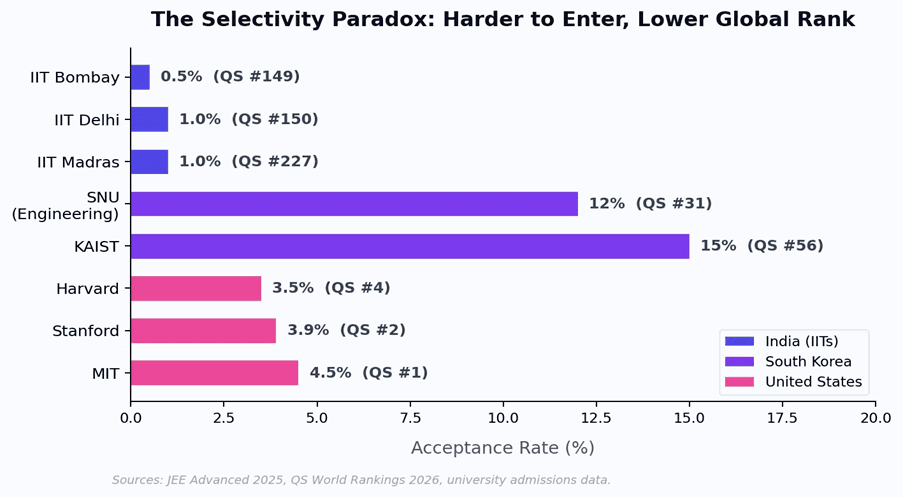
Figure 1: Acceptance rates vs. QS global rankings reveal an inverse relationship between selectivity and global name recognition for non-Western institutions.
The National Institutes of Technology (NITs) present an even more striking case. India’s 31 NITs collectively accept only the top 2-5% of JEE Main candidates - over 1 million students compete annually - yet not a single NIT appears in the QS World Top 500. A Computer Science graduate from NIT Trichy (the highest-ranked NIT, NIRF #9 in India) likely outperformed 98% of all engineering aspirants in a country of 1.4 billion people. A hiring manager in New York has almost certainly never heard of the institution.
“The global credential system was not designed for meritocracy. It was designed for familiarity.”
2. The Experience Paradox: When Your Employer Is Invisible Too
The credential gap extends far beyond universities. Work experience at the most competitive, technically demanding companies in Asia carries almost zero signal in Western hiring pipelines - even when those companies operate at a scale that dwarfs their Western counterparts.
Consider Toss.
The South Korean fintech super-app serves roughly 30 million registered users - approximately 60% of the entire South Korean population. In 2024, Toss reported $1.4 billion in consolidated revenue, a 43% year-over-year increase. It operates Toss Bank, Toss Securities, and Toss Payments under a single platform, and is targeting a U.S. IPO in 2026 at a valuation exceeding
$10 billion. A senior engineer at Toss has built payment infrastructure that processes transactions for more than half a nation’s population. Yet on a resume reviewed by a recruiter in New York, “Toss” registers as nothing. Stripe, which serves roughly 4.7 million businesses globally, is instantly recognized.
The pattern repeats across Asia’s tech landscape.
Naver commands approximately 70% of South Korea’s search market - it is Korea’s Google, with a $24 billion market cap and deep investments in AI, cloud, and robotics through Naver Labs. Kakao is the operating system of Korean daily life: messaging (KakaoTalk, used by 93% of the population), payments, mobility, entertainment, and banking under a single ecosystem. Engineers at these companies solve problems at a scale and complexity that rivals anything at FAANG. But a recruiter in London or Berlin will almost certainly scroll past both names.
India presents the same paradox at even larger scale.
Flipkart, India’s largest e-commerce platform (valued at $38 billion, owned by Walmart), operates infrastructure serving over 400 million registered users. Its engineering challenges - real-time inventory across a subcontinent, fraud detection at massive scale, payment processing in a market with dozens of competing systems - are among the most complex in global e-commerce. Razorpay, valued at $7.5 billion, powers payments for over 300 million end consumers and is the backbone of Indian digital commerce. An SDE-2 at either company has survived a multi-round interview process that routinely rejects 95%+ of applicants, many of whom already hold IIT or NIT degrees.
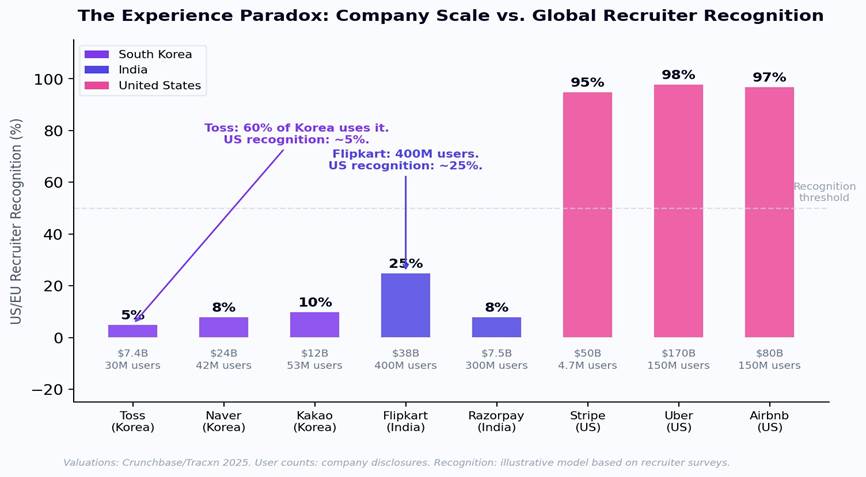
Figure 2: Company scale (users, valuation) vs. recruiter recognition in US/EU markets. Asian tech giants operating at massive scale remain largely invisible to Western hiring systems.
The implications are profound. A software engineer who spent five years at Toss building payment systems for 30 million users, then moves to the United States, will have their experience discounted or ignored entirely. They will be asked to “prove” skills that they have already demonstrated at a scale most American startups will never reach. Meanwhile, a two-year stint at a Series A startup in San Francisco - with 50,000 users and uncertain revenue - carries immediate credential weight.
“The resume does not have a field for the complexity of the problems you solved. Only the name of the company where you solved them.”
This is not merely a branding problem. It is a structural information asymmetry baked into every layer of the hiring stack: ATS systems that cannot contextualize foreign employers, recruiters who lack the time or incentive to research unfamiliar companies, and hiring managers who default to pattern-matching against the small set of names they already know. The result is a global labor market that systematically undervalues experience gained at some of the world’s most technically demanding companies - simply because those companies are headquartered in Seoul, Bangalore, or Jakarta rather than San Francisco.
3. The $40 Billion Problem: Brain Waste at Scale
When credentials are invisible, talent gets misallocated. The Migration Policy Institute estimates that approximately 2 million college-educated immigrants in the United States - roughly one in four - are either unemployed or working in jobs far below their education level. This underemployment costs
$39.4 billion annually in lost wages and $10.2 billion in uncollected taxes at federal, state, and local levels.
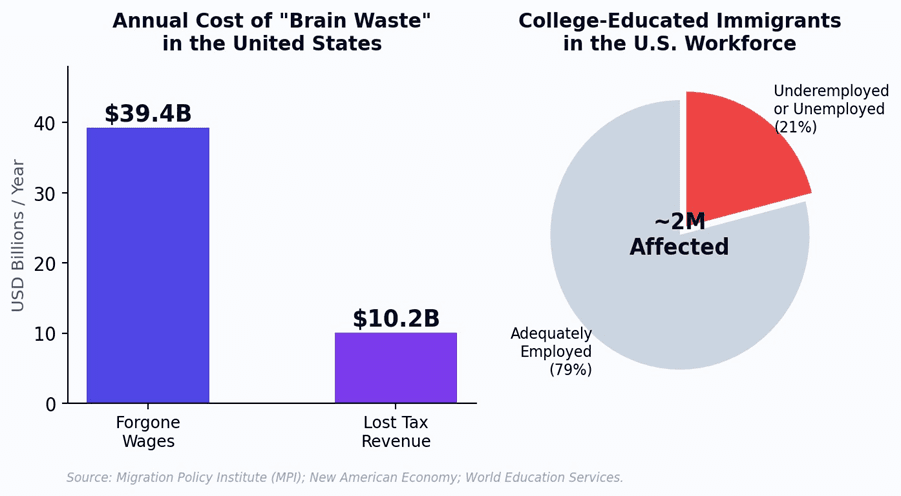
Figure 3: The annual economic cost of "brain waste" in the United States alone, alongside the share of college-educated immigrants affected.
The problem extends far beyond America. Across the OECD, the International Migration Outlook 2025 reports that immigrants entering the labor market earn 34% less than native-born workers of the same age and gender in their first year. Two-thirds of that gap comes from immigrants being sorted into lower-paying sectors and firms - not from lower productivity.
Eurostat data from 2024 shows that 39.6% of non-EU citizens with tertiary degrees are working in low-or medium-skilled occupations. In some countries, the figures are staggering: South Korea records a 73% overqualification rate for tertiary-educated immigrants, while Italy and Spain both exceed 50%. These are not unskilled workers; they are engineers, physicians, and computer scientists whose degrees happen to originate from the wrong side of a recognition border.
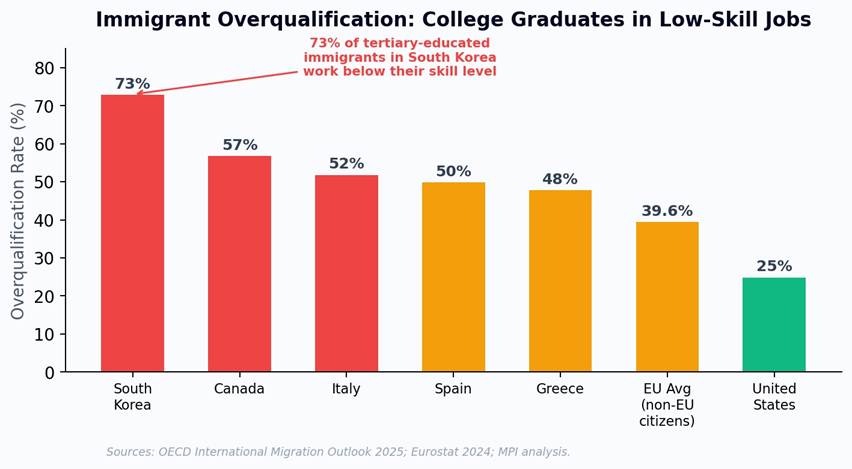
Figure 4: Overqualification rates of tertiary-educated immigrants across select OECD countries.
4. Why the Problem Resists Simple Solutions
The instinctive reaction is to improve credential evaluation services. Countries like Canada and Germany have invested heavily in this approach. Canada’s Foreign Credential Recognition Program funds direct evaluation services, bridging education, and employer awareness campaigns. Germany introduced “recognition partnerships” in March 2024 allowing qualified migrants to start work immediately while their credentials are assessed.
Yet the evidence is sobering. A landmark study published in the Journal of Ethnic and Migration Studies found that while formal credential recognition helps, it “hardly harmonizes the hiring chances of native- and foreign-trained applicants.” Even after official equivalency is established, employer bias persists. Foreign degrees are viewed as inferior regardless of accreditation outcomes. In Canada, 40-44% of immigrants report that employers not recognizing their credentials remains a major or moderate barrier to their careers - and this holds true even for immigrants who have been in the country for more than 15 years.
The most damning evidence comes from the employers themselves. A landmark Harvard Business School study, “Hidden Workers: Untapped Talent,” estimated that 27 million people in the United States alone are systematically excluded from hiring pipelines by automated screening systems. Among the employers surveyed globally, 88% acknowledged that their own ATS systems were filtering out highly qualified candidates who did not precisely match preset criteria. The study found that companies willing to hire from these overlooked talent pools were 36% less likely to face talent shortages - and that hidden workers outperformed their peers on six key metrics including productivity, quality, and attendance.
Three structural forces make this problem resistant to incremental reform:
First, the ATS bottleneck.
Modern Applicant Tracking Systems are used by 98.5% of Fortune 500 companies. Engineering roles can receive 2,000+ applications within a week. While recent research debunks the myth that ATS systems auto-reject 75% of resumes, the real problem is subtler: recruiters use Boolean keyword searches to filter candidates, and a resume listing “IIT Bombay” or “Toss” simply does not match any pattern the recruiter has been trained to look for. The signal is present on the page. The interpretation layer is entirely absent.
Second, the decentralization trap.
Credential recognition is fragmented across countries, provinces, states, and professional bodies. Canada alone has different processes across its 10 provinces and 3 territories. The EU operates 27 distinct national systems. No single evaluation translates everywhere.
Third, the incentive gap.
Employers have limited motivation to learn foreign credential systems. When a San Francisco startup receives 500 applications for an engineering role, the cognitive cost of evaluating an unfamiliar university is high relative to simply selecting a Stanford or Berkeley graduate.
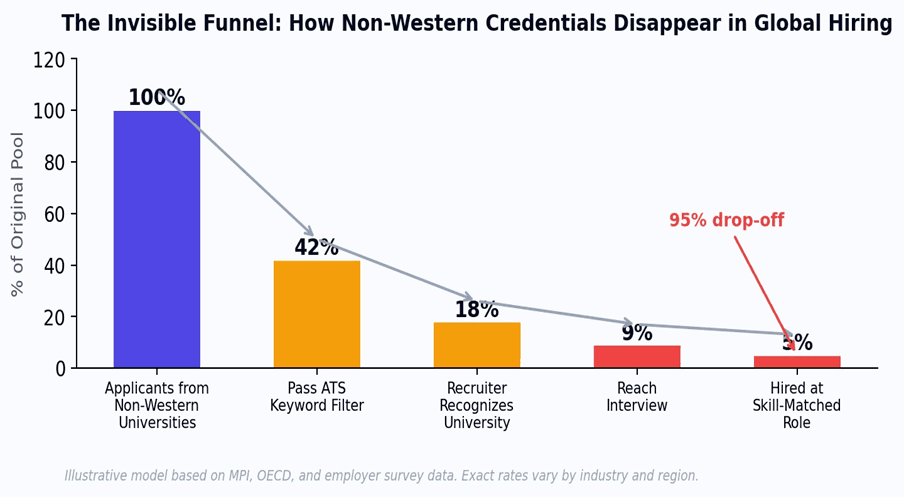
Figure 5: Illustrative model of how non-Western credentials are filtered out at each stage of the global hiring pipeline.
5. The AI Inflection Point: From Credentials to Capabilities
The global hiring industry is beginning to shift toward skills-based assessment. A 2025 report noted that employers are increasingly moving away from credential-centric hiring, instead prioritizing practical skills verification. Blockchain-based credential platforms like TrueProfile.io and Blockcerts are gaining traction for tamper-proof verification. Skills passports and micro-credentials are spreading across borders.
But verification alone is not enough. The missing piece is interpretation - an AI system that can ingest a credential from any institution on earth and produce a standardized, contextualized signal that any employer can immediately act on. This is not simply a translation problem. It requires multilingual NLP to parse transcripts and degree structures, deep knowledge graphs mapping institutional quality, selectivity, and program rigor across 200+ countries, real-time skills inference that goes beyond what a credential states to what it actually demonstrates, and cost structures low enough to serve the billions of professionals outside the Western premium-SaaS pricing envelope.
This is exactly the architecture that Redrob Passport is built to deliver.
Redrob Passport operates as a universal credential and experience intelligence layer. It takes any combination of educational credentials, professional certifications, employer history, work experience, and verified skills assessments – from any country, in any language – and produces a standardized profile that maps directly to employer requirements. Critically, it contextualizes not just university names but employer names: it understands that five years at Toss in Seoul represents payment infrastructure experience at a scale that exceeds most U.S. fintech companies, and that an SDE-2 role at Flipkart involved surviving a selection process as competitive as any at a top Silicon Valley firm. Because Redrob runs its own LLM infrastructure (a 5-model ensemble delivering 90% of frontier performance at 5% of the cost), it can serve this capability at price points that make sense for emerging market professionals - not just Fortune 500 HR departments.
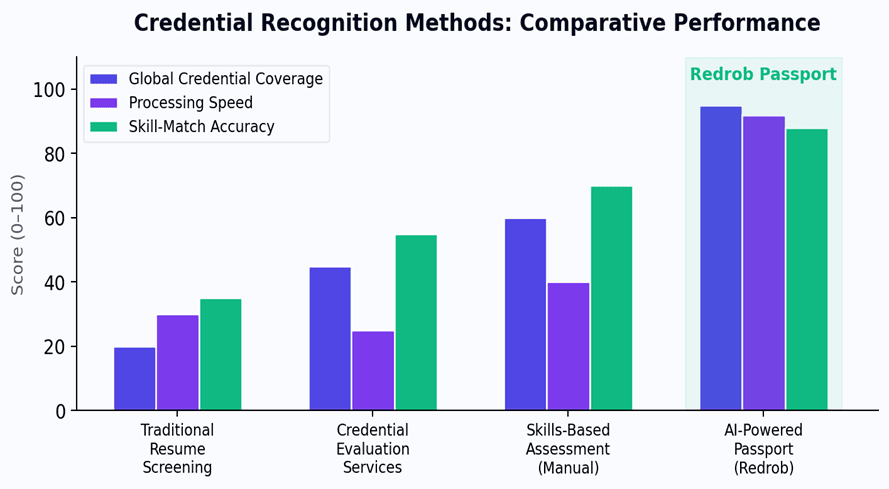
Figure 6: Comparative performance of credential recognition methods across coverage, speed, and skill-match accuracy.
6. What a Post-Credential World Looks Like
Imagine a world where an IIT Bombay Computer Science graduate with four years at Flipkart, a Seoul National University engineer who spent three years at Toss, and a Stanford alumnus from Stripe apply for the same role. Instead of their resumes being filtered through an ATS that only recognizes one of three universities and one of three employers, each candidate’s profile is processed through an AI layer that understands that all three survived a top-1% selection process at both the university and employer level, maps their coursework and work experience to the role’s specific skill requirements, and produces a normalized score that an employer can evaluate in seconds.
This is not a marginal improvement. It represents a fundamental re-architecture of how human capital flows across borders. Consider the implications:
For employers:
Access to a dramatically larger qualified talent pool. An AI-powered credential layer does not just find candidates; it finds candidates that legacy systems systematically exclude. In an era of global talent shortages - the OECD reports that labor migration declined 21% in 2024 even as demographic pressures intensify - this is not a nice-to-have. It is a competitive necessity.
For professionals:
Liberation from geographic credential arbitrage. A Redrob Passport means your IIT degree, your SNU diploma, your NIT transcript carries the same interpretive weight in New York as it does in Mumbai or Seoul. The credential barrier that currently costs skilled immigrants years of underemployment disappears.
For economies:
Unlocking billions in trapped productivity. If even half of the $39.4 billion in annual
U.S. brain waste were recovered, the economic impact would exceed the GDP of many small nations. Scale this globally and the figures become transformative.
7. The Invisible Becomes Visible
The global hiring system was built in an era when most professionals lived and worked within a single country, and when the handful of globally recognized institutions could serve as reliable proxies for talent. That era is over. There are now more engineering graduates in India alone than in the United States and Europe combined. South Korea produces more STEM PhDs per capita than any country on earth. The talent is there. The infrastructure to recognize it is not.
Redrob Passport is built on a simple premise: the most expensive hiring mistake is not choosing the wrong candidate. It is never seeing the right one. Harvard Business School found that companies hiring from overlooked talent pools are 36% less likely to face talent shortages, and that these workers outperform on productivity, engagement, and retention. With AI that understands credentials and experience at a global scale, the world’s most selective universities and most demanding employers stop being invisible - and millions of skilled professionals finally get the recognition they earned.

Work Smarter with
One AI platform powering job search, work, discovery, and productivity.
Latest AI Blogs.

Jun 23, 2026
How Recruiters Actually Shortlist Candidates Today
Garima

Jun 23, 2026
Best AI Job Search Agents in 2026: Find Jobs Smarter with Redrob
Bhushan

Jun 23, 2026
How Recruiters Shortlist Candidates in 2026: A Complete Guide
Garima

Jun 23, 2026
How to Get More Interviews Without Applying to Hundreds of Jobs
Bhushan
Jun 23, 2026
AI Resume Checker vs ATS Resume Checker: What's the Difference
Garima

Jun 23, 2026
One AI Assistant vs Multiple AI Tools: Which Is Better
Garima