
Redrob
Your sales team works hard. They research accounts, build lists, send follow-ups, and track responses.
Yet despite all that effort, reply rates stay low, pipelines feel stuck, and reps complain that “leads just aren’t converting.”
The problem isn’t your salespeople.
And it’s not even your messaging.
It’s your outdated sales prospecting tools.
According to Experian research, nearly 40% of B2B sales reps say outdated or inaccurate data is the biggest blocker to closing deals, even more than pricing or competition.
Many teams still rely on legacy sales prospecting tools that were built for a very different market - one where static databases, manual filtering, and bulk exports were enough. Today’s B2B buyers move faster, change roles often, and expect relevance from the first touch.
If your team is still using yesterday’s prospecting tools, you’re not just slowing down outbound - you’re actively losing deals.
This blog breaks down 5 clear signs your sales team is stuck with outdated prospecting technology and what it’s costing your revenue.
What Are Outdated Prospecting Tools?
Outdated prospecting tools are platforms that rely on static data, limited filters, and manual workflows to identify leads. They typically focus on surface-level attributes like:
Job title
Company size
Industry
Location
What they don’t capture is real-time buying behavior, intent signals, or data accuracy at scale.
Modern B2B prospecting tools are expected to do far more:
deliver verified data, highlight intent, enrich leads automatically, and integrate seamlessly into outbound workflows.
Why Modern Prospecting Demands Better Tools
B2B sales has changed dramatically:
Buyers research silently before engaging
Decision-makers change roles frequently
Inbox competition is at an all-time high
Personalization is expected, not optional
Using legacy outbound sales tools in this environment leads to poor targeting, irrelevant messaging, and wasted effort.
That’s why identifying the signs of outdated tools early can save months of lost pipeline.
5 Signs Your Sales Team Is Held Back by Outdated Prospecting Tools
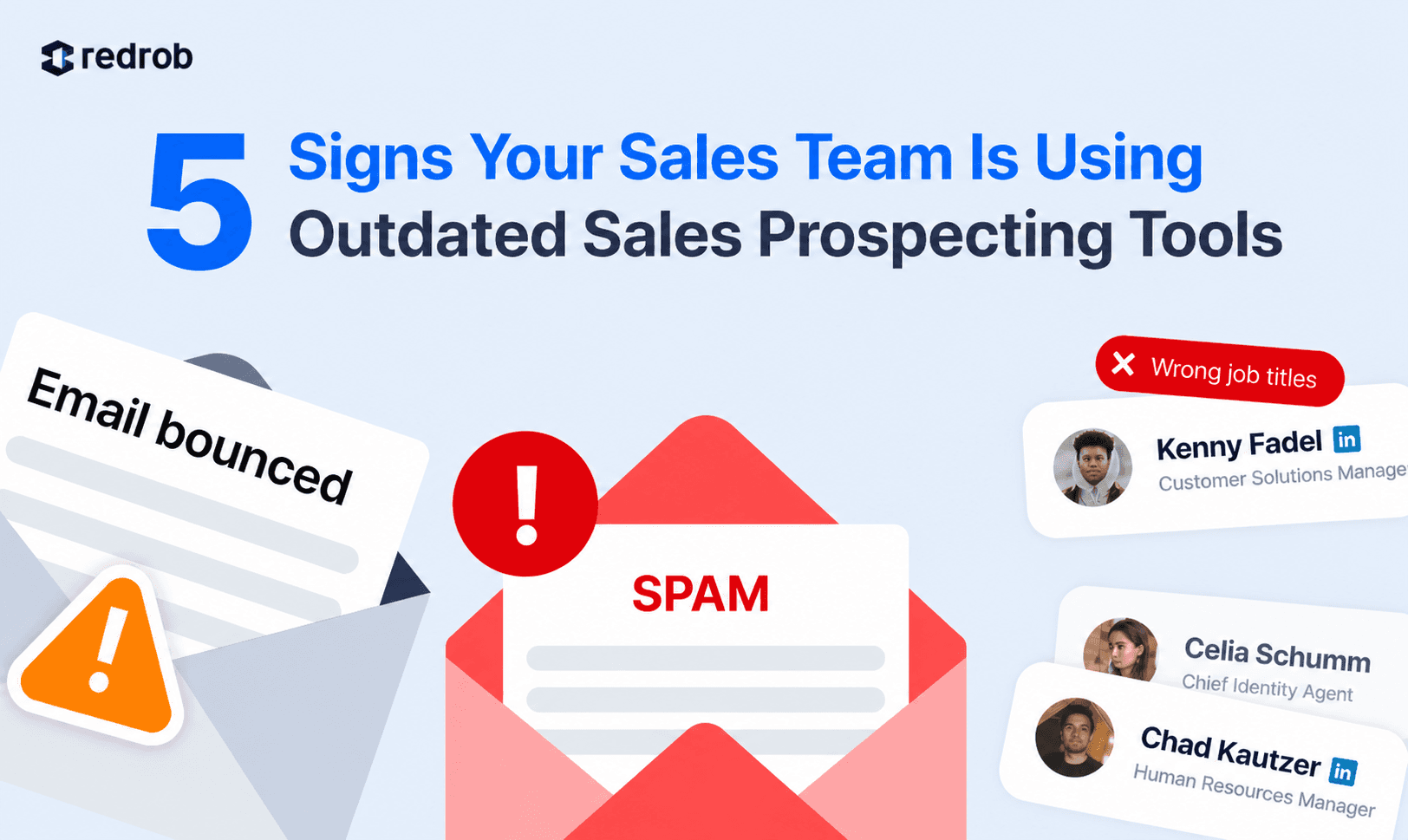
Sign #1: Your Data Is Constantly Outdated
If reps regularly complain about:
Bounced emails
Wrong job titles
Prospects who left the company months ago
You’re dealing with stale data.
Did you Know according to BigMailer Email bounce rates above 5% can severely damage sender reputation, reducing inbox placement for future campaigns.
Older sales prospecting tools refresh databases infrequently, meaning your team spends time reaching people who no longer exist in those roles. This hurts deliverability, damages domain reputation, and lowers confidence in outbound.
Modern Redrob continuously verifies and refreshes contact data across multiple sources - not once every few months.
If your team is manually verifying contacts, your tools are already behind.
Sign #2: Prospecting Takes Hours Instead of Minutes
Ask your reps how long it takes to build a “good” list.
If the answer involves:
Switching between LinkedIn, spreadsheets, and CRMs
Exporting CSVs
Cleaning duplicates manually
Your prospecting process is broken.
Outdated prospecting tools weren’t built for speed or scale. They assume manual effort is acceptable. In reality, reps should be spending time talking to buyers - not managing data.
Modern B2B prospecting tools like Redrob use automation, AI search, and enrichment to turn hours of work into minutes.
Sign #3: You’re Targeting Titles, Not Buyers
Job titles alone don’t equal buying power.
If your targeting logic still looks like:
“Marketing Manager at SaaS companies with 50-200 employees”
You’re missing context.
Legacy outdated sales prospecting tools stop at surface-level filters. They don’t capture:
Growth signals
Funding events
Hiring trends
Tech adoption
Competitive movement
Redrob helps teams identify who is likely to buy now, not just who fits a basic profile.
Without intent signals, your team is guessing - not prospecting.
Sign #4: Outreach Feels Generic and Low-Intent
If your outbound emails sound like:
“Just checking if this is relevant for you…”
That’s a symptom of poor prospecting, not bad copy.
When sales prospecting tools don’t provide context, reps can’t personalize effectively. They don’t know why the prospect should care - so messages stay generic.
High-performing teams use outbound sales tools that surface:
Recent company changes
Expansion plans
Hiring activity
Strategic priorities
This allows outreach to feel timely, relevant, and human - not automated spam.
Sign #5: Sales and Marketing Data Don’t Sync
Another major red flag:
Your sales team doesn’t trust marketing leads - and marketing doesn’t trust sales data.
Outdated prospecting tools often operate in silos:
No CRM sync
No enrichment for inbound leads
No visibility into engagement history
Modern B2B prospecting tools like Redrob bridge this gap by creating a shared, verified data layer that both sales and marketing rely on.
When tools don’t talk to each other, revenue teams don’t either.
The Cost of Using Outdated Sales Prospecting Tools
The real damage isn’t just inefficiency - it’s lost opportunity.
Using outdated tools leads to:
Lower reply rates
Longer sales cycles
Burned outbound domains
Frustrated reps
Unpredictable pipeline
Teams that focus on high-intent accounts often see stronger reply quality without increasing outbound volume.
This isn’t about working harder.
It’s about working smarter.
How Redrob Replaces Legacy Prospecting Workflows
Redrob is built to solve exactly what outdated sales prospecting tools can’t.
Natural Language Lead Search
Describe your ideal buyer in plain English - Redrob finds matching leads instantly. No complex filters or manual guesswork.
AI-Powered Data Enrichment
Automatically enrich every lead with verified emails, phone numbers, social profiles, and firmographic data - powered by AI.
700M+ Global Profiles
Access a massive pool of global contacts filtered by industry, region, seniority, and technology usage.
Verified Across 19+ Trusted Sources
Every contact is cross-checked against multiple data providers, ensuring accuracy and high deliverability.
Advanced High-Intent Filters
Identify companies showing buying signals like funding, leadership hiring, expansion, or tech adoption - all in one place.
Built for Modern Outbound
Redrob works as a next-generation sales intelligence software layer for teams that want speed, accuracy, and intent - not spreadsheets.

Final Takeaways
If your sales team is struggling with low replies, stale data, or slow prospecting, the issue may not be strategy - it’s tooling.
Outdated sales prospecting tools:
Limit visibility
Waste rep time
Reduce conversion rates
Modern prospecting tools empower teams with intent, context, and verified data - turning outbound into a predictable growth channel.
With Redrob, you don’t just upgrade tools.
You upgrade how your team sells.
FAQs
1. What are outdated sales prospecting tools?
Tools that rely on static, unverified data and basic filters without intent signals or automation.
2. Why should replace legacy prospecting tools?
They slow down prospecting, reduce reply rates, and cost more in lost opportunities than their subscription price.
3. What should modern B2B prospecting tools include?
Verified data, intent signals, AI enrichment, CRM sync, and fast list-building.
4. Is Redrob different from prospecting tools?
Yes. Redrob adds context and intent, while basic tools only provide contact lists.
5. How does Redrob improve outbound sales?
Redrob helps teams find high-intent, verified leads faster - so reps spend less time searching and more time closing.

Work Smarter with
One AI platform powering job search, work, discovery, and productivity.
Latest AI Blogs.

Jun 23, 2026
How Recruiters Actually Shortlist Candidates Today
Garima

Jun 23, 2026
Best AI Job Search Agents in 2026: Find Jobs Smarter with Redrob
Bhushan

Jun 23, 2026
How Recruiters Shortlist Candidates in 2026: A Complete Guide
Garima

Jun 23, 2026
How to Get More Interviews Without Applying to Hundreds of Jobs
Bhushan
Jun 23, 2026
AI Resume Checker vs ATS Resume Checker: What's the Difference
Garima

Jun 23, 2026
One AI Assistant vs Multiple AI Tools: Which Is Better
Garima