
Himanshi Gupta
Most sales teams don’t struggle because they lack leads. They struggle because they spend weeks talking to the wrong ones. Hours go into research, lists keep growing, and outreach still gets ignored. That silence is frustrating, especially when targets don’t move and pressure keeps building.
It usually shows up the same way. Deals look fine in the CRM, follow-ups stretch longer than expected, and replies slow down.
Ever wondered why effort keeps increasing but momentum doesn’t?
That gap comes from working with interest instead of intent. A high-intent prospecting list shifts focus to companies already showing signs of buying activity, not just matching a profile. Conversations start earlier, feel relevant, and don’t need repeated chasing.
This blog breaks down how intent works, how to spot it before competitors do, and how to turn those signals into meetings that actually convert.
5 Steps to Build a High-Intent Prospecting List That Converts
Every strong outbound motion follows a structure. What separates average results from predictable growth is how early intent is identified and how cleanly it flows into execution.
Step 1: Lock the ICP to a “buying moment,” not a persona
If the ICP is “Head of Sales at SaaS companies,” the list will always be noisy. A stronger starting point is intent-based prospecting based on what changes inside a company right before a purchase.
Use buying-moment cues that map to your offer, such as:
hiring surges in a relevant function
funding triggers for expansion budgets
role changes that indicate a new mandate
geographic expansion or new office launches
Redrob, being one of the best AI tools for sales prospecting, surfaces signals like job role changes, funding triggers, and hiring surges so teams don’t start from cold assumptions.
Quick check: If the account is growing, changing, or scaling - what’s the operational pain that follows?
Step 2: Build the account set first, then choose the buyers
Most teams build contacts first and “hope” the account fits. Flip the order.
Start with a tight account list using firmographics, then layer intent signals:
industry + size + region
growth indicators (hiring, expansion)
relevance indicators (category fit, tech alignment)
This approach makes high-intent prospecting list building predictable because the account logic stays consistent across reps and quarters.
Redrob’s Smart Filters are designed to help teams target fast-growing, high-intent companies without spending hours on manual research.
Question: Would this company still be a target if the contact changed roles tomorrow?
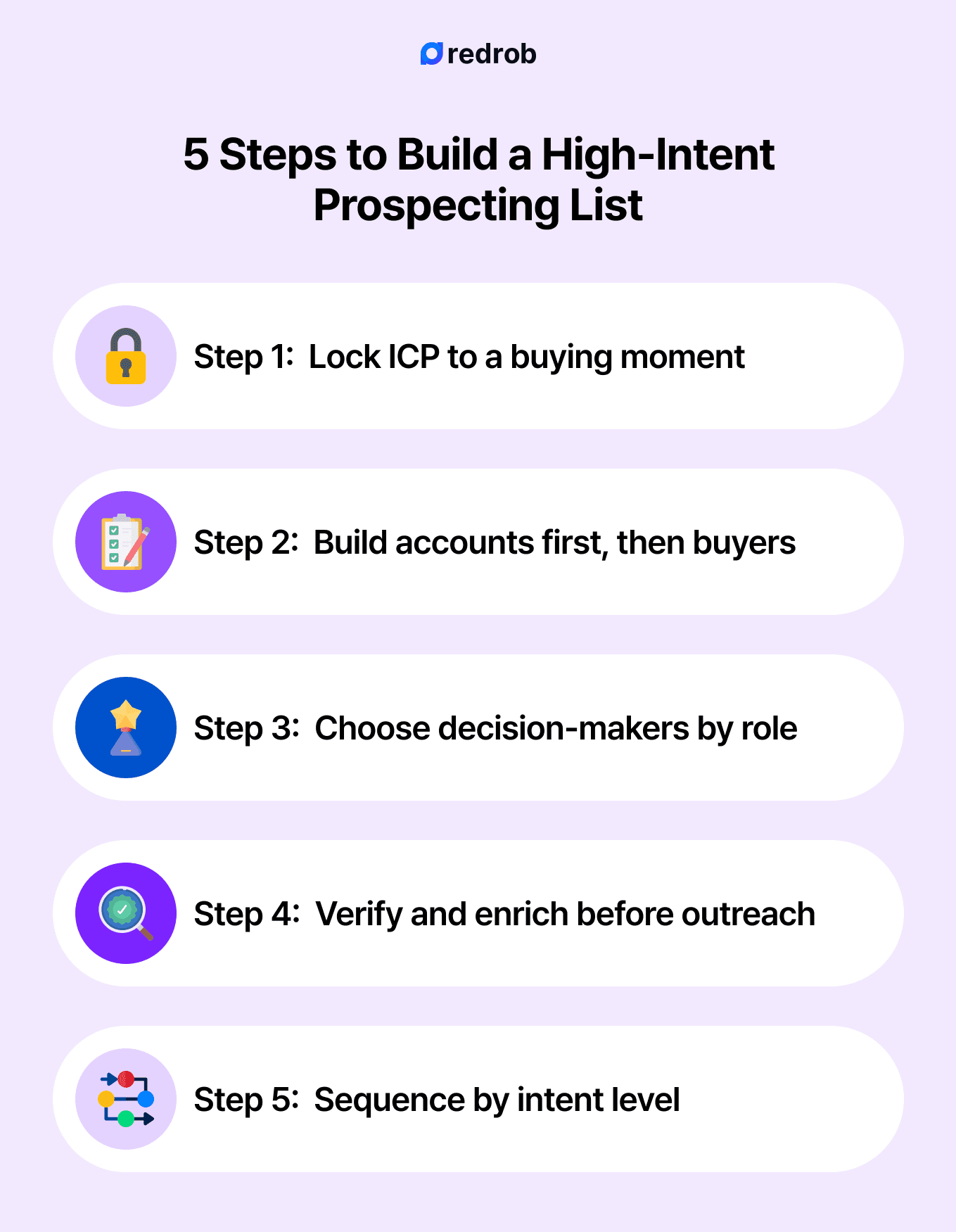
Step 3: Pick decision-makers using role clarity, not job-title shortcuts
A job title alone is not a buying role. Your list should reflect who influences budget, who owns the workflow, and who feels the pain.
To find high-intent leads, map roles into a simple buying committee:
Economic buyer (budget owner)
Champion (day-to-day owner)
Technical evaluator (implementation gatekeeper)
Then filter contacts who are current, reachable, and relevant.
Redrob emphasizes reaching decision-makers quickly and reduces the time spent searching by pairing smart search with intent filters.
What to avoid: pulling 50 “VP” titles from mismatched accounts and calling it a strategy.
Step 4: Verify, enrich, and standardize before outreach starts
A list that looks complete can still be operationally broken. If emails bounce, phones don’t connect, or company fields are missing, reps lose time and domains take a hit.
This is where sales prospecting list quality becomes measurable:
deliverable email
reachable phone (when required)
correct company domain
correct seniority + function
consistent fields for routing and personalization
Redrob positions “verified direct contacts” with real-time validation and highlights accuracy-focused workflows to reach real decision-makers.
For scaling teams, API-based enrichment removes the manual cleanup loop. Redrob also highlights a unified enrichment setup that pulls from multiple providers through a single endpoint and targets strong match rates.
One more reality check: verified data is not a one-time cleanup - it’s continuous validation.
Step 5: Activate the list with sequencing that matches intent level
A list built on signals should not be messaged like a cold directory dump. The outreach should reflect why now.
Use intent level to decide:
message angle (trigger-based vs pain-based)
channel mix (email + LinkedIn + call)
follow-up cadence (tight for hot signals, slower for mild signals)
This is where teams automate outbound without losing relevance - because the personalization inputs come from the signal, not from manual guesswork.
Redrob includes automated email sequences and campaign controls designed to support healthier delivery and consistent execution across time zones.
Practical workflow: Build the list → verify and enrich → launch sequences → review replies by signal type → double down on what converts.
That’s how high-intent prospecting becomes a system, not a sprint.
Why High-Intent Prospecting Matters More Than Ever
When markets tighten, buyers don’t respond to “nice messaging.” Buyers respond to relevance and timing.
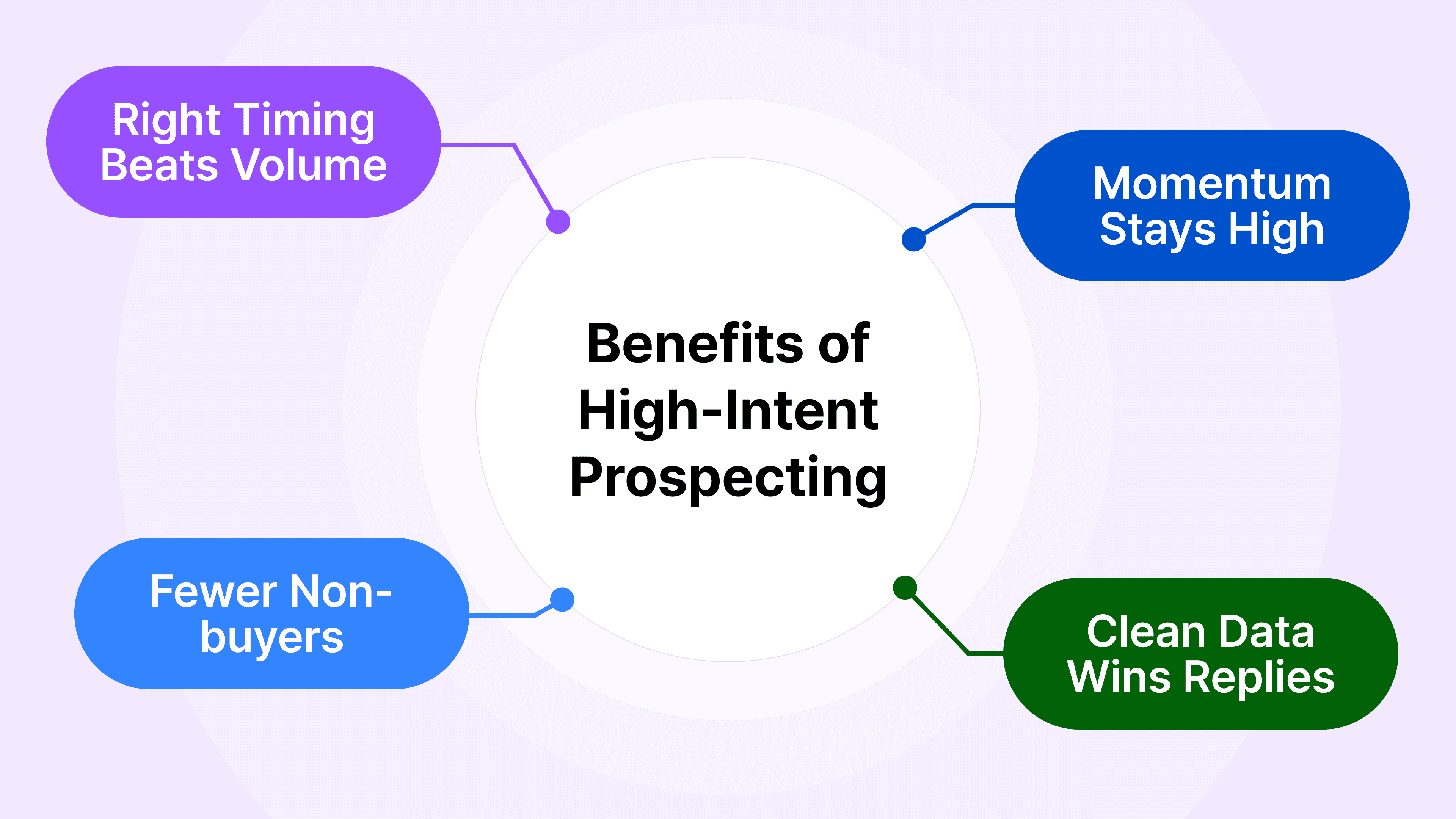
A standard list might look bigger, but it usually hides three costs:
time wasted on accounts that won’t buy
deliverability damage from outdated records
low morale from repeated silence
That’s why a high-intent prospecting list tends to outperform even when it’s smaller.
Redrob’s own positioning calls out the shift directly: buying signals matter more than contact volume, and manual research time becomes a growth bottleneck.
Prospecting List vs Intent List (what changes in execution)
Dimension | Prospecting list | Intent list |
Targeting logic | Static filters (industry, size, title) | Buying triggers (hiring, funding, expansion) |
Data quality impact | Bounces get “accepted” as normal | Verification is treated as a requirement |
Rep effort | Heavy manual research | Search and enrichment reduce admin work |
Messaging | Generic pains, generic timing | “Why now” tied to a trigger |
Outcome | Activity without conversion | Higher reply quality and faster qualification |
If a team wants a healthier sales pipeline, the list has to reflect urgency, not just fit.
Also, don’t underestimate the stack problem. Many teams buy separate tools for search, enrichment, and outreach, then lose weeks to handoffs. Redrob explicitly positions itself around reducing tool-hopping with a more connected workflow.
How Redrob Enables Intent-First Prospecting at Scale
We built Redrob for leaders who want outcomes, not another place to store contacts. Our Smart Filters help you target companies showing buying signals like funding, hiring, and expansion, so your list starts with timing.
Then we protect execution. Verified contacts reduce bounce risk, and natural language search speeds up targeting when filters get complex.
Here’s how Redrob fits directly into a high-intent workflow:
Use Smart Filters to segment by growth signals and active change.
Pull decision makers faster using global people search coverage.
Verify emails and phones before sequences start to keep deliverability clean.
Capture leads from LinkedIn using the Chrome extension to save time on manual entry.
Enrich at scale using a unified API that queries 20+ sources through one endpoint.
If the goal is a repeatable high-intent prospecting list, the next step is simple: start with one trigger, build one weekly segment, and measure meetings booked per segment. Then scale what works.
Frequently Asked Questions
What is high-intent prospecting?
High-intent prospecting is reaching out to accounts already showing purchase-ready signals like hiring, funding, expansion, or tech changes. It focuses on timing and relevance to generate high-intent leads that convert faster.
What qualifies as a high-intent prospecting list?
A high-intent prospecting list is built around buying signals like hiring surges, funding, expansion, or tool changes, combined with verified decision-makers. It prioritizes timing so outreach converts into meetings faster.
How do you build a high-intent prospecting list without bloating it?
To build a high-intent prospecting list, pick one trigger, apply tight ICP filters, then add only role-relevant buyers. Keep the list small, refresh weekly, and remove accounts once signals cool down.
How is intent-based prospecting different from a regular sales prospecting list?
A sales prospecting list focuses on fit (industry, size, location). Intent-based prospecting adds timing by targeting accounts showing change. That difference reduces wasted sends and improves sales pipeline movement.
How can teams automate outbound while staying relevant?
Automate outbound by sequencing only verified contacts, grouping prospects by a single trigger, and using role-specific messaging. Automations should schedule follow-ups and sync updates, not replace research and segmentation.
What are the best AI tools for sales prospecting when accuracy matters?
The best AI tools for sales prospecting help identify high-intent leads, speed up list creation, and validate contact data. Prioritize tools like Redrob, that support natural language search and reliable enrichment over generic AI copywriting.
Can Redrob speed up prospecting list building for high-intent leads?
Yes. Redrob supports prospecting list building using Smart Filters for buying signals and verified contacts, so teams spend less time sorting lists and more time booking conversations with high-intent leads.
Does Redrob help scale enrichment workflows for a growing sales pipeline?Redrob offers a unified enrichment API to fill missing fields and maintain data freshness at scale. This keeps the sales pipeline clean, reduces manual cleanup, and supports consistent high-intent prospecting across campaigns.

Work Smarter with
One AI platform powering job search, work, discovery, and productivity.
Latest AI Blogs.

Jun 23, 2026
How Recruiters Actually Shortlist Candidates Today

Garima

Jun 23, 2026
Best AI Job Search Agents in 2026: Find Jobs Smarter with Redrob
Bhushan

Jun 23, 2026
How Recruiters Shortlist Candidates in 2026: A Complete Guide
Garima

Jun 23, 2026
How to Get More Interviews Without Applying to Hundreds of Jobs
Bhushan
Jun 23, 2026
AI Resume Checker vs ATS Resume Checker: What's the Difference
Garima

Jun 23, 2026
One AI Assistant vs Multiple AI Tools: Which Is Better
Garima