
Himanshi Gupta
AI is no longer a “nice-to-have” in revenue teams - it’s becoming the default operating layer for how modern sales orgs decide where to spend time.
Salesforce’s research shows that 83% of sales teams with AI grew revenue in the past year, compared with 66% of teams without AI. That gap is exactly why sales leaders are pushing AI deeper into pipeline reviews, territory planning, and forecasting.
But there’s a catch that most teams feel within weeks: AI can’t fix what your data can’t explain.
If your CRM is full of outdated titles, missing seniority, wrong locations, and dead emails, your reps will still chase the wrong accounts - just faster. That’s why AI enrichment for the sales pipeline has become a core lever for better decisions, not just better reporting.
Here’s a quick gut-check question: when you look at your “hot” pipeline today, how many deals are truly hot - and how many are just incomplete?
In this blog, we’ll break down what’s driving AI adoption in sales, why enrichment is the foundation underneath it, and how sales leaders can use enrichment to prioritize, qualify, and forecast with confidence - without relying on opinions in every pipeline meeting.
AI Adoption Is Exploding: Data Enrichment Shift Sales Leaders Can’t Ignore
The market is moving from “more activity” to “better decisions,” and enrichment is the fuel.
AI in sales isn’t a pilot anymore. Salesforce’s State of Sales report notes that 81% of sales teams say they use AI today, and the same research highlights how much teams depend on trustworthy data to make AI useful.
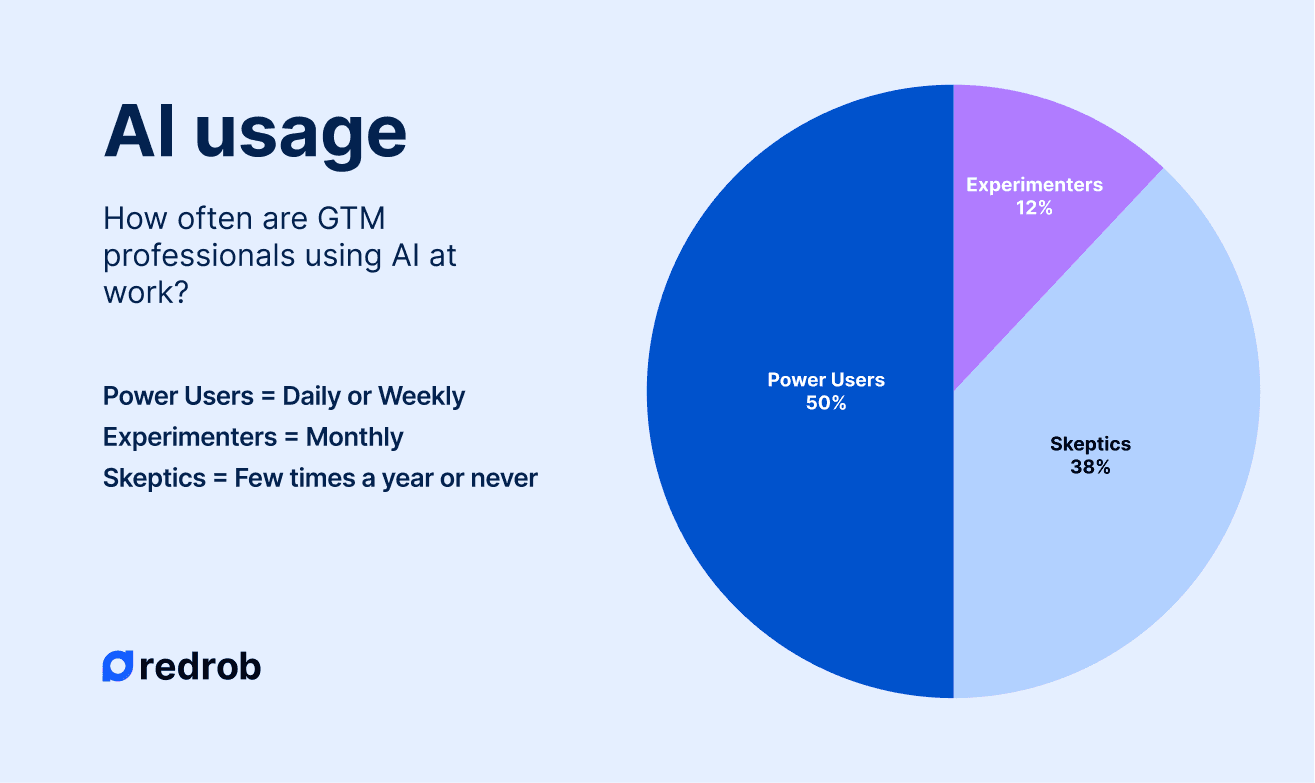
Let’s have a quick look at the chart below reflecting why AI use in GTM is no longer occasional….
Now zoom into the part that’s often missed…
Data enrichment is becoming a market category because teams are tired of working around missing context. Grand View Research estimates the global data enrichment solutions market at $2.37B in 2023, with a projected 10.1% CAGR from 2024 - 2030.
And the urgency is real because B2B data decays quickly. Cognism cites that 22.5% of B2B data can go bad each year, which means one out of five records becomes unreliable without ongoing updates.
If you’re leading revenue, you don’t need AI “everywhere.” You need accurate inputs where pipeline decisions are made - which is why AI enrichment for sales leaders is becoming part of the operating rhythm.
How AI Enrichment Turns Data Into Pipeline Clarity
Enrichment isn’t about “more fields,” it’s about decision-ready context at the exact moment reps act.
#1: Fix The Inputs Before You Fix The Forecast
Bad inputs create confident forecasts that collapse at the end of the quarter.
Most pipeline problems aren’t created in stage 3 or stage 4. They start when your team targets the wrong persona, assigns the wrong account tier, or routes leads without enough context. With AI data enrichment, sales leaders can standardize the fields that quietly break conversion:
Accurate role and seniority (so “Head of X” isn’t treated like a VP)
Firmographics that match your ICP (so reps stop chasing false positives)
Verified contact points (so activity isn’t wasted on dead endpoints)
Be honest - when a deal slips, do you trace it back to “timing,” or to missing information that made the opportunity look qualified too early?
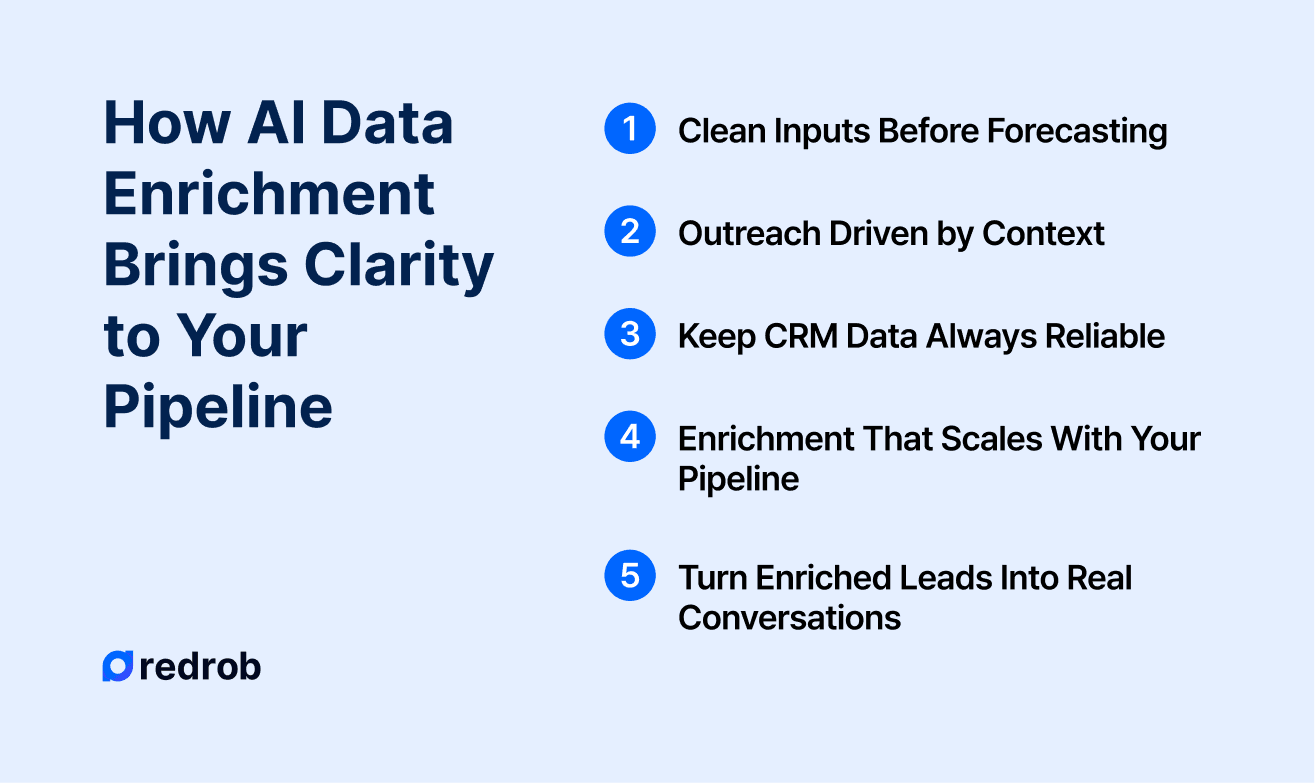
#2: Prioritize Outreach With Context, Not Gut Feel
The fastest pipeline isn’t built by working harder, it’s built by picking better targets.
Sales teams adopting AI often start with automation in outreach. That helps, but it doesn’t solve prioritization. With sales data enrichment, pipeline decisions improve when every record answers questions like:
Is this buyer a decision-maker or an influencer?
Is the company growing, hiring, or expanding right now?
Do we have enough detail to personalize without guessing?
This is why we built Smart Intent Signals in Redrob - because timing is a pipeline multiplier. When your reps focus on accounts that show intent, “good-fit” becomes “good-fit and active,” which changes how fast the pipeline moves.
Quick question: if your team had to cut prospecting time by 50% next week, would they still pick the same accounts?
#3: Keep Your CRM Trustworthy With Continuous Enrichment
If your CRM is stale, your pipeline reviews become debates instead of decisions.
A CRM is supposed to be a system of record, but without consistent updates, it becomes a museum of old information. With CRM data enrichment, leaders can reduce the risk of bad pipeline calls by keeping records current - especially for accounts already in motion.
Here’s a practical way sales ops teams implement it:
Enrich at the moment of capture (so junk doesn’t enter the CRM)
Re-verify contacts before sequencing (so reps don’t burn domains)
Refresh key fields for open opportunities (so forecasting reflects reality)
If a buyer changed roles last month, do you want to discover that after three follow-ups - or before the first one?
#4: Use API-First Enrichment To Scale The Workflow
Manual enrichment doesn’t scale, and tool-hopping kills adoption.
Most teams don’t fail at enrichment because they don’t care. They fail because enrichment sits outside the workflow and depends on human discipline. With AI-powered data enrichment, the winners operationalize enrichment through automation - so it happens as a rule, not a request.
This is where an API-first approach matters. Redrob’s Unified API pulls data from multiple providers through one endpoint, helping teams reduce stack complexity while improving match rates at scale. When enrichment is connected through API, you can trigger actions like:
Auto-route leads when seniority and territory match
Auto-enrich accounts when they enter a high-intent segment
Auto-sync verified fields back to your CRM without manual cleanup
This is also why lead data enrichment performs best when it’s embedded into prospecting, not treated as a separate “data project.”
Want enrichment to run automatically inside your workflow?
#5: Turn Enriched Leads Into Better Conversations, Not Just Better Lists
Better data should show up in outcomes: replies, meetings, and clean conversion.
Sales leaders don’t buy enrichment for the sake of enrichment. They buy it to improve pipeline quality and predictability. With enriched lead data for sales, reps walk into conversations with context that actually helps:
The right person, not just the right company
A clear reason for outreach, not generic personalization
Verified email and phone data that improves connect rates
This is also where B2B data enrichment directly impacts cost-per-meeting. When reps stop targeting the wrong personas and stop sequencing dead contacts, you don’t just get more replies - you reduce wasted time and wasted budget.
One question to ask in your next pipeline review: how many deals are stuck because the buyer isn’t real, reachable, or relevant?
Verified vs. Scraped Data: What Actually Impacts Pipeline Decisions
AI can help you move faster, but it can’t fix unreliable inputs. This is why the difference between verified and scraped data matters in every pipeline review. One improves decision quality; the other inflates activity while quietly damaging conversion.
What Sales Leaders Care About | Verified Data | Scraped Data |
Email deliverability | Higher confidence from validation | Higher bounce risk |
Role accuracy | More reliable titles/seniority | Titles can be outdated |
Contact reachability | Phone/email checked closer to real-time | Often stale by the time it hits CRM |
CRM cleanliness | Reduces duplicates + wrong fields | Increases cleanup work |
Forecast confidence | Cleaner qualification inputs | Inflates pipeline with false positives |
How We Use AI Enrichment at Redrob to Power Predictable Growth
We built one system to find, verify, and enrich - so sales leaders can decide faster with less risk.
Sales leaders come to us when the outbound motion feels heavy: reps spend hours researching, tools don’t agree with each other, and pipeline looks “healthy” until it suddenly isn’t. Redrob was built to remove that friction by combining prospecting, verification, and enrichment into one workflow - so pipeline decisions are driven by current signals, not outdated records.
We support AI enrichment for the sales pipeline by making targeting and enrichment practical inside the day-to-day work your team already does.
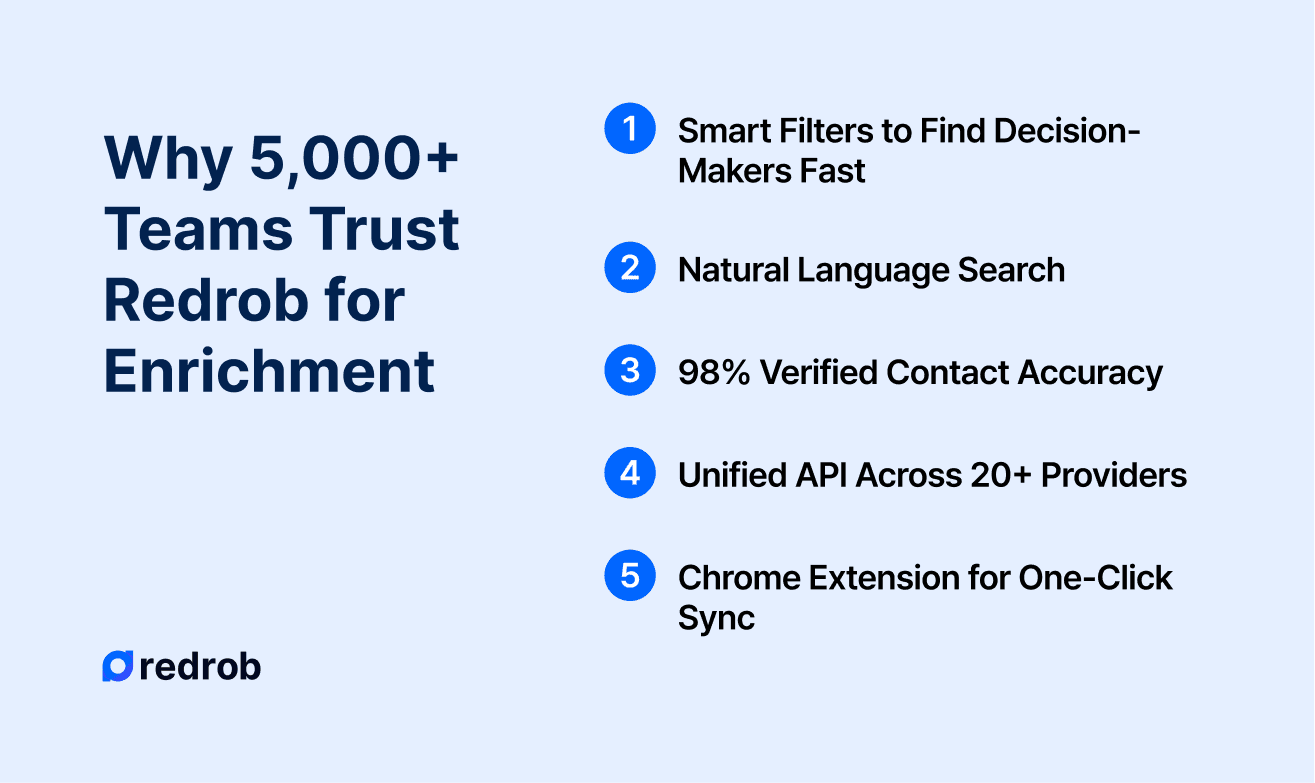
Here’s how teams typically implement Redrob effectively:
Use Smart Filters to reach decision-makers faster
Apply natural language search to build precise segments
Rely on real-time verification for accurate email and phone data
Use our API layer to enrich and sync across CRM workflows
Capture contacts with the Chrome Extension and sync in one click
Directives we recommend….
start with one pipeline motion (like outbound to fast-growing accounts)
enforce enrichment rules there
measure lift in reply rate and meeting quality before expanding
If you want your pipeline reviews to focus on strategy - not data arguments - Redrob helps you make the inputs trustworthy and the decisions faster.

Work Smarter with
One AI platform powering job search, work, discovery, and productivity.
Latest AI Blogs.

Jun 23, 2026
How Recruiters Actually Shortlist Candidates Today

Garima

Jun 23, 2026
Best AI Job Search Agents in 2026: Find Jobs Smarter with Redrob
Bhushan

Jun 23, 2026
How Recruiters Shortlist Candidates in 2026: A Complete Guide
Garima

Jun 23, 2026
How to Get More Interviews Without Applying to Hundreds of Jobs
Bhushan
Jun 23, 2026
AI Resume Checker vs ATS Resume Checker: What's the Difference
Garima

Jun 23, 2026
One AI Assistant vs Multiple AI Tools: Which Is Better
Garima