
Himanshi Gupta

At 9:12 AM, a sales lead opens a CRM dashboard.
The pipeline looks full.
The calendar looks empty.
This gap is not because teams are lazy or tools are missing. It happens because the way B2B lead generation has been done for years no longer matches how buyers behave today. Decision-makers are harder to reach, inboxes are crowded, and generic outreach is ignored within seconds.
By 2026, high-performing sales teams will not win by sending more emails or hiring more reps. They will win by knowing who to reach, when to reach them, and why that moment matters.
This shift is already happening quietly inside the best sales teams. The rest are still chasing volume.
Let’s talk about what the top 1% will do differently - and why it matters to revenue, not vanity metrics.
Why Traditional B2B Sales Models Are Losing Ground
Sales used to be a volume game. More emails. More calls. Bigger lists.
That approach no longer holds.
By 2026, decision-makers will receive fewer but more relevant messages. The modern B2B buyer behaves very differently, and outdated outreach simply doesn’t land like it used to.
Recent study by Gartner shows:
73% of B2B buyers actively avoid suppliers that send irrelevant outreach - generic messages now turn into missed opportunities.
61% of B2B buyers prefer a rep-free buying experience, meaning outreach must add real value rather than interrupt.
Here’s what is failing fast:
Bulk prospecting with static data
Outreach based only on firmographics
Long research cycles before first contact
Heavy dependence on large BDR teams
High-performing teams are not fixing these issues by hiring more people. They are fixing them by changing systems, signals, and timing.
How High-Performing Sales Teams Operate in 2026
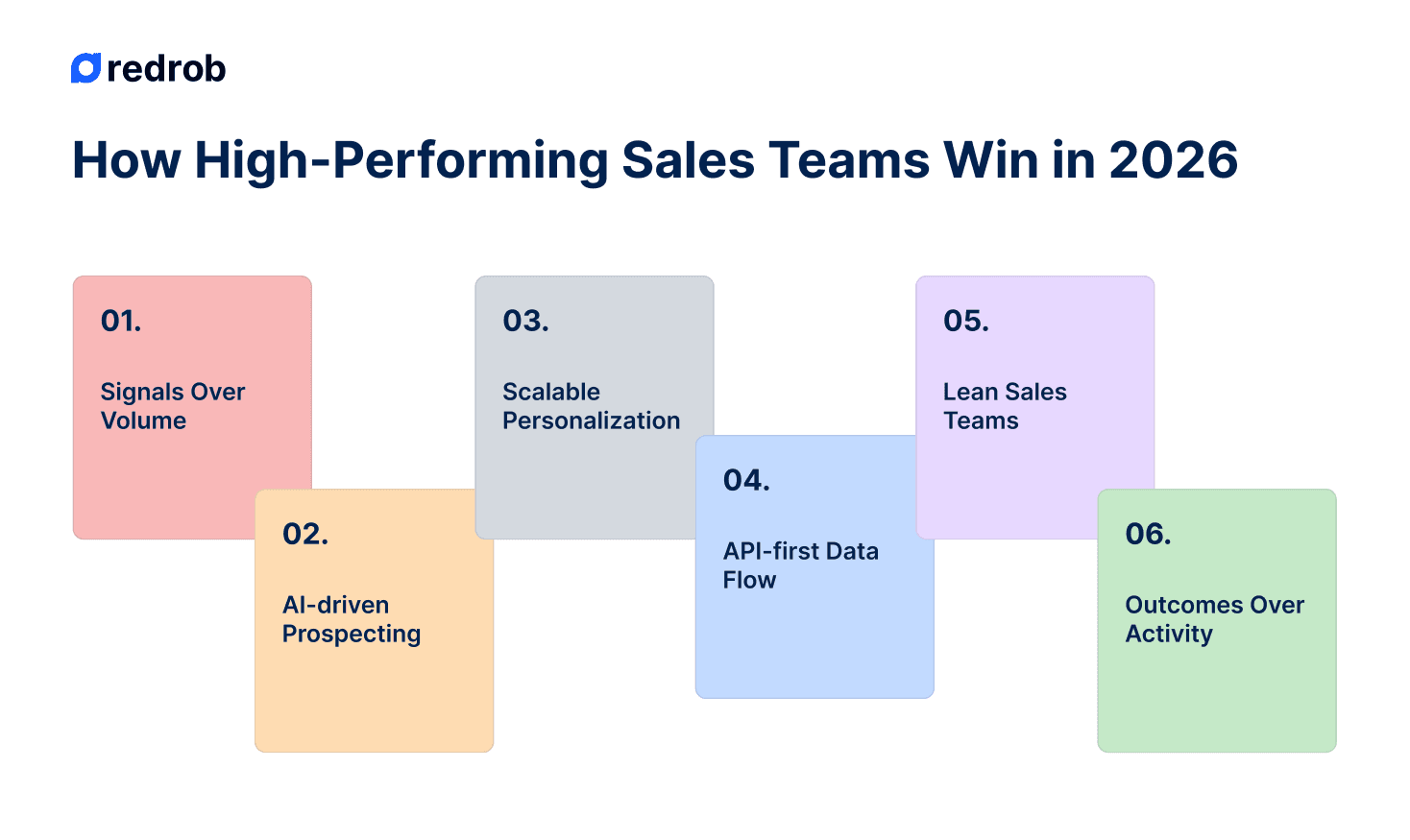
The gap between average and top-performing sales teams is widening. The difference lies in how early they act, how precise they target, and how well they connect data across systems.
Below are the core changes defining top sales teams in 2026.
1. They Will Prioritize Buying Signals Over Contact Volume
High-performing teams will stop measuring success by the number of contacts added to CRM.
Instead, the focus will shift to:
Companies actively hiring
Teams expanding into new markets
Businesses launching new products
Signals that show budget movement
Why does this matter? Because intent shortens sales cycles.
Intent-led outreach converts up to 3x better than static list-based targeting. Teams that act on real signals book meetings faster with fewer touches.
This is where modern sales lead generation software plays a critical role, especially platforms built to surface intent rather than raw data.
2. They Will Compress Prospecting Time Using AI
In 2026, spending 30 hours a week on research will be seen as a failure, not dedication.
High-performing teams will use AI to:
Identify the right accounts in minutes
Filter decision-makers automatically
Remove outdated or irrelevant data
AI will not replace sales reps. It will remove friction.
When research drops from hours to minutes, reps spend more time in live conversations. This shift alone changes pipeline velocity.
Teams adopting AI-first prospecting already see reply rates climb above 30%, compared to single-digit averages with manual methods.
3. They Will Personalize at Scale Without Manual Effort
Personalization will still matter in 2026, but manual personalization will not scale.
Top teams will rely on systems that:
Pull role-specific context automatically
Align messaging with company activity
Adjust outreach based on signal strength
Instead of writing one-off messages, sales teams will design intelligent sequences that adapt.
This approach is becoming a core part of advanced B2B marketing strategies, where sales and marketing signals work together instead of operating in silos.
4. They Will Integrate Data Through APIs Instead of Tool-Hopping
Disconnected tools slow teams down. Every export, import, and sync creates gaps.
High-performing teams will centralize data flow using APIs that:
Enrich CRM records in real time
Pull data from multiple providers through one endpoint
Maintain high match accuracy
APIs will not be a backend feature anymore. They will be a revenue enabler.
Teams using unified APIs already report cleaner pipelines and faster handoffs between sales and marketing. This is critical as outbound and inbound lines continue to blur.
5. They Will Reduce Headcount Dependency Without Reducing Output
Hiring more BDRs is no longer the default growth move.
By 2026, strong teams will:
Generate more meetings with smaller teams
Automate repetitive tasks
Use intent-based targeting to improve efficiency
That’s why modern B2B lead generation services are being evaluated less on data size and more on output quality.
6. They Will Measure Outcomes, Not Activity
High-performing teams will stop celebrating activity metrics.
Instead, they will track:
Cost per qualified meeting
Signal-to-meeting conversion
Time-to-first-response
Pipeline influenced by intent
This outcome-first mindset aligns sales with revenue, not just effort. It also exposes which channels and signals actually drive growth.
Teams that make this shift gain clarity fast - and eliminate wasted motion.
Common Myths About B2B Sales in 2026 (That Are Already Holding Teams Back)
Even as sales systems evolve, many teams still operate with assumptions formed years ago. These beliefs are not obvious problems. In fact, they often sound practical and familiar. But in 2026, they no longer align with how buyers move, decide, or respond.
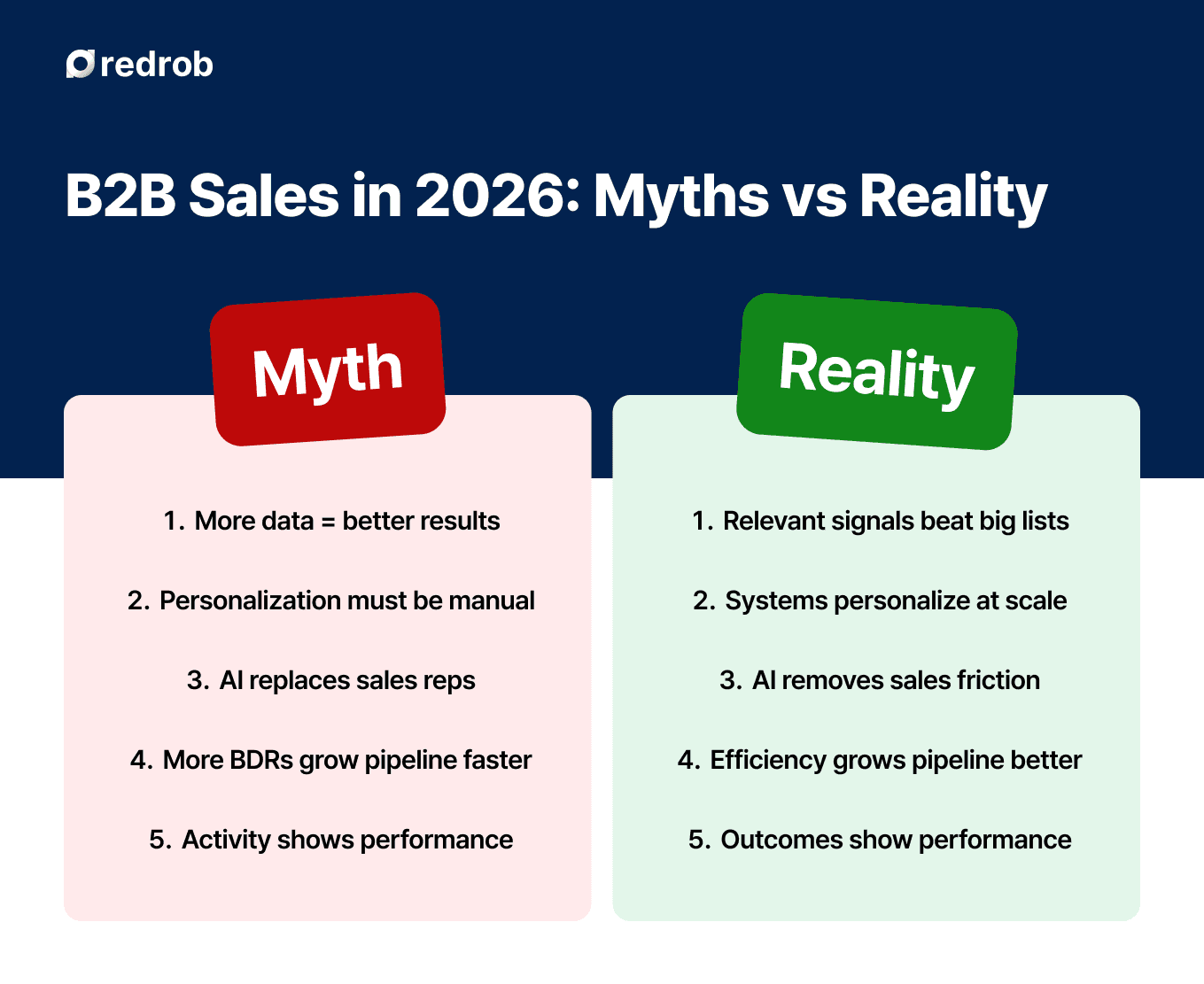
Let’s look at a few common myths that high-performing teams have already moved past.
Myth 1: More Data Automatically Means Better Sales Results
This is one of the most expensive myths in B2B sales.
Having millions of contacts does not help if most of them are outdated, inactive, or irrelevant. In fact, large datasets often slow teams down. Reps waste time filtering, guessing intent, and chasing accounts that are not ready.
What actually works in 2026:
Fewer accounts with real buying signals
Fresh, verified data tied to business activity
Clear context on why a company might buy now
Quality reduces effort. Volume increases noise.
Myth 2: Personalization Only Works When Done Manually
Many teams still believe real personalization means writing every message from scratch. That approach does not scale and burns out reps.
High-performing teams think differently.
They personalize systems, not sentences.
Modern sales workflows use signals, role context, and company activity to adapt messages automatically. The output feels human because the logic behind it is relevant.
Manual effort is not the goal. Relevant timing is.
Myth 3: AI Will Replace Sales Reps
This fear keeps many teams from adopting AI fully.
In reality, AI does not replace conversations. It removes the work that blocks them.
AI helps with:
Account research
Decision-maker discovery
Data cleanup
Signal detection
The rep still sells. AI just gets them to the right person faster.
Teams using AI correctly do not send fewer human messages. They send fewer useless ones.
Myth 4: Hiring More BDRs Is the Fastest Way to Grow Pipeline
This used to be true. It is not anymore.
Adding headcount without fixing targeting and timing only increases cost. It also creates management overhead and inconsistent quality.
In 2026, strong teams grow pipeline by:
Acting earlier on intent
Automating repetitive steps
Letting smaller teams handle larger opportunity flow
Efficiency scales better than headcount.
Myth 5: Activity Metrics Still Show Sales Performance
High call counts and email volume can look impressive on dashboards. But they rarely explain revenue.
Modern sales leaders care more about:
Signal-to-meeting ratio
Time to first response
Cost per qualified meeting
If activity does not move the pipeline, it does not matter.
Letting go of these myths is often the first real upgrade a sales team makes.
How Redrob Is Powering High-Performing Sales Teams
High-performing sales teams need systems that remove friction, not add layers.
Redrob is built for teams that want qualified meetings on the calendar without hiring large BDR teams or spending weeks on research.
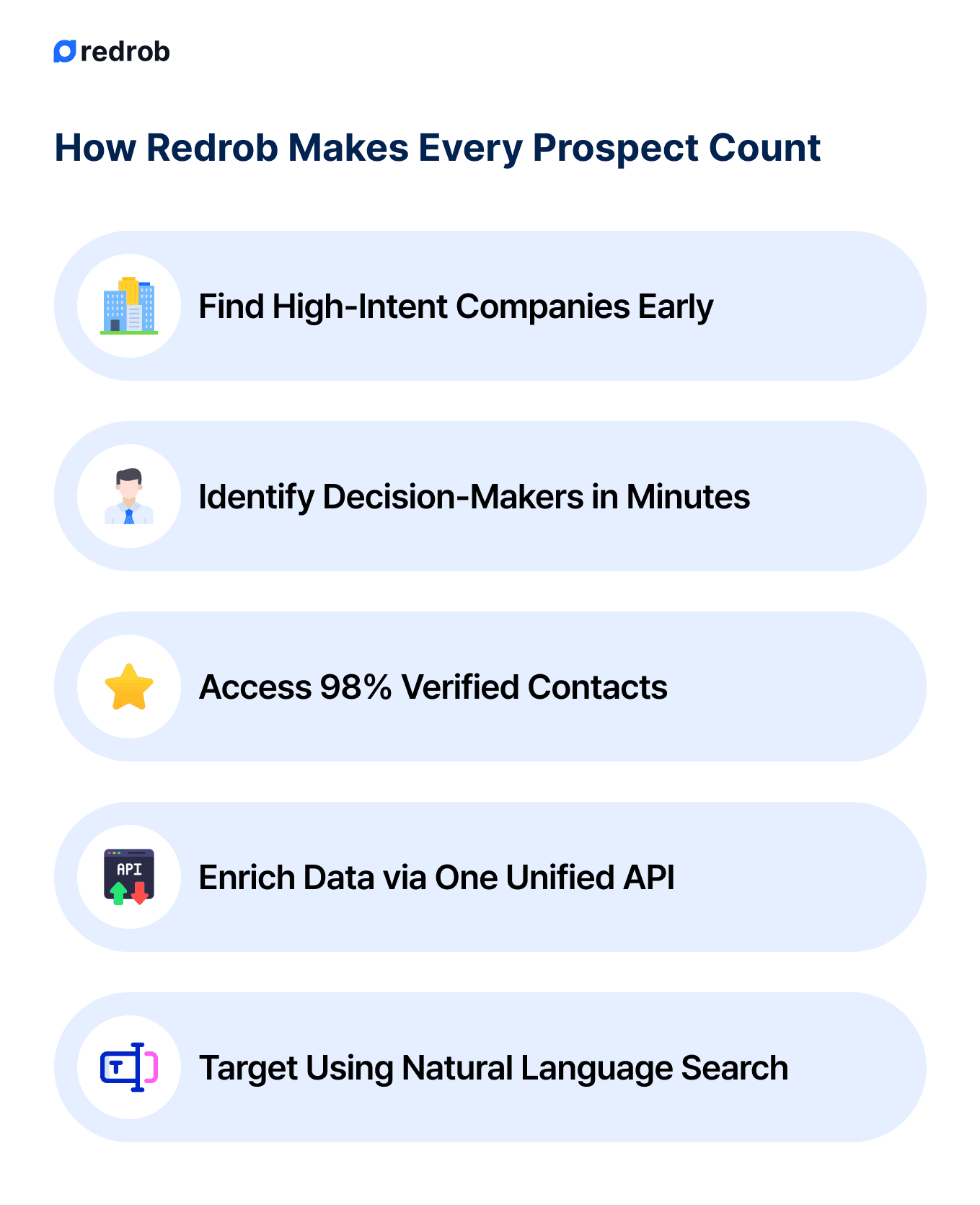
What makes Redrob different:
Smart intent filters that surface high-intent companies early
AI-powered prospecting to find decision-makers in minutes
Verified contact data with 98% accuracy
Unified API access to enrich records from multiple providers
Natural language search that matches how sales teams actually think
Teams using Redrob report:
5x more qualified meetings
Up to 34% reply rates
70% lower cost per meeting
Instead of managing multiple tools, Redrob brings targeting, enrichment, and outreach readiness into one system.
For early-stage startups and growth teams, this approach aligns perfectly with how B2B lead generation services must operate in 2026.
Sales success next year will not come from working harder. It will come from working with clearer signals, better data, and fewer distractions.
Redrob is designed for that reality. See how Redrob helps you find high-intent accounts, identify decision-makers, and enrich contacts in minutes.
Frequently Asked Questions
1. What will matter most in B2B sales in 2026?
In 2026, B2B sales will depend on intent signals, data accuracy, and timing. High-performing teams will rely on smarter B2B lead generation services instead of volume-based outreach and manual prospecting.
2. How is sales lead generation software changing B2B sales?
Sales lead generation software is shifting focus from static contact lists to real-time intent, verified data, and faster prospecting. This helps teams book qualified meetings with fewer touches and shorter sales cycles.
3. Are traditional B2B marketing strategies still effective?
Traditional B2B marketing strategies still work when aligned with intent data and sales signals. Generic campaigns are declining, while strategies connected to buyer behavior and timing are delivering higher pipeline impact.
4. Why are intent signals important for B2B lead generation?
Intent signals show when a company is actively evaluating solutions or changing priorities. B2B lead generation services that surface these signals help sales teams reach buyers at the right moment.
5. Can AI replace sales reps in B2B sales?
No. AI supports sales reps by reducing research, cleaning data, and identifying opportunities. Modern sales lead generation software allows reps to focus more on conversations, relationships, and closing deals.
6. How should B2B teams measure sales success in 2026?
B2B teams should track outcomes like signal-to-meeting conversion, cost per qualified meeting, and pipeline influenced by intent. These metrics align sales efforts with revenue and modern B2B marketing strategies.

Work Smarter with
One AI platform powering job search, work, discovery, and productivity.
Latest AI Blogs.

Jun 23, 2026
How Recruiters Actually Shortlist Candidates Today

Garima

Jun 23, 2026
Best AI Job Search Agents in 2026: Find Jobs Smarter with Redrob
Bhushan

Jun 23, 2026
How Recruiters Shortlist Candidates in 2026: A Complete Guide
Garima

Jun 23, 2026
How to Get More Interviews Without Applying to Hundreds of Jobs
Bhushan
Jun 23, 2026
AI Resume Checker vs ATS Resume Checker: What's the Difference
Garima

Jun 23, 2026
One AI Assistant vs Multiple AI Tools: Which Is Better
Garima