
Bhushan
An entire generation of Indian professionals learned to work around broken systems. Fragmented hiring. Siloed tools. AI built for someone else's context. And somehow, that became normal.
Not anymore.
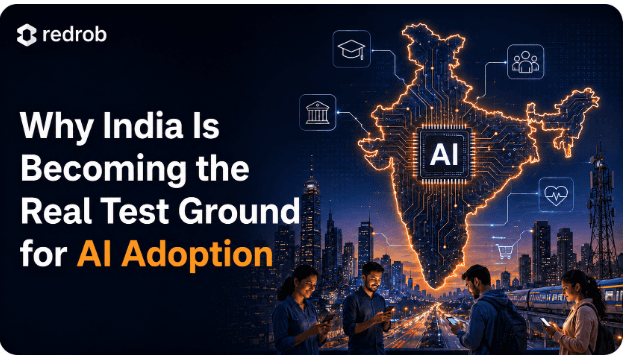
AI adoption in India isn't a future story. It's happening right now in hiring pipelines, campus placement cells, enterprise operations, and the hands of a 25-year-old in Pune running a job search on her phone. What makes India AI market dynamics different from anywhere else in the world isn't speed. It isn't scale alone. It's the specific pressure of a 1.4 billion-person economy demanding tools that actually fit in language, in context, in cost.
Redrob AI was built in that pressure. Not adapted for it. Built in it.
In this blog, we'll explore why India has become the most consequential test ground for AI in Bharat, what the data says about where AI adoption is accelerating, and why the next wave of AI tools India professionals rely on will look nothing like the ones imported from Silicon Valley.
The Scale No Other Market Can Match
India adds roughly 7–8 million new graduates to its workforce every year. They are not entering a job market built for them. They are entering a market with 900+ active job portals, AI resume screening tools calibrated for English-first resumes, and hiring systems that weren't designed for multilingual, multi-city, multi-context job seekers.
The result: a structural mismatch between talent volume and tool readiness.
According to a 2024 NASSCOM report, India is projected to be home to over 250 million AI-assisted workers by 2027 making it the largest base of AI-augmented professionals globally. But that projection only holds if the tools reach them in a form they can actually use.
This is where AI adoption in India diverges from the global narrative. Elsewhere, enterprise AI adoption is primarily a productivity story doing existing work faster. In India, it's an access story. The professionals who benefit most from AI for Indian professionals are the ones who never had access to the right tools to begin with.
Still Using AI Built For Someone Else's Reality?
India's scale needs tools built for how Indians actually work.
Why India Is Different: Three Structural Realities
1. The Language Reality
India has 22 scheduled languages and hundreds of dialects. A significant portion of its professional population thinks, writes, and communicates in a language that isn't English.
Most AI tools India professionals encounter were built English-first. They perform adequately in Hindi. They fall apart in Tamil, Telugu, Marathi, Kannada. This isn't a translation problem it's a design problem. A tool that was never built for a language context cannot be patched into it later.
AI in Bharat only works at scale when language is a first-class design decision. Thirty-plus languages, native not translated is not a feature. It's the baseline requirement.
2. The Data Reality
AI implementation is only as good as the data it runs on. General-purpose AI tools know everything about the world. They know very little about a product manager role in Pune at 12 LPA, or a logistics company in Coimbatore posting a role on a portal that LinkedIn has never indexed.
The India AI market requires India-specific training data. Six years of Indian professional context. 790M+ profiles. 20M+ live jobs aggregated from 50+ platforms. Without that foundation, AI resume screening produce results that are accurate in theory and useless in practice.
3. The Cost Reality
According to Stanford HAI's 2024 AI Index, the cost of deploying frontier AI models remains a significant barrier for emerging markets. The average Indian startup cannot afford enterprise AI at global pricing and the average Indian professional certainly cannot.
AI for Indian professionals has to solve the cost equation, not just the capability equation. 87% of GPT-5 capability at 0.5% the cost is not a marketing claim. It's the commercial condition under which AI adoption actually happens at Bharat's scale.
AI That Actually Knows the India AI Market
Built on 6 years of Indian professional data
Where AI Adoption Is Accelerating in India Right Now
Hiring and Talent Acquisition
AI candidate sourcing are the areas where enterprise AI adoption in India is moving fastest. The reason is straightforward: the talent market is so large and fragmented that manual processes cannot scale.
Large enterprises particularly in IT, BFSI, and manufacturing are deploying AI for recruiters to cut time-to-hire from 45 days to under 14. The tools that survive in this environment are the ones calibrated for Indian resume patterns, Indian role hierarchies, and Indian compensation data.
Generic AI implementation borrowed from global HR-tech platforms doesn't hold up here. Indian job titles don't map cleanly to global taxonomies. Indian salary structures are hyper-localised. AI for recruiters that doesn't understand this distinction creates more noise, not less.
Campus Placement and Early Career
India's campus placement ecosystem is uniquely high-stakes. Final-year students across thousands of engineering and MBA colleges are measured by themselves, their families, and their institutions by placement outcomes. The anxiety is structural.
AI in Bharat campus context means: resume builders that understand what Indian placement officers actually look for, job aggregators that surface roles from companies that visit Tier-2 campuses but never post on LinkedIn, and research tools that let a student prepare for an interview with a company they've never heard of.
AI adoption in India at the campus level isn't about automation. It's about access. The student at NIT Raipur deserves the same quality of career intelligence as the student at IIM Ahmedabad. AI tools India built natively can close that gap. Imported ones cannot.
Enterprise Operations and Workflows
Beyond hiring, enterprise AI adoption in India is accelerating across operations procurement automation, internal knowledge management, customer communication in regional languages, and compliance workflows that span multiple regulatory environments.
The India AI market here is notable for one reason: Indian enterprises operate under conditions of genuine complexity. Multilingual teams, multi-jurisdiction compliance, legacy IT infrastructure, and price sensitivity that would disqualify most global AI implementation vendors on day one.
The enterprises that are winning with AI adoption in India are not deploying off-the-shelf global tools. They are deploying tools built with Indian operational context or customising aggressively until global tools conform to Indian reality.
Your Next Hire Is on a Platform You've Never Opened
AI candidate sourcing across 50+ platforms
Start sourcing smarter
The Step-by-Step: How Indian Organisations Are Implementing AI That Actually Works
There is a difference between AI implementation that looks good in a board presentation and AI adoption that actually changes how work gets done. Here is what the organisations succeeding with AI in Bharat are doing differently.
Step 1: Define the India-specific problem first
Not "how do we adopt AI" but "what is broken in our specific Indian operating context, and does AI fix that specific thing?" The organisations that start with the technology and work backwards to the problem fail. The ones that start with the broken process and ask whether AI tools India can solve it are the ones that see results.
Step 2: Audit the data foundation
AI implementation is only as strong as the data it runs on. Indian professional data. Indian salary benchmarks. Indian language coverage. Before deploying any AI for recruiters or talent tool, verify that the underlying data is Indian-native not translated, not adapted, not approximated.
Step 3: Start with high-frequency, high-friction tasks
AI resume screening, job aggregation, research summarisation, workflow automation for repetitive compliance tasks these are high-frequency processes where AI adoption delivers ROI in weeks, not quarters. Don't start with AI that requires organisational transformation. Start with AI that fixes the thing that's wasting 20 hours a week.
Step 4: Measure in outcomes, not activity
The metric is not "AI used." The metric is: did time-to-hire drop? Did candidate quality improve? Did the team spend less time on tasks that didn't require human judgment? Enterprise AI adoption that measures process completion instead of outcome improvement stalls.
Step 5: Build the habit before scaling
AI in Bharat organisations that try to transform everything at once succeed less often than organisations that make one tool indispensable then expand. The goal is to make AI for Indian professionals the reflex, not the decision. When a team member opens Redrob AI before anything else, the habit has formed.
Final Thoughts
AI adoption in India is not a technology story. It is a context story.
The professionals in Bharat who need AI tools India built for them are not a niche. They are the next billion. They think in languages that most AI ignores. They work in job markets that most AI doesn't track. They operate under cost constraints that most AI doesn't respect.
The India AI market is not waiting for global AI to catch up. It is building its own foundation from 790M+ profiles, 6 years of data, 50+ platforms, 30+ languages native.
Redrob AI is that foundation. Not an Indian version of something else. The real thing, built here.
The Next Billion Professionals Deserve Better Tools
Redrob AI is built for them from the ground up, for Bharat.
Frequently Asked Questions
What makes AI adoption different in India?
India's scale, 22+ languages, and cost constraints create conditions global AI tools weren't built for. AI adoption in India demands India-native data and pricing, not Western tools adapted for Bharat.
How is AI used in Indian hiring today?
AI candidate sourcing help enterprises cut time-to-hire and find candidates beyond LinkedIn or Naukri. Tools calibrated for Indian job titles and compensation structures are the ones that actually work.
What should Indian companies look for in an AI platform?
India-native data, 30+ language coverage, and pricing built for the India AI market not a translated global product. If it can't handle a regional job portal or a Hindi resume, it's a workaround, not a solution.
Is Redrob AI only for job seekers?
No. Redrob AI covers Jobs, Resumes, Research, Productivity, and Workflows for job seekers, enterprise hiring teams, and campus placement cells. One platform, built for AI in Bharat.
How fast can Indian organisations see results from AI?
Start with high-friction tasks AI resume screening, job aggregation, automation and most organisations see ROI in weeks. Enterprise AI adoption works fastest when it fixes something specific before it tries to transform everything.

AI tool overloArtificial Intelligence has become a part of everyday work. Recruiters use it to source talent,
Latest AI Blogs.

Jun 23, 2026
Why Your AI Stack Isn’t Delivering Results
Garima

Jun 23, 2026
Why Indian Teams Are Switching to AI Workflows
Garima

Jun 23, 2026
The Ultimate Guide to Acing AI and Tech Job Interviews : Redrob AI

Bhushan

Jun 23, 2026
How Redrob AI Helps Students Transition from College to Career
Bhushan

Jun 23, 2026
India's Leading AI Platforms in 2026: Redrob AI, Sarvam AI, BharatGPT & CoRover.ai
Bhushan

Jun 23, 2026
AI for TPOs: How Redrob Simplifies Campus Hiring Workflows
Bhushan