
Garima
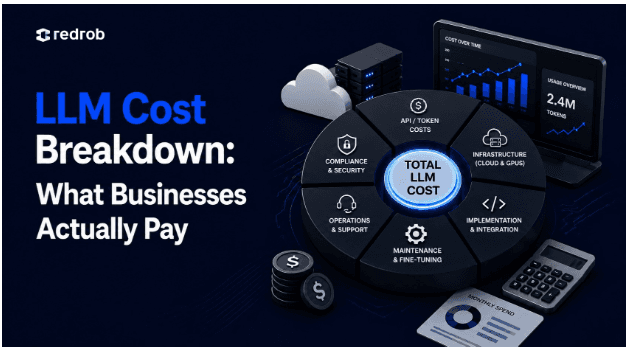
AI adoption often begins with a simple question: What does it cost?
The answer, however, is rarely limited to the price of an AI model.
Many organizations evaluate AI based on initial demonstrations, only to discover that real costs emerge during large-scale implementation through usage volume, infrastructure requirements, data processing, multilingual workflows, and the additional context needed to make AI effective for business operations.
For Indian enterprises, the calculation becomes even more complex. Businesses operate across diverse languages, industries, and workforce environments creating AI requirements that are different from markets where most global models were originally developed.
Redrob AI is built around this reality: enabling AI in Bharat with technology designed for Indian business workflows, professional data, and enterprise-scale adoption.
This blog explores how LLM pricing actually works, the hidden factors driving AI costs, where businesses overspend, and how organizations can build a more efficient AI strategy.
What Businesses Are Actually Paying For Using an LLM
Before comparing vendors or building procurement arguments, understand the cost components first.
1. Token Usage: The Core Pricing Factor
Every input you send and every output you receive is measured in tokens - roughly 0.75 words per token. A 500-word document is approximately 650–700 tokens. Enterprise workflows that process thousands of documents daily are moving millions of tokens per week, often without anyone doing that maths first.
2. Model Selection: Capability Must Match the Use Case
Advanced models provide stronger reasoning capabilities but typically come with higher operational costs. A frontier model GPT-4-class, Claude Opus-class costs 10x to 50x more per token than a mid-tier model. For tasks requiring complex reasoning or nuanced language generation, that premium is justified. For document classification, FAQ retrieval, or structured data extraction
The right AI strategy focuses on performance-to-cost efficiency rather than maximum model capability.
3. Infrastructure: The Operational Cost Layer
Latency, uptime, concurrent request limits, dedicated vs. shared compute - these are real costs that vary significantly by provider.
Indian businesses that need AI running during peak Indian business hours, in regional infrastructure, face a different cost reality than teams in markets these models were originally built for.
4. Context Requirements: The Hidden Cost Driver
AI systems require context to generate accurate business-specific outputs.
However, repeatedly providing policies, workflows, industry information, and operational guidelines increases processing requirements and overall cost. For businesses using models that lack regional or industry-specific understanding, additional context becomes necessary for every interaction.
A model built with relevant domain knowledge reduces dependency on repeated instructions improving both efficiency and cost control.
Where Indian Businesses Are Actually Overspending on AI
Using a Frontier Model for Mid-Tier Tasks
The most common and most expensive mistake. Teams default to the most capable model because it feels safer. The result: a frontier model answering basic queries that a purpose-built, India-trained model could handle at a fraction of the cost.
No Caching Layer on Repetitive Workflows
The same job descriptions, company backgrounds, role requirements, and policy documents get pushed into the model with every single API call. Even basic prompt caching can reduce per-request costs by 30–60% on repetitive workflows. Most teams implement this last, after months of inflated bills.
Multilingual Inefficiency at Scale
India operates in 30+ languages. Global LLMs handle Hindi, Tamil, Telugu, Bengali but handle them with significantly lower efficiency than English. More tokens, more context, more retries, more corrections. The cost per useful output in vernacular languages on a non-India-native model is meaningfully higher. At enterprise scale, that gap compounds fast.
Overbuilding Context Instead of Choosing the Right Model
Many enterprise teams solve the "model doesn't understand India" problem by writing very long system prompts explaining Indian career structures, salary bands, and business norms.
Those prompts run with every call. AI adoption in India that works at real cost efficiency requires a model trained on this context - not one that needs it spelled out every time.
Stop Paying Premium Prices for Everyday AI Tasks
Use the right model for the right workload
Explore Redrob AI
The India-Specific Numbers That Change the Calculation
According to the Stanford AI Index Report, the cost of running a frontier AI model has dropped by over 99% in the last five years but that cost curve reflects global infrastructure economics. Indian businesses building workflows on top of global LLMs are still paying in dollars, often with no regional pricing parity, against rupee-denominated budgets.
The India AI market is projected to reach $6 billion by 2027, driven substantially by enterprise adoption in hiring, HR automation, and productivity workflows as per NASSCOM.The businesses that scale efficiently will not be the ones using the most powerful model available. They will be the ones using the right model, at the right tier, trained on the right data.
Redrob AI runs at 87% of GPT-5 performance at 0.5% of the cost. That is not a positioning claim. It is a calibration choice. Built on 6 years of Indian professional data - 790M+ profiles, 20M+ live jobs, 50+ platforms. it needs less context scaffolding to understand Indian hiring patterns, Indian salary structures, and Indian professional language. Less scaffolding. Fewer tokens. Lower cost. Better output.
For Indian startups and enterprises evaluating AI tools India for hiring, productivity, or research workflows cost per useful output, not cost per token, is the number that actually matters.
How to Think About AI Cost for Indian Organisations: A Step-by-Step Framework
Step 1: Map Your Tasks by Reasoning Complexity
Sort your AI use cases into three buckets - high reasoning (complex synthesis, ambiguous decisions), mid-tier (structured extraction, matching, ranking), and low-tier (classification, retrieval, formatting). Most enterprise AI workflows are 60–70% mid and low tier. Price accordingly.
Step 2: Audit Your Context Spend
Pull your last 30 days of API logs. Calculate what percentage of each request is static context system prompts, background documents, company policies that does not change between calls. Any static context that repeats is a caching opportunity. Implement prompt caching before optimising anything else.
Step 3: Benchmark on Indian Data, Not Global Benchmarks
Global LLM benchmarks (MMLU, HumanEval, etc.) are built on English-dominant, Western-context test sets. They tell you very little about how a model performs on a JD written for a Tier-2 Indian city, a resume in Hinglish, or a salary query for a mid-career professional in Hyderabad. Build your own evaluation set from real Indian data before committing to any vendor.
Step 4: Price for Scale, Not for Demos
Most vendor pricing looks reasonable at demo scale. 100 API calls per day is a pilot. 100,000 API calls per day is a product. Build your cost model at 10x and 100x your current volume before signing anything.
Step 5: Evaluate Purpose-Built vs. General-Purpose
For Indian hiring, HR automation, and career workflows - a model trained on Indian professional context does not just outperform a general model on accuracy. It costs less to run because it requires less context injection to produce correct results. Redrob AI is the only platform built from the ground up on six years of Indian professional data. That training data is the cost advantage.
The Real Cost Conversation Most AI Vendors Won't Have
Global AI vendors talk about capability. What they avoid is total cost of ownership for a non-English, non-Western enterprise context.
Integration Overhead
Indian HR systems, ATS platforms, job boards, and professional data sources are not natively connected to global AI infrastructure. The engineering cost of integration and the ongoing maintenance is real and often underestimated in initial procurement decisions.
Accuracy Degradation on Indian Content
A model that performs at 95% accuracy on English professional content may perform at 75–80% on equivalent Hindi or Tamil content. That 15–20% gap represents rejected outputs, manual corrections, and workflow failures. Those corrections cost time. Time costs money. At enterprise volume, this is not a rounding error.
Language and Locale Gaps That Compound at Scale
India operates professionally in 30+ languages. A general-purpose model with basic multilingual support is not the same as a model trained natively on Indian professional language. The difference shows in every automated job description, every resume review, every candidate communication — and in the token count behind each one.
Redrob AI was built to eliminate these costs. Not by being cheaper in isolation — but by being more efficient on Indian workflows because it was trained on them. The AI adoption in India that scales at enterprise level is the kind where you do not have to explain the context every single time.
Final Thoughts
The LLM cost question is not really a technology question. It is a fit question.
A model trained on San Francisco hiring patterns, English-dominant professional language, and Western salary structures will perform less efficiently on Indian workflows and bill the same rate regardless.
The businesses and hiring teams that win on AI in Bharat will be the ones that chose fit over prestige. The ones that measured cost per correct output, not cost per token. The ones that chose a platform built from the ground up for India's scale, India's languages, and India's professional reality.
Redrob AI is that platform. 6 years of data. 790M+ profiles. 30+ languages, native. 87% of GPT-5 performance at 0.5% of the cost.
The switching stops here.
Measure Cost Per Outcome, Not Cost Per Token
Focus on results, not usage metrics

AI tool overloArtificial Intelligence has become a part of everyday work. Recruiters use it to source talent,
Latest AI Blogs.

Jun 23, 2026
Why Your AI Stack Isn’t Delivering Results
Garima

Jun 23, 2026
Why Indian Teams Are Switching to AI Workflows
Garima

Jun 23, 2026
The Ultimate Guide to Acing AI and Tech Job Interviews : Redrob AI

Bhushan

Jun 23, 2026
How Redrob AI Helps Students Transition from College to Career
Bhushan

Jun 23, 2026
India's Leading AI Platforms in 2026: Redrob AI, Sarvam AI, BharatGPT & CoRover.ai
Bhushan

Jun 23, 2026
AI for TPOs: How Redrob Simplifies Campus Hiring Workflows
Bhushan